

Image: Chinese Academy of Sciences
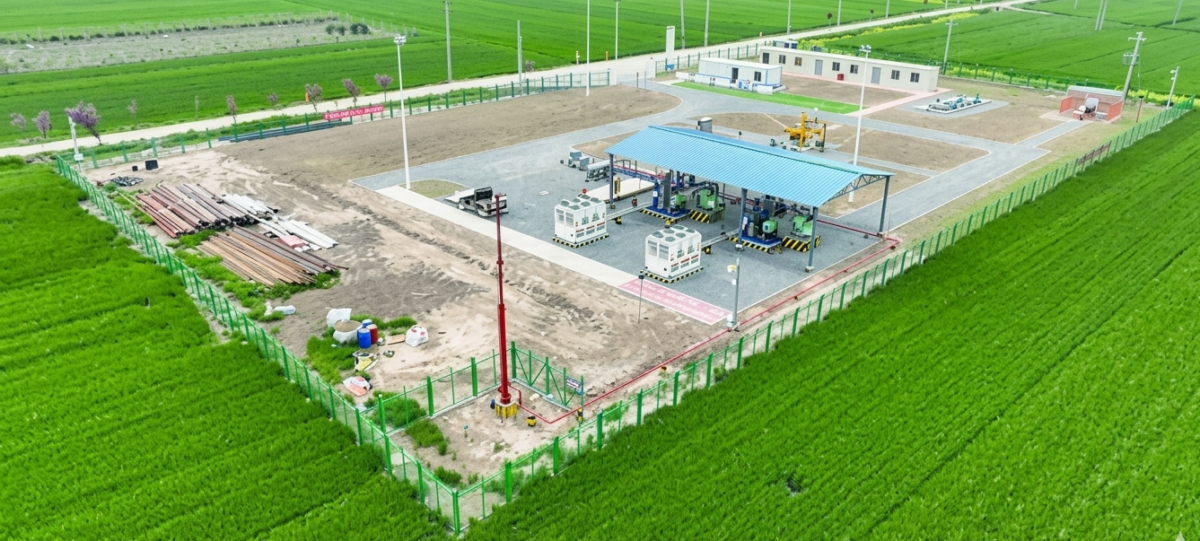
The Chinese Academy of Sciences (CAS) has put into operation China’s first large-scale hydrogen storage demonstration project in Pingdingshan City, Henan Province.
The project was jointly developed by the Wuhan Institute of Geotechnical Mechanics of the Chinese Academy of Sciences and the China Pingmei Shenma Group, with the participation of China National Petroleum Corporation (CNPC) and China Petrochemical Corporation (Sinopec).
The salt cavern storage system was built at a depth of 1,418 m, with a solution mined cavity volume of more than 30,000 m³. It has a hydrogen storage capacity of 1.5 million standard m³.
CAS said the project represents the first successful large-scale technical application of hydrogen storage in salt caverns in China and addresses several technical challenges that previously limited commercial implementation.
The consortium developed a small-scale site selection and design framework to assess sealing performance in layered geological conditions.
Key technical developments include the use of layered salt rock formations for reservoir construction and a better understanding of hydrogen migration behavior in ultra-low permeability salt structures. To address challenges such as hydrogen-induced material corrosion and seal reliability, anti-hydrogen embrittlement housing materials and high-integrity sealing systems for storage infrastructure have been developed.
According to the developers, all major core equipment used in the project will be produced domestically, achieving full localization of critical technologies and supply chains.
Researchers involved in the project said it verifies the technical feasibility of geological hydrogen storage in China and provides a potential technical pathway for overcoming storage bottlenecks expected in the country’s hydrogen expansion plans during the 15th Five-Year Plan period.
In addition to storage applications, the system is expected to support grid balancing by absorbing excess renewable energy from wind and solar power generation, improving system stability.
This content is copyrighted and may not be reused. If you would like to collaborate with us and reuse some of our content, please contact: editors@pv-magazine.com.
Popular content

