

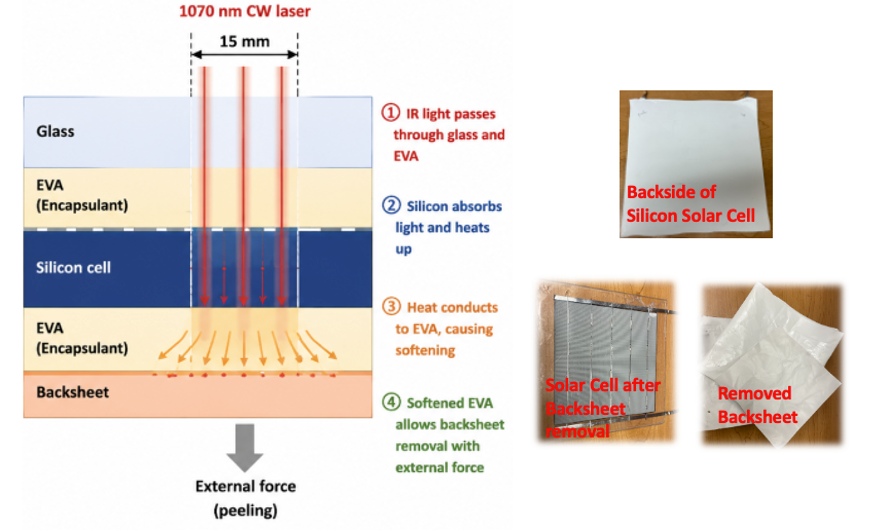
US researchers have developed an IR-CW laser-based method to remove backplates from silicon solar panels at the end of their life without damaging the glass or wafers, using controlled heating of the silicon-EVA interface through the front glass. The process enables clean mechanical delamination while maintaining device performance and provides a more energy-efficient and cost-effective alternative to conventional thermal or chemical recycling methods.
Researchers from the University of Virginia in the United States have developed a laser-based technology that makes it possible to remove backsheets from discarded solar panels without damaging the glass or silicon wafers.
“We introduce a novel laser-based approach to backsheet removal that is non-chemical, environmentally friendly, and both cost and energy efficient, while preserving the tempered glass and silicon wafers,” said corresponding author Mool C. Gupta. pv magazine. “Preserving the structural and functional integrity of the remaining module components is critical for the downstream recovery and recycling of valuable materials such as silicon, silver and glass, which are often lost or degraded in conventional recycling approaches.”
“A key aspect of our work is that the laser selectively heats the silicon after it passes through the glass, softening the ethylene vinyl acetate (EVA) encapsulant and allowing controlled separation of the backplates without significant damage to the underlying materials,” he added. “Unlike conventional thermal or chemical approaches, this method avoids harsh chemicals, reduces material degradation and enables the recovery of large, intact areas of the backplate at a lower processing cost.”
The new approach is based on continuous wave infrared (IR-CW) laser technology, which emits infrared radiation as a continuous, stable beam rather than in pulses. This steady energy release enables controlled, uniform heating of targeted layers within the module, enabling precise thermal activation of the silicon-EVA interface while minimizing mechanical and thermal stress on surrounding materials.
The researchers explained that the IR-CW laser emits infrared light through the glass surface of the solar module. Once the radiation reaches the silicon wafer, it is absorbed, creating localized heating that softens the EVA encapsulant. This controlled heating allows easy separation of the backing layer, which can then be mechanically removed with minimal force.
The research team investigated IR-CW laser-assisted delamination of monocrystalline silicon photovoltaic modules consisting of glass, EVA encapsulant, silicon wafers and polymer backplates. A 1,070 nm continuous wave fiber laser was focused through the glass side, where the optical transparency of glass and EVA allows energy to reach the silicon wafer and generate local heating at the silicon-EVA interface. The process was evaluated over different module sizes and characterized using microscopy and spectroscopy, supported by thermal modeling of laser-induced heat distribution.
The analysis confirmed that the silicon and metallization layers remain intact, while separation of EVA and backsheet is achieved without compromising structural integrity under optimized conditions. Electrical measurements further showed no significant deterioration in device performance after laser treatment. Thermal modeling supported these findings, indicating rapid heating of the silicon layer and controlled temperature gradients across the module stack.
A preliminary techno-economic assessment also indicated that IR-CW laser-assisted backplate removal is economically competitive due to its low energy consumption and efficient operation. For industrial fiber laser systems, equipment depreciation and electricity costs together amount to approximately $0.22 per module under laboratory-scale conditions. In contrast, pyrolysis requires high-temperature furnace operation, where energy consumption translates to $0.50-1.00 per module, not including additional gas handling costs, the researchers said.
“Solvent-based delamination, while less energy intensive, comes with chemical procurement and disposal costs that scale poorly with module volume,” she added. “Mechanical writing and manual peeling have negligible capital costs, but are slow, labor-intensive and can damage wafers, reducing recovery yield.”
The new laser technology was presented in “Laser removal of the backplate of silicon solar cells while retaining tempered glass and silicon wafer“, published in Solar Energy Materials and Solar Cells. “This study provides a scalable pathway for sustainable photovoltaic recycling and supports circular economy strategies for waste solar panels,” concluded Gupta.
This content is copyrighted and may not be reused. If you would like to collaborate with us and reuse some of our content, please contact: editors@pv-magazine.com.
