

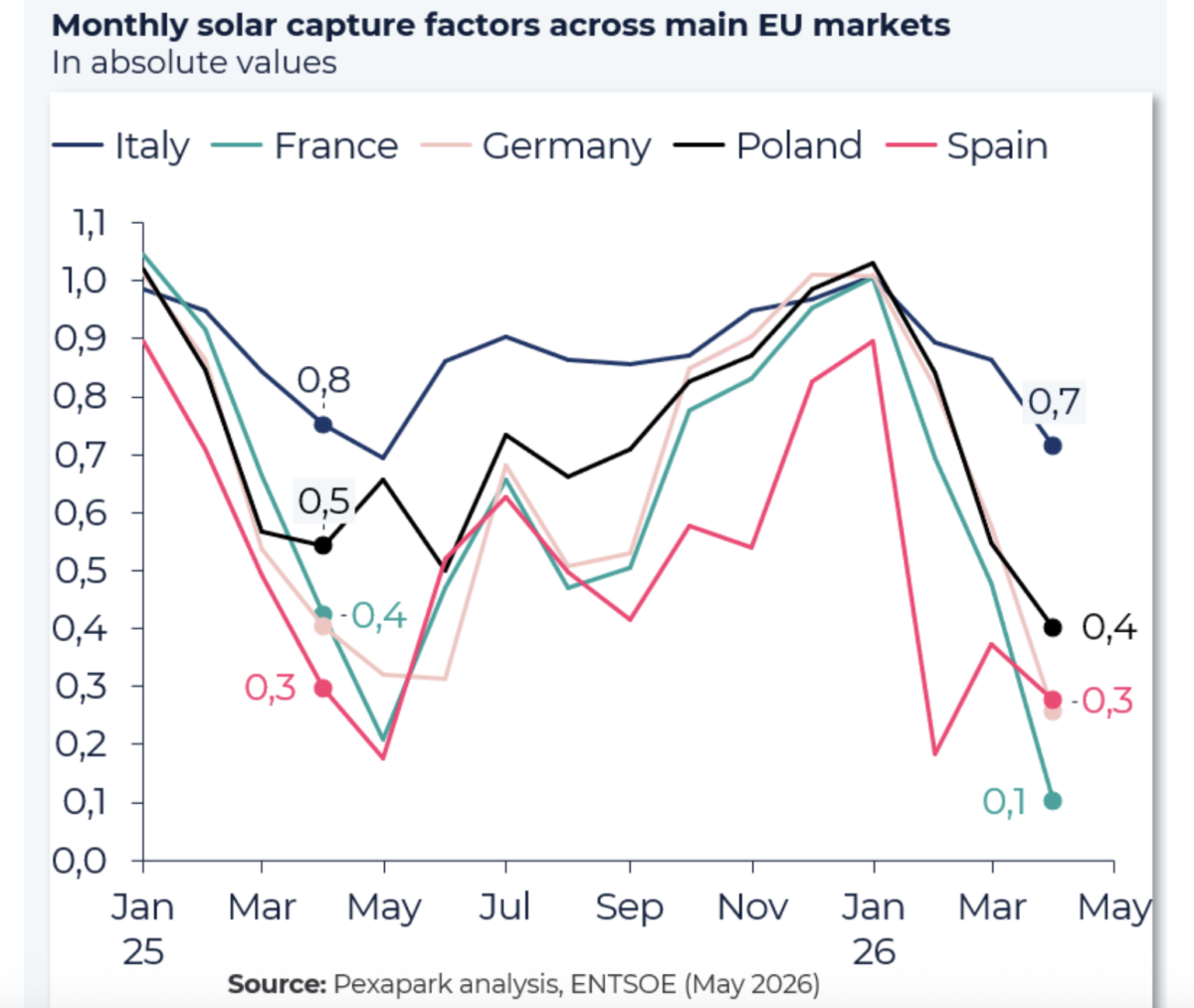
Pexapark’s latest analysis shows that strong solar production and weaker demand caused a decline in solar capture factors in France, Germany, Italy, Poland and Spain. These countries are also experiencing an increase in the share of solar energy production under negative price hours.
Solar energy capture drivers are declining in some of Europe’s key electricity markets, according to the latest analysis from Swiss research agency for sustainable energy Pexapark.
Analysis of The solar absorption rates in April 2025 and April 2026 are highlighted is decreasing in France, Germany, Italy, Poland and Spain. At the same time, Pexapark also noted an increase in the share of solar production during negative price hours.
Pexapark analyst David Battista notes that the trend occurred despite broader volatility in commodity markets related to the conflict in Iran. He said this suggests that solar capture drivers are still primarily determined by structural oversupply dynamics within Europe, rather than fuel or geopolitical movements.
The largest decline in solar capture factors was observed in France, which fell to around 0.10 in April 2026, compared to around 0.42 in April 2025, a 75% year-on-year decline. Negative price hours increased from 90 to 139, while the share of solar energy generated during negative price events increased from 29.2% in April 2025 to 45.1% in April 2026.
Mild temperatures, weakened demand during holiday periods and improved nuclear power availability also played a role in the collapse of solar capture factors. “As neighboring markets also experienced similar solar surpluses, export opportunities were limited, leading to more frequent domestic oversupply conditions and deeper price declines during peak solar production hours,” Battista wrote, adding that market conditions support France’s proposed reform of large-scale solar contracts for difference.
In Germany, capture factors fell from 0.40 in April 2025 to around 0.26 in April 2026, a drop of around a third, while negative price hours rose from 75 to 123 and the share of solar energy produced during negative price periods rose from 32.6% in April 2025 to 46.8% in April 2026.
Spain’s solar capture rate last fell from 0.30 in April 2025 to 0.28 in April 2026, but Pexapark recorded a more pronounced decline earlier this year. Capture factors fell to around 0.18 in February 2026, compared to 0.71 in February 2025, due to exceptionally strong hydropower production.
Last February, there were 148 negative price hours in Spain, compared to zero in February the year before, which Battista said indicates there is now oversupply even in the winter months. “Spain’s rapidly growing solar fleet, combined with limited storage and limited export capacity during periods of regional oversupply, increasingly exposes solar systems to both seasonal and structural price pressures,” he explains.
In Italy, home to some of the highest electricity prices in Europe, solar factors fell from 0.75 in April 2025 to around 0.71 in April 2026, which is the second lowest level ever, according to Pexapark analysis. Battista writes that this decline is notable given Italy’s still relatively lower solar penetration compared to Germany and Spain. He adds that northern Italy remains largely unaffected, while last month saw the rise of zero price hours in the country’s central and southern zones.
Pexapark’s analysis ends with Poland, where solar prices fell from around 0.54 in April 2025 to around 0.40 in April 2026, while negative price hours increased from 75 to 87 and the share of solar production during negative price periods rose from 27.1% to 28.5%.
Battista said the data shows there are oversupply pressures in Poland, but the mix of coal generation and relatively lower solar production have so far helped maintain higher capture factors than in more saturated Western European markets. “However, increasing deployment of solar energy and greater integration with neighboring markets suggest that similar pressures could increase over time, especially during periods of low demand,” he added.
Pexapark says early data from May reinforced April’s trend, with several markets posting record or near-record negative price events and absorbing further deterioration in solar economics.
“The April 2026 data suggests that European solar markets may be entering a new phase where periods of severe midday oversupply are no longer isolated events but recurring structural conditions, especially in the intermediate months,” Battista wrote. “Prolonged negative price periods are becoming increasingly common in Germany and France in particular, raising the prospect that 2026 could see new lows for solar capture factors in parts of Europe if current buildout trends continue.”
This content is copyrighted and may not be reused. If you would like to collaborate with us and reuse some of our content, please contact: editors@pv-magazine.com.
