Australian energy storage manufacturer RedEarth Energy Storage is set to commercialize its Australian-made vehicle-to-grid electric vehicle charging, and has also released two next-generation products from its smart energy ecosystem.
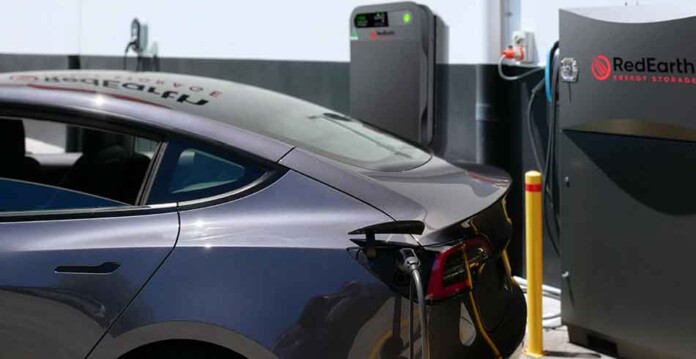
Energy storage manufacturer headquartered in Queensland RedEarth energy storage has announced the pricing and commercial availability of its Australian-made vehicle-to-grid (V2G) bi-directional charger, along with the introduction of two new products from its smart energy ecosystem, including the Gecko plug-and-play energy storage system and the Troppo low-voltage battery.
Describing the charger as an Australian first, RedEarth has partnered with Germany-based bi-directional charger technology company Ambibox to produce the RedEarth V2G chargers locally.
Pre-orders for the 11 kW three-phase RedEarth V2G charger will launch in November 2025 with a suggested retail price of AUD 9,990 ($6,507) ex GST, with commercial delivery expected in early 2026.
RedEarth CEO Marc Sheldon said the charger allows EV owners to use their vehicle’s battery system to supplement their home energy storage system, giving them access to additional energy reserves during power outages.
“For homeowners participating in the energy market, this feature will also allow EV batteries to interact with the wholesale market, charging when electricity prices are low or negative, and discharging to generate revenue when prices are high,” Sheldon said.
“We have also provided a clear pathway for installers looking to get on the V2G bandwagon with the V2G charger, helping them stay relevant and competitive in a rapidly evolving home energy market.”
Gekko energy storage system
The next generation Gecko is RedEarth’s new all-in-one plug-and-play energy storage system, Built specifically for urban installations where wall space and accessibility are important design considerations.
The Gecko can be configured for grid-tied, off-grid or hybrid applications and offers home backup capabilities, can be AC-tied and easily connected to a generator.
Energy storage can be customized on the Gecko using up to eight low-voltage Troppo batteries for a total capacity of 32.8 kWh. In the first quarter of 2026, when the Troppo Ultra becomes available, the storage capacity of the Gecko will be further expanded to 44.8 kWh.
The Gecko is available in both single-phase (5 kW, 8 kW or 10 kW) and three-phase (12 kW or 15 kW) configurations, making it powerful enough to support homes or small businesses.
The system connects to RedEarth’s private power plant (PPP) platform, allowing users to monitor and manage energy consumption in real time, participate in flexibility markets and share excess energy externally, for example with friends and family.
The PPP app supports electric vehicle charging and V2G optimization, allowing households to use electric vehicles as mobile batteries.
“The Gecko has been designed for simplicity and speed of installation, allowing installers to respond to increased market demand driven by the Program for cheaper home batteriesSheldon said.
“Our products are engineered and engineered right here in Brisbane for Australia’s harsh environments. When combined with our PPP platform, customers gain full control over their energy, giving them the opportunity to participate in the energy market. They can choose how they store, trade or share their energy for greater energy independence.”
The Gecko is expected to be available from November 2025.
Troppo Ultra
The next generation of the RedEarth Troppo, the Troppo Ultra, is a redesigned low-voltage battery that will deliver a 40% increase in core capacity.
Designed as a modular solution for RedEarth’s battery energy storage systems (BESS), the Troppo Ultra offers a nominal capacity of 5.6 kWh per unit.
It comes with an intelligent battery management system (BMS) that makes it backwards compatible with other RedEarth systems built with Troppo batteries, allowing for seamless integration.
The Troppo Ultra is expected to be available in early Q1/2026, subject to certification approval from the Clean Energy Council.
This content is copyrighted and may not be reused. If you would like to collaborate with us and reuse some of our content, please contact: editors@pv-magazine.com.
Popular content