

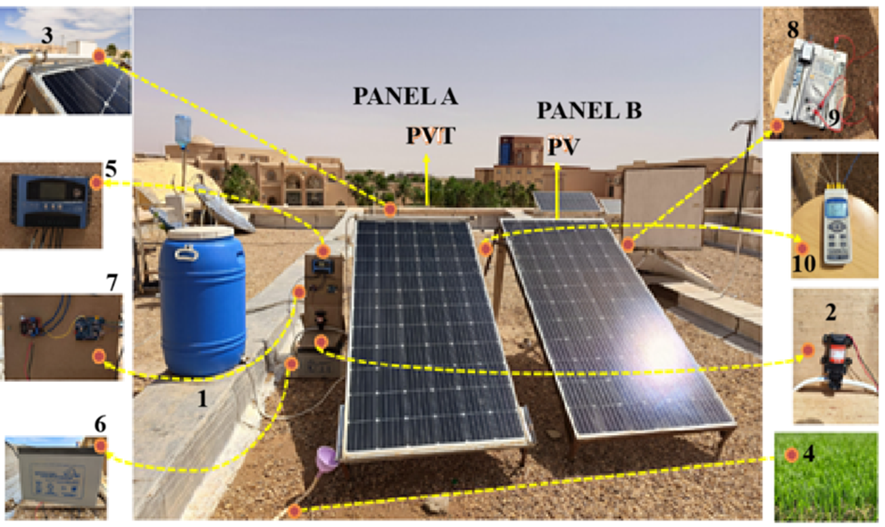
An Algerian research team has developed a smart water spray cooling system for PV panels that activates only when the temperature exceeds a certain threshold, increasing efficiency and minimizing water consumption in desert conditions. The system increased power and reduced module temperatures, providing comparable efficiency to continuous cooling, but with much lower water consumption, pump operation and costs.
A research team from Algeria’s Kasdi Merbah University has developed a new smart water spray cooling system for PV panels.
“The novelty of this research lies in the design of a smart water spray cooling system based on an Arduino controller,” said corresponding author Mahmoud Bourouis. pv magazine. “The system only activates when the PV panel temperature exceeds a predefined threshold, improving energy efficiency and minimizing water consumption – an important consideration in desert environments.”
“We take into account additional environmental parameters, such as wind speed and humidity. We will also explore alternative cooling techniques, including phase change materials (PCM) and nanofluids, to further improve the efficiency of PV panels operating in desert environments.”
The prototype of the system was tested in an experimental setup in the dry climate of Ouargla, a city in the northeastern Algerian Sahara. It contained two identical 390 W monocrystalline modules: one was equipped with a cooling system and the other served as a reference. Both were installed at a slope of 31°, facing south. For the cooled module, water was pumped from a storage tank at a rate of 3.5 L/min through a PVC pipe mounted along the top edge of the panel. The pipe had nine evenly spaced outlets, each 3mm in diameter and angled at approximately 40°.
On June 9 and 10 and July 1 and 2, 2024, the system provided continuous, uninterrupted cooling. On June 11–12 and July 3–4, 2024, it was upgraded to a smart configuration using a digital temperature sensor and controller. The cooling was automatically activated when the temperature of the back surface of the module exceeded 41.5 °C and deactivated when it fell below 38.5 °C.
During the eight days of testing in June and July, solar radiation in Ouargla ranged from 128.8 W/m² to 982 W/m², and ambient temperatures varied between 30 C and 45 C. Measurements were recorded from 8:30 AM to 4:00 PM at 30-minute intervals.
“The continuous cooling system significantly improved the performance of the PV panel. The output power increased from 272.1 W to 350.5 W, while the module temperature decreased from 58.6 C to 36.7 C, resulting in an efficiency improvement of up to 28.8%,” said Bourouis.
Meanwhile, the smart cooling system increased power generation from 251 W to 337 W and reduced the module temperature from 56.1 C to 35.7 C. The intelligent system achieved an average cooling efficiency of 15.5%, with a water consumption of 63.86 l/kWh, a pump operating time of 75 minutes/day and a pump power of 30.6 W. In comparison, the continuous cooling system delivered a similar efficiency of 15.44%, but needed significantly more water. and pump operation: 391.95 l/kWh, 450 min/day and 183.6 W respectively.
“In terms of costs, intelligent cooling with annual electricity costs of €0.07020/W ($0.081/W) is definitely cheaper than continuous processes of €0.07514/W and non-cooling systems of €0.07135/W,” the team explains. “It can be said that both cooling systems are effective in counteracting the negative impact of high temperatures on the efficiency of solar cells in PV systems. Although the absolute power may be higher in the case of continuous cooling, the advantages of soft cooling in terms of cost, consumption and water use make it the preferred choice in desert conditions.”
The results are presented in “Improving the efficiency of solar photovoltaic systems via smart cooling in dry environments”, published in Applied thermal technology. Scientists from Algeria Kasdi Merbah UniversityFrance’s University of Paris and Spain’s University of Rovira i Virgili contributed to the study.
This content is copyrighted and may not be reused. If you would like to collaborate with us and reuse some of our content, please contact: editors@pv-magazine.com.
