
Close Menu
  • News
  • Industry
  • Solar Panels
  • Commercial
  • Residential
  • Finance
  • Technology
  • Carbon Credit
  • More
    • Policy
    • Energy Storage
    • Utility
    • Cummunity
What's Hot

Dutch solar owners asked to switch off during peak periods to ease the distribution crisis

June 7, 2026

The hydrogen flow: Toyota demonstrates its racing prototype on liquid hydrogen

June 7, 2026

Era of electrification exposing Australia’s weakest link

June 6, 2026
Facebook X (Twitter) Instagram
Solar Energy News
Sunday, June 7
  • News
  • Industry
  • Solar Panels
  • Commercial
  • Residential
  • Finance
  • Technology
  • Carbon Credit
  • More
    • Policy
    • Energy Storage
    • Utility
    • Cummunity
Solar Energy News
Home - Solar Industry - PV-based molecular thermal energy storage system achieves 14.9% solar energy utilization efficiency
Solar Industry

PV-based molecular thermal energy storage system achieves 14.9% solar energy utilization efficiency

solarenergyBy solarenergySeptember 24, 2024No Comments3 Mins Read
Facebook Twitter Pinterest LinkedIn Tumblr Email
Share
Facebook Twitter LinkedIn Pinterest Email

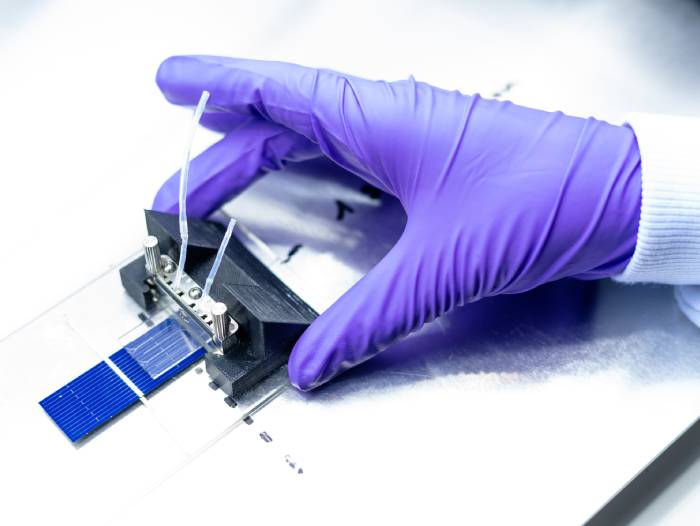
An international research project investigated the feasibility of converting solar energy into chemical energy with the design of a hybrid device with a solar energy storage and cooling layer integrated with a silicon-based solar cell. During testing, the device recorded record energy storage efficiency and reduced the cell surface temperature by approximately 8 C under standard solar irradiation conditions.

September 24, 2024 Patrick Jowett

An international research team led by the Universitat Politècnica de Catalunya in Barcelona created a hybrid device that combines molecular solar thermal energy (MOST) with silicon-based photovoltaics. The researchers say this is the first hybrid device that combines a silicon solar cell with an innovative storage system.

In the research paper “Hybrid solar energy device for simultaneous generation of electrical energy and storage of molecular solar energyavailable indoors Joulethe team explains that the MOST system is made of elements such as carbon, hydrogen, oxygen, fluorine and nitrogen, avoiding the need for rare materials.

The hybrid system consists of organic molecules that, when irradiated with high-energy photons such as ultraviolet light, undergo a chemical transformation and store energy for later use. The system also serves as an optical filter and coolant for the solar cell, which was found to improve the use of solar energy and address the limitations of existing conventional solar and storage technologies.

Experimental tests conducted on the system have shown a record energy storage efficiency of 2.3%. Meanwhile, the integration of the MOST system with the solar cell was found to reduce the surface temperature of the cell by approximately 8 C under standard solar irradiation conditions, thereby reducing energy losses due to heat.

See also  Prices for solar cells remain stable in a quiet market

The hybrid system also showed a solar energy use efficiency of 14.9%, which represents an improvement over the two hybrid solar systems when operating independently.

In the conclusion of the research report, the team said the hybrid system is a “significant step toward a sustainable energy storage technology that complements PV systems.” It adds that the system has demonstrated the ability to produce more consistent power delivery over different periods of time, meaning it could theoretically be configured to use different materials throughout the day to optimize efficiency.

“A notable advantage of the MOST-PV hybrid system is its dual functionality, allowing simultaneous energy storage and electricity generation from solar energy, exemplifying an integrated approach to energy use,” the researchers said.

Researchers from the University of Cambridge, Chalmers University of Technology in Gothenburg and Barcelona’s Institute of Materials Science all contributed to the research.

This content is copyrighted and may not be reused. If you would like to collaborate with us and reuse some of our content, please contact: editors@pv-magazine.com.

Popular content

Source link

achieves efficiency Energy molecular PVbased solar storage system thermal utilization
Share. Facebook Twitter Pinterest LinkedIn Tumblr Email
solarenergy
  • Website

Related Posts

Dutch solar owners asked to switch off during peak periods to ease the distribution crisis

June 7, 2026

Britain’s next energy dependency is already taking shape

June 5, 2026

UK government considers community grant for battery storage

June 5, 2026
Leave A Reply Cancel Reply

Don't Miss
Energy Storage

Greek startup launches direct PV water heating solution – SPE

By solarenergyJanuary 16, 20260

Axinar has launched SolBox, a direct PV water heating system that powers electrical resistance accumulators…

REC tests Alpha Pure-RX solar panels against 45 mm hailstones

December 13, 2025

The current state of the American polysilicon production

March 28, 2025

The National Grid upgrade allows 100 MW BESS to connect to Solar Power Portal

November 11, 2024
Stay In Touch
  • Facebook
  • Twitter
  • Pinterest
  • Instagram
  • YouTube
  • Vimeo
Our Picks

Dutch solar owners asked to switch off during peak periods to ease the distribution crisis

June 7, 2026

The hydrogen flow: Toyota demonstrates its racing prototype on liquid hydrogen

June 7, 2026

Era of electrification exposing Australia’s weakest link

June 6, 2026

‘Come out from behind your screen, our industry is ultimately about people’

June 6, 2026
Our Picks

Dutch solar owners asked to switch off during peak periods to ease the distribution crisis

June 7, 2026

The hydrogen flow: Toyota demonstrates its racing prototype on liquid hydrogen

June 7, 2026

Era of electrification exposing Australia’s weakest link

June 6, 2026
About
About

Stay updated with the latest in solar energy. Discover innovations, trends, policies, and market insights driving the future of sustainable power worldwide.

Subscribe to Updates

Get the latest creative news and updates about Solar industry directly in your inbox!

Facebook X (Twitter) Instagram Pinterest
  • Contact
  • Privacy Policy
  • Terms & Conditions
© 2026 Tsolarenergynews.co - All rights reserved.

Type above and press Enter to search. Press Esc to cancel.