

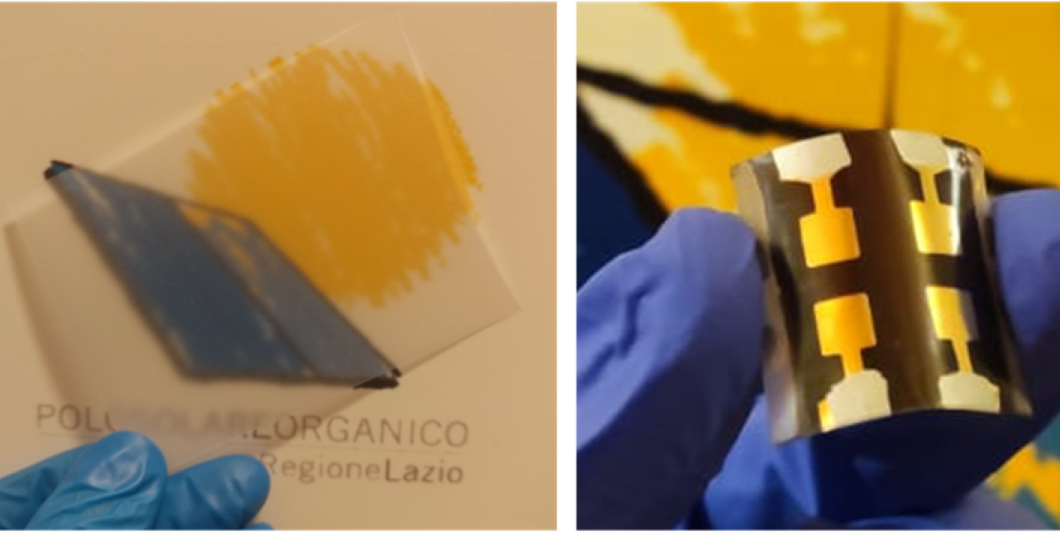
An international research group demonstrated the first perovskite solar cells on polycarbonate substrates, suitable for flexible PV applications. Using an industrially compatible manufacturing method, the group produced devices with an energy conversion efficiency of 13.0%, of which 87% was retained after 1000 bending cycles at a 20 mm radius.
An international research group demonstrated a method to fabricate perovskite solar cells on polycarbonate substrates that is compatible with industrial production processes for flexible PV devices.
“Here we developed the very first perovskite solar cell on polycarbonate films with an energy conversion efficiency of 13.0% by developing a planarization layer with a sheet coating that also provided the necessary solvent resistance,” said Zeynab Skafi, the first author of the study. pv magazine.
Tests have shown that 87% of efficiency is retained after 1000 bending cycles at a radius of 20 mm. “Dark storage (ISOS-D-1) and thermal stability (ISOS-T-1) tests showed that T80 values of 1776 hours and 144 hours respectively,” the group explained.
It also noted that these values can ultimately be improved by applying ultra-high permeation barriers, as previous research has shown these reduce water vapor transmission rates by three orders of magnitude.
The team pointed out that polycarbonate has advantages over other flexible substrates, such as polyethylene terephthalate (PET) and polyethylene naphthalate (PEN), due to its relatively high glass transition temperature and low moisture absorption. 90% in the visible spectrum, which is comparable to PET and PEN with 90% and 88.7% respectively.
It added that the polycarbonate had not previously been used for this type of application, despite other advantages such as its light weight, flexibility and low cost. “Until now, polycarbonate has never been used for this purpose, even though it has a huge market, not far from that of PET and much larger than that of PEN, due to its poor solvent resistance and high surface roughness,” said the corresponding author Thomas M. Brown told it pv magazinee.
The team solved roughness and solvent resistance challenges by using a blade coating method to apply a planarizing layer of commercial, ambient-curable refractory resin.
The step reportedly reduced the “surface roughness from 1.46 µm to 23 nm, and halved the water vapor transmission rate, “significantly improving” solvent resistance and allowing the deposition of precursor inks.
In the experiment, the perovskite solar cells were fabricated as follows: a substrate made of polycarbonate and indium tin oxide (ITO), a tin oxide (SnO2) electron transport layer, a perovskite layer, a hole transport layer based on Spiro-MeOTAD and gold (Au) contacts. The ITO layer was optimized by controlling the transmittance, plate resistance, surface roughness and all layers except the two electrodes, which were processed in solution at low temperatures below 100 C.
The team emphasized that the manufacturing process is “compatible with low-cost manufacturing” and allows integration with other printed electronic components.
The researchers concluded that combining perovskite cells with polycarbonate films enables the integration of light-trapping capabilities into a wide range of indoor and outdoor applications. “Opening the flexible solar cell market to new substrate materials could play an important role in harvesting energy, powering future electronic devices and contributing to fast-growing markets such as smart windows, skylights, buildings, smart digital cards and identity cards. Brown said.
The results are detailed in “Flexible perovskite solar cells on polycarbonate film substrates”, published in Advanced energy materials.
The research group consisted of Italy-based researchers from CHOSE (Center for Hybrid and Organic Solar Energy) Tor Vergata University, ENEA Frascati Research Center, Halocell Europe and Istituto di Struttura della Materia, together with scientists from Germany’s Fraunhofer Institute for Organic Electronics, Electron Beam and Plasma Technology (FEP), and the University of Guilan in Iran.
This content is copyrighted and may not be reused. If you would like to collaborate with us and reuse some of our content, please contact: editors@pv-magazine.com.
