

Researchers from the Polytechnic University of Madrid have validated a model to simulate solar sources for vehicle-integrated PV in urban environments, taking into account reflections and shadows from buildings and objects.
A team of researchers from the Polytechnic University of Madrid (UPM) has developed a model to simulate the impact of buildings and objects on direct and diffuse solar radiation in vehicle-integrated solar photovoltaics (VIPV).
For their modeling, the scientists used light detection and ranging equipment (LiDAR), radiation sensors and panoramic imaging over the entire sky.
“The fundamental goal of our research has always been to develop a modeling tool capable of estimating the solar forcing on the PV surface of a vehicle without relying on external measuring equipment,” said corresponding author Javier Macias. pv magazine. “The validation process confirmed that the results provided by the software closely match real-world conditions, meaning that all necessary input for accurate solar resource estimation can indeed be derived from LiDAR data alone, without the need for additional sky imagery or hardware.”
A key aspect of the research involved the use of LiDAR point clouds to generate accurate virtual representations of urban topography. One of the most challenging aspects, according to Macias, was developing algorithms capable of accurately estimating each radiation component based on LiDAR and solar position data.
“The complexity increases when it comes to the reflected radiation, because it depends not only on the sun angle at a given time, but also on the reflective properties of urban elements,” says Macias. “While LiDAR data provides highly detailed urban scenes, it does not include the physical properties of objects such as color and material. Finding an algorithm that could estimate the reflected component from point clouds and solar data alone was extremely demanding.”
The experimental setup consisted of a vehicle parked for a day in winter near the researchers’ laboratory, where buildings and trees provide shade all day long.
To model shadows, a shadow factor (SF) was defined to cancel out the direct radiation component when the vehicle is in the shadows, according to the team. To model the diffuse component, the visible part of the isotropic sky is assumed to be expressed by the sky view factor (SVF), and the component is reflected by buildings, said the researchers, who added that the clear facade view factor (BFVF) is defined to to take into account the facades of buildings that reflect the direct solar component in a Lambertian manner.
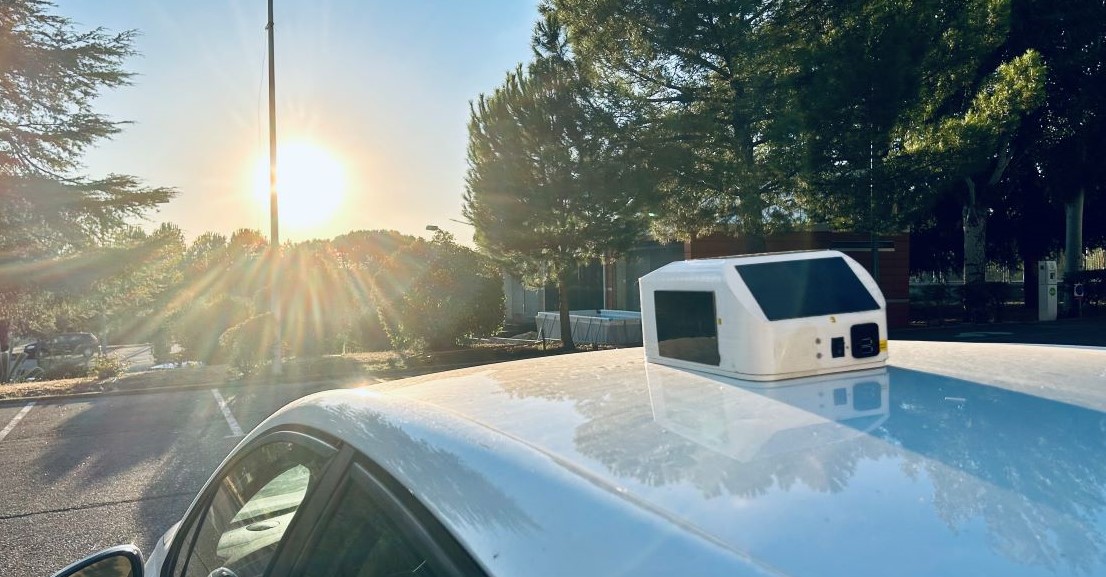
A fisheye camera that captured high-quality hemispheric images was placed on the roof of the vehicle, along with a sensor designed to measure radiation in five directions of the vehicle: hood, roof, trunk, left door and right door. Measurements were taken every minute during the day. A weather station was also placed near the parked vehicle.
Comparisons showed that the shadow effects of buildings could be accurately predicted. “The results show differences of an average of 36W/m2 between measuring and simulating. Furthermore, it is observed that the diffuse component due to reflection on buildings is of the same order as the component due to the air,” the research group said.
“In addition, depending on the position of the vehicle, effective air diffusion varies depending on the visible part of the sky, as do the varying levels of radiation reflected from buildings depending on the position of the sun,” she added .
They also explained that the LiDAR data makes it possible to obtain SVF and BFVF with comparable accuracy to using all-sky images with a relative error of 3% and 4% respectively.
The research is described in detail in the article “On the validation of a modeling tool for vehicle-integrated solar photovoltaics: reflected radiation in urban environments”, published in Solar energy materials and solar cells.
Looking ahead, the team wants to test the proposed model in moving vehicles. “We will collect radiation data from a moving vehicle using our custom-developed sensor mounted on the roof. These real measurements will then be compared to the theoretical predictions generated by the software, allowing us to refine the model for use in moving vehicles and various urban environments,” said Macias.
The study was completed at the UPM Solar Energy Institute, where researchers have developed characterization tools and models that integrate unique aspects of VIPV, such as the curvature of vehicle surfaces, dynamic motion and the influence of the urban landscape.
This content is copyrighted and may not be reused. If you would like to collaborate with us and reuse some of our content, please contact: editors@pv-magazine.com.
