

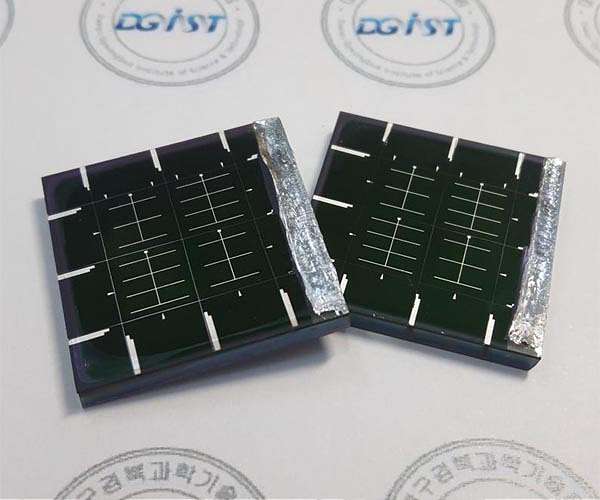
The next-generation silver doping method improves the performance of CZTSSe solar cells
A team of leading researchers from the Department of Energy and Environmental Technology at DGIST, including Kee-jeong Yang, Dae-hwan Kim and Jin-gyu Kang, in collaboration with Professor Kim Jun-ho of Incheon National University and Professor Koo Sang-mo of the department of Electronic Materials Engineering, has developed a method to improve the efficiency of kesterite (CZTSSe) thin-film solar cells by integrating silver (Ag) doping. This innovative technique suppresses cell defects, promotes crystal growth and is positioned to support the commercial viability of CZTSSe solar cells.
CZTSSe cells, which are based on copper, zinc, tin, sulfur and selenium, are known for their cost-efficiency, abundant resources and environmental friendliness. Their material composition makes them a promising, scalable alternative to conventional solar cells that rely on scarce metals. Despite these advantages, CZTSSe cells have historically been hampered by low efficiency and high power losses due to electron–hole recombination, posing commercialization challenges.
To address this, the DGIST-led team introduced Ag into the solar cell precursor, allowing Ag to act as a stabilizer for Sn while promoting better material integration at lower temperatures. This process facilitates faster and larger crystal formation, effectively reducing defects and improving cell efficiency. Through systematic testing, the researchers determined that Ag placement in the precursor has a significant impact on defect and recombination behavior. Their findings suggest that proper placement of Ag can prevent Sn loss and optimize defect suppression, while improper placement can hinder alloy formation, leading to performance-degrading defect clusters.
Furthermore, the team found that Ag doping contributes to the formation of a liquid phase that accelerates crystal growth, improving the density and crystallinity of the absorber layer. This results in an improved energy band structure and minimizes defects, facilitating more efficient charge transport through the cell. These developments have the potential to stimulate the production of high-quality, cost-effective solar cells.
“In this study, we analyzed the effect of Ag doping, which had not been clearly identified before, process by process, and found that silver plays a role in suppressing tin loss and improving defects,” said Yang Kee-jeong, a senior researcher. at the Department of Energy and Environmental Technology. “The results provide important insights into the design of silver-doped precursor structures to improve solar cell efficiency and are expected to contribute to the development of various solar cell technologies.”
This research was funded by the Source Technology Development Program (Leapfrog Development of Carbon Neutral Technology) of the Ministry of Science and ICT and the Future-Leading Specialization Research Program (Grand Challenge Research and Innovation Project (P-CoE)). The findings have been published in the journal *Energy and Environmental Science* (Impact Factor: 32.4), a leading publication in the energy sector.
Research report:Reduction of carrier recombination loss by suppressing Sn loss and defect formation via Ag doping in Cu2ZnSn(S,Se)4 solar cells
