

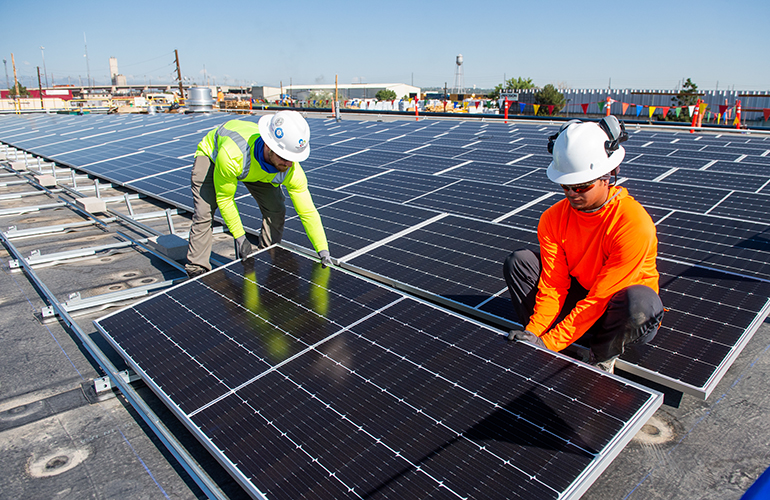
As solar panel deployment becomes more prevalent, commercial lenders will increasingly encounter buildings, fields and parking lots covered in photovoltaic systems. When calculating mortgages for commercial properties, lenders will be in one of three scenarios: The property owner owns the solar panels; the property owner leases the roof, field or parking lot to a third-party for solar panel installation; or the property owner leases the solar array through a power purchase agreement (PPA) without owning the panels or system.
Each scenario carries distinct implications for lenders, which are important to understand to navigate solar-related financing.
Property owner also owns the solar panels

Credit: Namaste Solar
When the property owner also owns the solar panels, lenders should treat the solar array similarly to any other asset or fixture owned by the property owner. The lender should file a Uniform Commercial Code-1 (UCC-1) fixture on the solar array, which empowers lenders to seize subject properties if the customer defaults on payments. But it should be noted that the lender may not be the first in line in this scenario if the solar array was financed separately.
Additionally, lenders should file a UCC-9, a framework for transactions involving personal property, and ensure that loan documents include provisions securing the property owner’s interest in the investment tax credit (ITC) associated with the solar panels. It may also be advantageous for lenders to refinance the existing solar panels as well. This ensures priority under both the UCC-1 and UCC-9 filings and lets the lender benefit from the 30% ITC.
Leasing the property to a third party
If the building owner leases the roof, field or parking lot to a third-party owner (TPO) of the solar array and only receives rental income, this arrangement should be treated like any other lease. The lender can capture it through the standard assignment of leases and rents, ensuring the regular payments are secured.
PPA
When the building owner leases the solar array from a TPO, the arrangement usually involves a PPA and a UCC-1 fixture lien on the solar panels and the ITC. The PPA is a contract between the solar system owner and the property owner, where a solar array is built with no upfront cost to the property owner. The TPO typically files a UCC-1 to protect its interest in the solar property in case the borrower defaults.
Many long-term solar leases function as installment sales, with the property owner gaining ownership of the array over time. Lenders can determine if the lease is closer to a sale by checking whether the property owner can purchase the array for a nominal fee at the end of the lease term and by seeing who benefits from the ITC. If the structure of the lease resembles an installment sale, it is prudent for lenders to file both a UCC-1 and UCC-9 to secure their interests in the panels and the ITC, even if they may not hold the first position for financing.
Understanding how solar panel ownership and leasing structures affect financed properties is crucial for managing risk and maximizing security. By familiarizing themselves with the various filing requirements and potential benefits, such as the ITC, lenders can better protect their interests and take advantage of opportunities in an increasingly solar-powered commercial real estate market.
Brian G. Cafferty is a partner at GoldMark Partners LLP, a boutique law firm based in Needham, Massachusetts, that focuses on commercial real estate and corporate law. Cafferty is an accomplished commercial real estate attorney with an extensive background in real estate, corporate governance and finance. He has expertise in corporate creation, governance, acquisitions, zoning, commercial leasing and environmental compliance. Cafferty has handled the development, financing and leasing of industrial, suburban office, retail and multi-family projects, including brownfield sites. He is also experienced with Chapter 91 filled tidelands and Chapter 21E hazardous waste sites. He can be reached at bcafferty@goldmarkllp.com.
