
Close Menu
  • News
  • Industry
  • Solar Panels
  • Commercial
  • Residential
  • Finance
  • Technology
  • Carbon Credit
  • More
    • Policy
    • Energy Storage
    • Utility
    • Cummunity
What's Hot

A deep learning model tracks the status of the EV battery with high precision

March 6, 2026

Mitsubishi Electric Trane announces new heat pump line for hydronic heating – SPE

March 6, 2026

Origis is developing a 413 MW solar portfolio in West Texas

March 6, 2026
Facebook X (Twitter) Instagram
Solar Energy News
Friday, March 6
  • News
  • Industry
  • Solar Panels
  • Commercial
  • Residential
  • Finance
  • Technology
  • Carbon Credit
  • More
    • Policy
    • Energy Storage
    • Utility
    • Cummunity
Solar Energy News
Home - Technology - Egyptian scientists build solar-powered mini fridge with thermoelectric cooling – SPE
Technology

Egyptian scientists build solar-powered mini fridge with thermoelectric cooling – SPE

solarenergyBy solarenergyOctober 29, 2024No Comments3 Mins Read
Facebook Twitter Pinterest LinkedIn Tumblr Email
Share
Facebook Twitter LinkedIn Pinterest Email

Egyptian researchers have developed a mini refrigerator powered by one to four thermoelectric units with different voltages. They simulated and tested the system under different conditions, achieving a maximum coefficient of performance (COP) of 77.3%.

October 26, 2024
Lior Kahana

Egyptian researchers have built and analyzed a solar-powered mini refrigerator using thermoelectric units (TUs) for cooling. The thermoelectric coolers (TECs) in this study utilize the Peltier effect, in which electric current flows in series through p-type and n-type semiconductors, cooling one side of the device and heating the other. .

“The primary objective of this research is to study the efficiency of a thermoelectric refrigerator under different operating conditions,” the academics said. “The aim is to meet the daily needs of residents of remote areas by using renewable energy sources without the need to store energy. Different configurations of Peltier elements, along with different voltages generated by the photovoltaic cells, will be tested to control the target temperatures.”

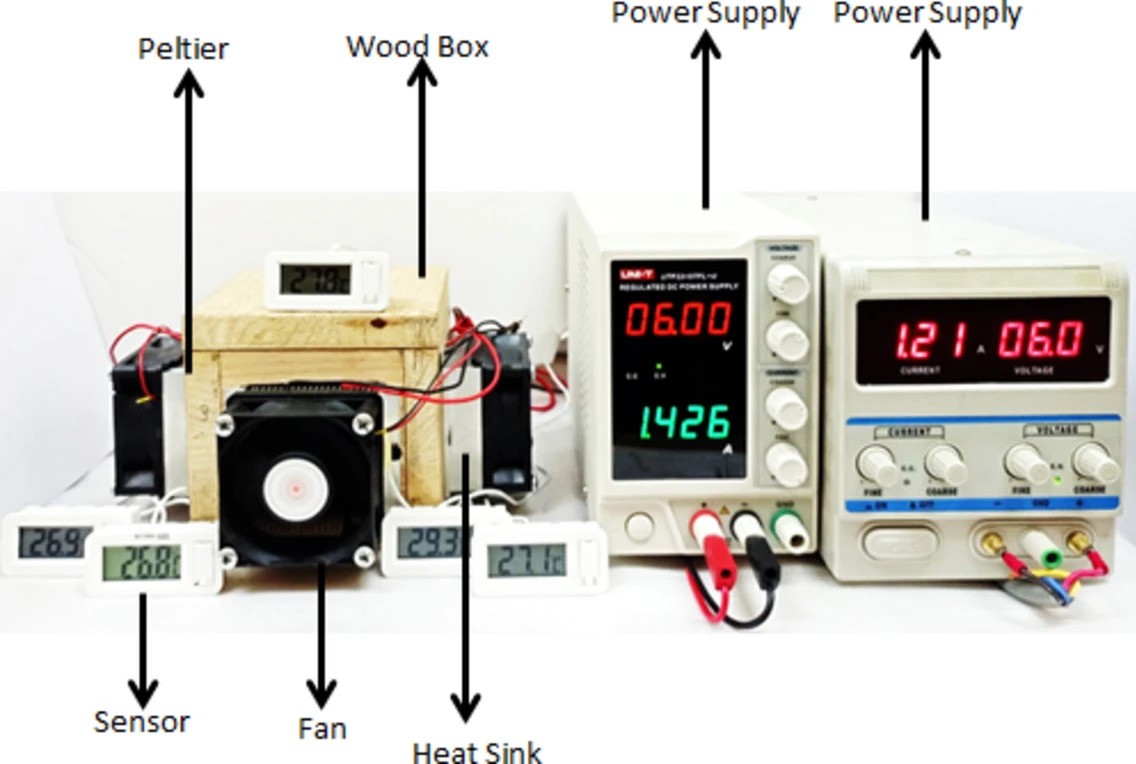
The experimental refrigerator box (RB) consisted of a wooden outer box and a stainless steel inner box, separated by thermal insulation foam. The standard system included four TU, each including a Peltier unit made of n-p junction semiconductors soldered to a copper, aluminum finned heat sink and a fan. The fan cools the warm side of the TU and ensures optimal operation. The RB measured 8 cm x 8 cm x 8 cm and had a volume of 512 cm3.

The researchers used a power supply to simulate different PV capacities and irradiation levels, applying voltages from 4 V to 14 V to operate one to four thermoelectric units. They placed 0.25 liters of water in the container and measured the starting and ending temperatures every five minutes during a 45-minute experiment.

See also  Australian hydrogen developer scores high purity during testing – SPE

“The best cooling is achieved by using four Peltier units, 10 V, an initial temperature of 30.9 C and a final temperature of 26.4 C,” the scientists said. “The lowest coefficient of performance (COP) is 11.2%, while the highest COP is 77.3%, obtained using one Peltier at 4 V.”

The researchers recreated the experimental model in a MATLAB Simulink simulation, optimizing the COP with one Peltier unit at 4 V and achieving a COP of 71.089%, showing strong agreement with their results. Using the MATLAB simulation, they also calculated that for an eight-hour operation in Giza, Egypt, the required irradiation levels were 149.5 W/m² in summer, 67.5 W/m² in winter, 119.3 W/m² m² in spring and 118.3 W. /m² in autumn. Target temperatures were set at 20°C in summer and spring and 15°C in winter and autumn.

They presented their results in “Optimization COP by RSM and MATLAB model of mini refrigerator based on thermoelectric units powered by solar photovoltaics”, which was recently published in Scientific reports. The research was conducted by scientists from the Egyptian National Research Center and Helwan University.

This content is copyrighted and may not be reused. If you would like to collaborate with us and reuse some of our content, please contact: editors@pv-magazine.com.

Popular content

Source link

build cooling Egyptian fridge mini scientists solarpowered SPE thermoelectric
Share. Facebook Twitter Pinterest LinkedIn Tumblr Email
solarenergy
  • Website

Related Posts

Mitsubishi Electric Trane announces new heat pump line for hydronic heating – SPE

March 6, 2026

Oleic acid anti-pollution coating for solar panels – SPE

March 5, 2026

Ground-mounted test field for Perovksite solar panels goes online in China – SPE

March 5, 2026
Leave A Reply Cancel Reply

Don't Miss
Technology

The energy management market in Europe will roughly double by 2030, says LCP Delta – SPE

By solarenergyJuly 15, 20240

A new analysis from LCP Delta shows that Germany is Europe’s largest market for home…

CertainTeed Solar Panels Review (2025)

January 10, 2025

EagleView aerial imagery integrates with Aurora Solar

August 15, 2024

Waste-to-Energy vs. Solar Panels ( 2024)

July 12, 2024
Stay In Touch
  • Facebook
  • Twitter
  • Pinterest
  • Instagram
  • YouTube
  • Vimeo
Our Picks

A deep learning model tracks the status of the EV battery with high precision

March 6, 2026

Mitsubishi Electric Trane announces new heat pump line for hydronic heating – SPE

March 6, 2026

Origis is developing a 413 MW solar portfolio in West Texas

March 6, 2026

New Jersey expands state community solar program by 3 GW

March 6, 2026
Our Picks

A deep learning model tracks the status of the EV battery with high precision

March 6, 2026

Mitsubishi Electric Trane announces new heat pump line for hydronic heating – SPE

March 6, 2026

Origis is developing a 413 MW solar portfolio in West Texas

March 6, 2026
About
About

Stay updated with the latest in solar energy. Discover innovations, trends, policies, and market insights driving the future of sustainable power worldwide.

Subscribe to Updates

Get the latest creative news and updates about Solar industry directly in your inbox!

Facebook X (Twitter) Instagram Pinterest
  • Contact
  • Privacy Policy
  • Terms & Conditions
© 2026 Tsolarenergynews.co - All rights reserved.

Type above and press Enter to search. Press Esc to cancel.