

Researchers have developed a new deep learning method to predict ultra-short-term PV power using an optimization method based on the behavior of dung beetles. The proposed approach reportedly outperformed seven other conventional forecasting methods over a one-year period.
Scientists from China’s Hubei University of Technology have proposed a new deep learning model for ultra-short-term PV power prediction.
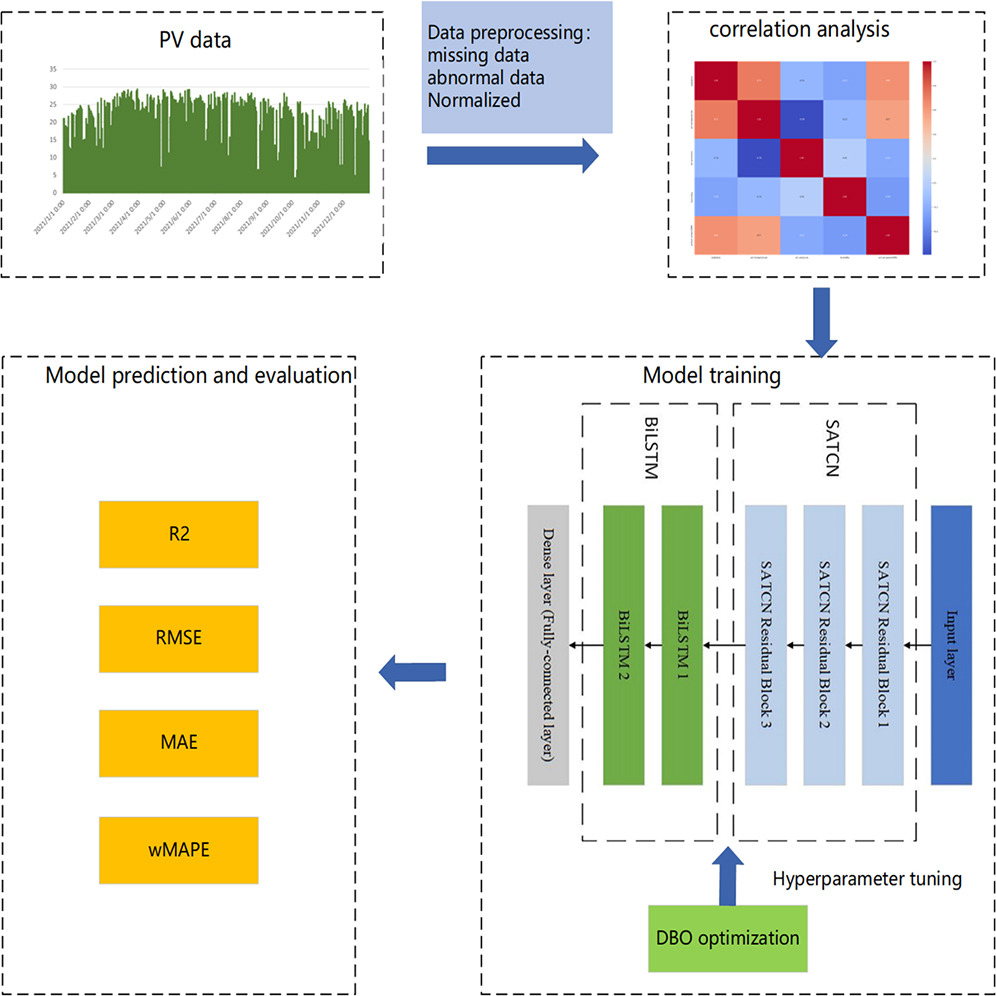
The new technique combines temporal convolutional networks with self-attention (SATCN), bidirectional long-short-term memory networks (BiLSTM) and dung beetle optimization (DBO) and is therefore called DBO-SATCN-BiLSTM.
“Existing methods for predicting photovoltaic energy generation have several shortcomings. Meta-heuristic learning methods, such as neural networks, are complex and time-consuming to train, and often rely on empirical parameter adjustments, which may not yield optimal results,” the group explains. “It is expected that swarm intelligence algorithms will improve the optimal parameters, but the optimization algorithms currently used still have certain limitations. For example, some optimization algorithms are relatively simple and easy to bring to local optimality. To address the above issues, this paper proposes a DBO-SATCN-BiLSTM.”
SATCN includes a convolutional neural network adapted to analyze time series data to mitigate the vanishing or exploding of gradients. The proposed model also uses the self-attention mechanism to capture the dependencies between different time steps in time series data. However, the BiLSTM layer uses its bidirectional data processing capabilities to obtain the forward and reverse data change characteristics in the sequence data.
The DBO section of the model works at the external level by identifying and optimizing the hyperparameters of the hybrid SATCN-BiLSTM model. Unlike parameters that are learned during training, hyperparameters are the external configurations that determine how a model works. The model is named after dung beetles because it imitates the way they roll dung balls to their nests, using scent and the position of the sun or moon to navigate. In this way, optimization searches for optimal solutions based on external guidance.
The model consists of an input layer, three layers of SATCN residual blocks, two layers of BiLSTM and a fully connected layer. The SATCN structure enables the extraction of the temporal features from photovoltaic energy data, while BiLSTM further captures the temporal correlation between forward and backward features.
The model was trained and tested based on years of information from a 30 MW PV power plant in Shaanxi Province, China. Using parameters such as temperature, humidity, barometric pressure and solar radiation during this year, the model was asked to predict the power in the next 15-minute step. You were also asked to perform a multi-step prediction of 45 minutes, representing three points into the future.
The results were compared with those of seven reference models: Convolutional Neural Network (CNN); BiLSTM only; temporal convolutional network (TCN); hybrid of CNN-BiLSTM; hybrid of TCN-BiLSTM, SATCN-BiLSTM with particle swarm optimization (PSO-SATCN-BiLSTM); and SATCN-BiLSTM with salp swarm algorithm (SSA-SATCN-BiLSTM).
In one-step prediction, it was found that the DBO-SATCN-BiLSTM achieved a root mean square error (RMSE) of 0.357 in predicting one year’s PV power.
“This shows a significant reduction of 33.1%, 23.4% and 18.1% compared to CNN, TCN and BiLSTM,” the academics pointed out. “It outperforms CNN-BiLSTM, TCN-BiLSTM, PSOSATCN-BiLSTM and SSA-SATCN-BiLSTM by margins of 17.5%, 10%, 2.9% and 2.4%,” the group said. “In terms of multi-step (three-step) predictions, errors in all models escalate as the prediction range increases. The DBO-SATCN-BiLSTM stands out with an RMSE of 0.437, indicating substantial improvements by 52.3%, 32.4%, 32.9%, 31.5%, 31.1%, 9.5% and 4.7% compared to the other seven models.”
Their findings were presented in “Algorithm-based hybrid deep learning model for dung beetle optimization for ultra-short-term PV power prediction”, published in iScience.
This content is copyrighted and may not be reused. If you would like to collaborate with us and reuse some of our content, please contact: editors@pv-magazine.com.
