

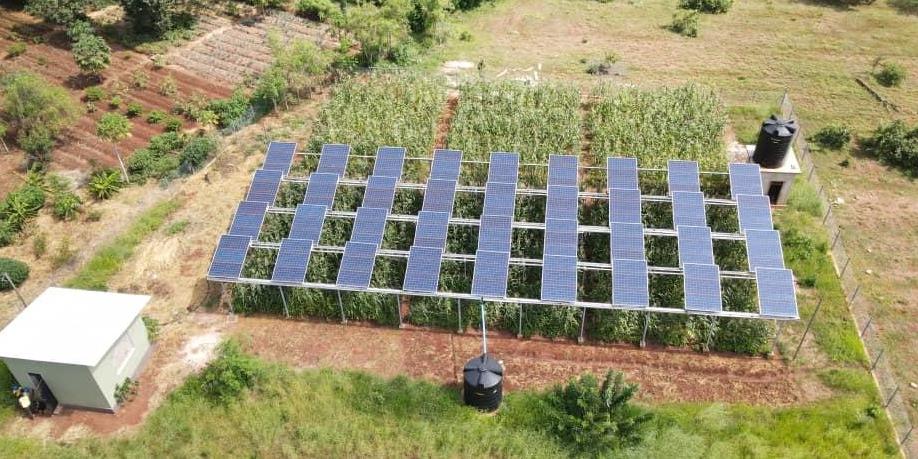
Research led by the University of Sheffield installed an off-grid agrivoltaic system in Tanzania and a grid-connected agrivoltaic system in Kenya. They found that the installations helped increase crop yields and save water, while generating electricity at a lower cost than the national grid.
An international research team has assessed the benefits of deploying agrivoltaic systems in Kenya and Tanzania.
“Despite the enormous potential for PV in East Africa, along with pressing food security needs, the potential for agrivoltaic energy in the region had not been explored. Not only that, but some of our findings differ significantly from other studies conducted elsewhere, such as in Europe, largely due to differences in climate,” said the study’s corresponding author, Richard Randle-Boggis. pv magazine. “We were surprised to see how well corn performed, not only because we expected lower yields under the shade of the solar panels, but because it is such an important crop for the region.”
“We also found that more crops survived under the panels during a warm spell, potentially indicating that agrivoltaic energy could protect crops from the more challenging climate conditions predicted for the future,” Randle-Boggis said. The team had expected to save on water use, but it was a really exciting finding to see that this translated into ‘more harvest per drop’, with some crops producing higher yields while using less irrigation.
The research paper “Harvesting the sun twice: energy, food and water benefits from agrivoltaics in East Africa”, available in Renewable sustainable energy reviews, says research on the food, energy and water benefits of agrivoltaics is currently lacking in sub-Saharan Africa.
The research paper includes data on electricity production, crop performance, irrigation and environmental parameters collected by the two systems: a 36.6 kW off-grid array located in Morogoro, Eastern Tanzania, at the home of agricultural organization Sustainable Agriculture Tanzania (SAT); and a 62.1 kW grid-connected array in Isinya, southern Kenya, at the headquarters of agricultural company Latia Agribusiness Solutions (LAS).
Both arrays are raised 3 m above the ground and have a panel density of 50%. They each feature 345W solar panels connected in groups of three, tilted 10 degrees north, which the newspaper said was selected to allow adequate water drainage and reduce pollution from the panels. A rainwater harvesting system with gutters at the bottom of the solar panels was installed to channel rainwater and panel cleaning water to storage tanks, supplementing the existing centralized irrigation systems.
Between June 2022 and May 2023, the Tanzanian system generated 12.55 MWh of electricity, which the researchers say equates to a savings of $5,310 per year on electricity from the Tanzanian national grid. In Kenya, the system generated 30.13 MWh, equivalent to 56% of the electricity LAS consumes annually. The researchers say this is a savings of $5,725 over the price of the grid, but added that if fully utilized the system could save more than $18,000.
The researchers analyzed eight types of crop growth at the Tanzanian site and four types of crop growth in Kenya. Some crops, such as corn, chard and beans, thrived under agrivoltaics, but even the lower-yield crops still generated the expected economic returns for the region, according to the research report.
Crop survival during warm periods improved under the agrivoltaic system. Panel shading also contributed to increased yields of some crops and helped reduce irrigation demand, while rainwater harvesting from panel runoff further reduced irrigation needs. The shade also helped reduce water loss through evaporation.
“By shading crops with solar panels we created a microclimate that helped certain crops produce more, but they were also better able to survive heat waves and the shade helped save water, which is crucial in a region seriously threatened by the climate change,” said Professor Sue Hartley, senior author of the study.
In its conclusion, the research paper states that agrivoltaic energy, whether on-grid or off-grid, can simultaneously achieve multiple sustainability goals in East Africa by contributing to energy security, climate change-resilient food production and water conservation in the region. “This technology could therefore provide significant benefits to governments and decision makers looking to optimize development investments for maximum impact,” the article adds.
But it also highlights that some results from the study contrast with results from existing agricultural voltaic research in temperate regions. “It’s important to remember that one size does not fit all,” said Dr. Richard Randle-Boggis, lead author of the study. “We need to tailor these systems to specific locations, especially in hot and dry climates.”
The international research team was led by the University of Sheffield in collaboration with the Center for International Forestry Research and World Agroforestry and the University of Arizona.
“Overall, we have shown that agrivoltaics can benefit the food, energy and water systems in East Africa,” says Randle-Boggis. Looking ahead, the research will continue to explore the economic and regional conditions for agrivoltaic energy. “Now that we have demonstrated the food, energy and water performance of the region’s agricultural voltaic systems, we need to understand the full economics of such systems and determine viable business models to support the introduction of the technology. We are also looking at where within the region agricultural voltaics can best be located to help guide decision making,” said Randle-Boggis.
This content is copyrighted and may not be reused. If you would like to collaborate with us and reuse some of our content, please contact: editors@pv-magazine.com.
