

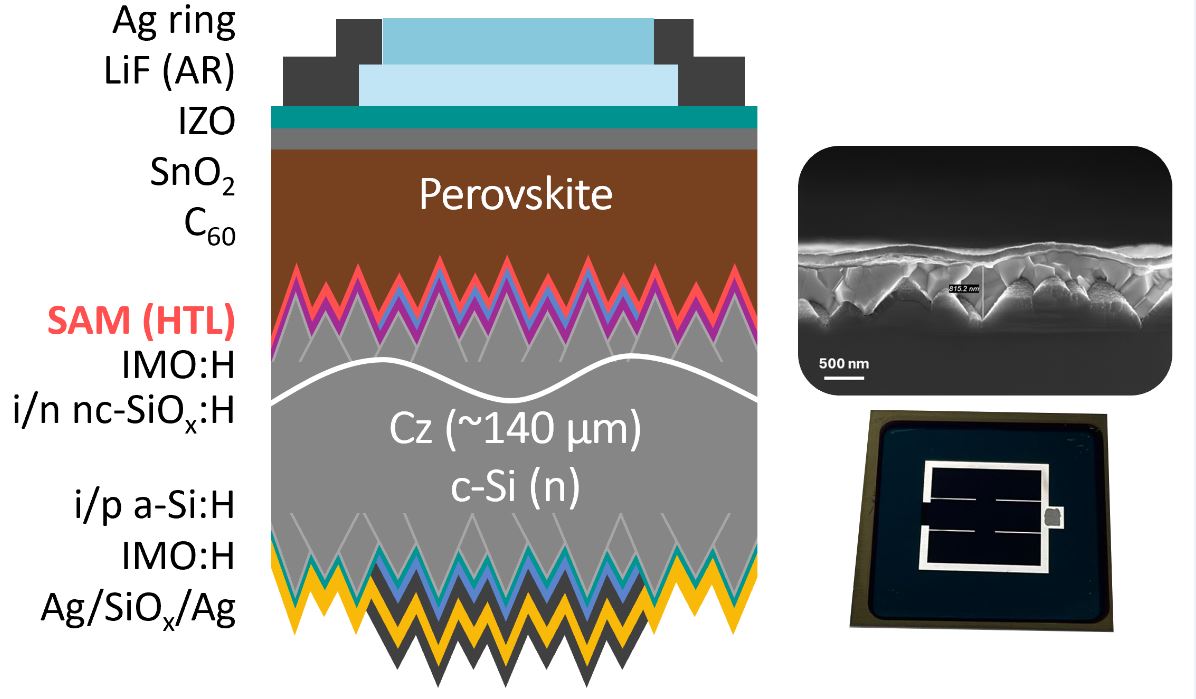
An international research team has developed a perovskite-silicon tandem solar cell with a hole transport layer based on methyl-substituted carbazole and textured silicon bottom heterojunction cells of submicron size. The proposed cell configuration uses commercially available silicon wafers from Czochralski and promises an efficiency of more than 30%.
An international research team has developed a perovskite-silicon tandem solar cell that uses a bottom cell based on a heterojunction (HJT) design and ienhanced hole transport layers (HTLs).
“The novelty of our approach lies in several innovative techniques and results for advancing perovskite-silicon tandem solar cells,” said the study’s lead author, Angelika Harter, pv magazine. “We have improved the wettability of the perovskite layer and reduced shunting problems common with conventional HTLs based on a phosphonic acid called methyl substmodified carbazole (Me-4PACz). This innovation leads to better film formation while retaining the very good HTL properties of Me-4PACz.”
Additionally, the research group has used submicron-sized textured silicon bottom cells, which they say overcomes the challenges associated with traditional micrometer-sized textures. “These textures enable better integration of solution-processed perovskite films, reducing reflection losses and improving light coupling, while maintaining compatibility with industrial manufacturing methods,” Harter said.
In addition, the scientists have optimized the thickness of the perovskite layer and the spin-coating parameters, which reportedly enable efficient film formation on the submicron textured surface and demonstrate the feasibility of using cost-effective and scalable solution-oriented methods for producing highly efficient tandem cells. “The approaches used in this work are tailored to industrial production capabilities, such as the use of commercially available Czochralski silicon wafers. Here it demonstrates compatibility with a solution-processed top cell and also highlights the potential for scale-up capabilities,” Harter explains.
The academics presented the new cell design in the paper “Perovskite/silicon tandem solar cells More than 30% conversion efficiency on submicron structured Czochralski silicon bottom cells with improved hole transport layers”, published in ACS applied materials and interfaceswhere they explained that they used a bottom HJT cell that was textured by wet etching random pyramids to improve reflection and passivation.
As for the perovskite film used in the top cell, they placed the Me-4PACz HTL combined with smaller PA molecules under the perovskite. “These additional PAs also enable the formation of more dipole-dipole interactions through hydrogen bonding to adjacent phosphonic acid anchor groups,” the group explained. “The different PAs were diluted in ethanol (EtOH) and mixed with Me-4PACz (in EtOH) at a ratio of 1:4 and spin-coated onto glass/ITO samples.”
The team built the tandem device with silver (Ag) metal contacts, the contacts of which are passivated silicon monoxide (SiOX), the bottom HJT cell, the proposed HTL, a perovskite absorber, electron transport layer (ETL) based on buckminster fullerene (C60) and tin oxide (SnO2), a transparent back contact made of indium zinc oxide (IZO), and a silver (Ag) metal contact.
“After optimizing the fabrication of perovskite absorbers for submicron textures, proof-of-concept tandems with the initial developments of the sequential application spin-spin-anneal of Me-4PACz with PAA enabled a champion device with an energy conversion efficiency of 30.22 % on a double-sided submicron structured Cz-Si SHJ bottom cell offering an open-circuit voltage up to 1.954 V and a stabilized efficiency of 30.15%,” the researchers said.
“Overall, we demonstrate a high total short-circuit current density of 40.35 mA/cm2This is remarkable considering the use of an industrially relevant silicon bottom cell with a thickness of only 140 μm and one of the highest reported values for thin Cz material,” she added.
Looking ahead, the research team said it plans to explore the use of sequential spin coating with an intermediate annealing step to further improve cell performance.
This content is copyrighted and may not be reused. If you would like to collaborate with us and reuse some of our content, please contact: editors@pv-magazine.com.
