In a new weekly update for pv magazineSolcast, a DNV company, reports that solar energy production in much of Europe is expected to drop this weekend as a significant low-pressure system moves polar air across the continent, bringing the first major widespread snowfall of the season.
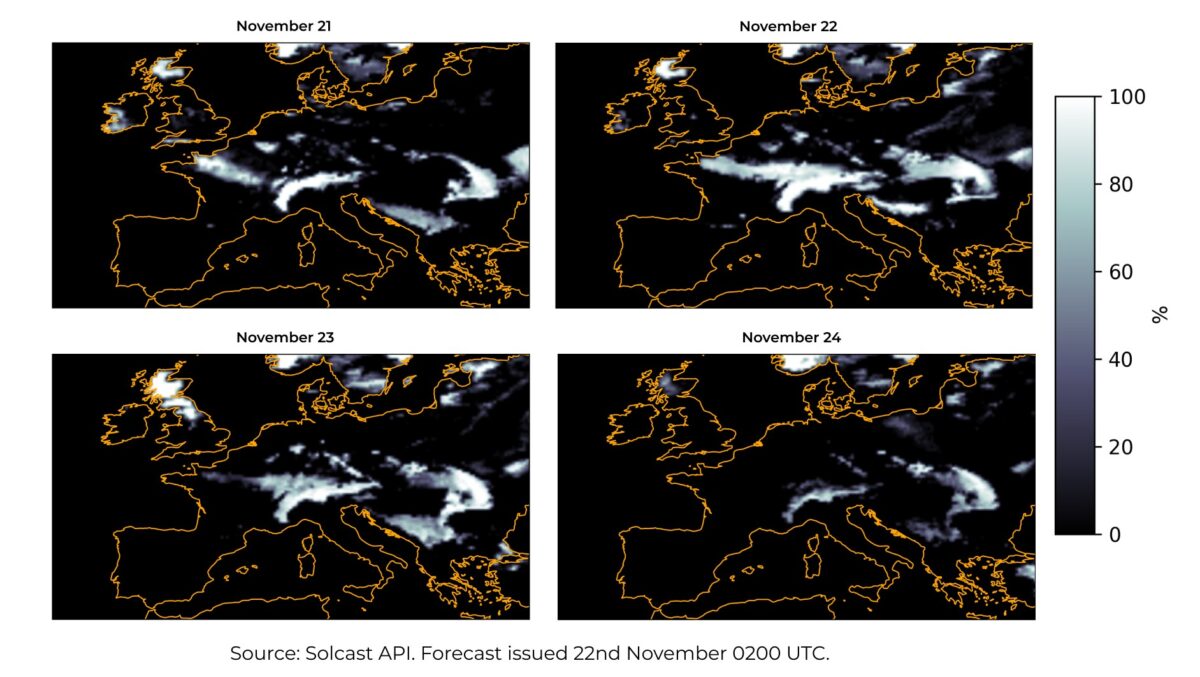
Solar output across much of Europe is expected to drop this weekend as a significant low-pressure system moves polar air across the continent, bringing the first major widespread snowfall of the season, according to analysis using the Solcast API. France, Germany, Scotland and parts of Eastern Europe are expected to see the biggest declines in solar power generation. The snow event, which started on Thursday, will continue eastwards over the weekend, with the biggest impacts occurring on Saturday before conditions improve by Sunday afternoon.

In Germany, snow falling on panels is forecast to reduce behind-the-meter (BTM) generation by up to 30% this weekend. The impact is expected to be most pronounced in the southern and western regions served by the Transnet-BW TSO, while the 50Hertz area in the northeast will remain largely unaffected. Meanwhile, in France, without widespread snowfall, a more modest reduction, up to 10%, is expected. These impacts should be largely resolved by Sunday as rising temperatures and sunshine are expected to clear snow from the panels. In Britain, significant pollution impacts will occur in Scotland, where heavy snowfall is expected. However, as UK generation capacity is concentrated in the south, this will only result in a reduction of around 5% of national solar energy production.

The first period of disruption to solar power generation is expected to occur on Saturday after a major snowfall. As temperatures rise during the day, a combination of sunlight and warming will cause the snow to slide off the panels. Although it can take a few days for snow pollution to form, it often disappears quickly. As the snow begins to melt, a thin layer of meltwater forms between the snow and the panels, allowing the snow to slide in large bands. This mechanism ensures that solar panels often clear snow well before the surrounding ground does, so the effects of snow pollution will be largely apparent by Sunday afternoon and will likely see solar grids come back online.
Such snow deposits and clearing events are rare and difficult to predict. Solcast models these phenomena directly using satellite and weather data to estimate the accumulation and sliding of snow on solar panels. While machine learning tools may struggle with the discontinuous and localized nature of such events, Solcast’s proprietary methods enable high-resolution forecasting of production impacts. Explicitly addressing snow pollution losses in your energy modeling helps quantify the duration and magnitude of such disruptions, and enables more accurate forecasts, both for individual assets and for networks.
Solcast produces these figures by tracking clouds and aerosols worldwide at a resolution of 1-2 km, using proprietary satellite data AI/ML algorithms. This data is used to drive irradiance models, allowing Solcast to calculate high-resolution irradiance, with a typical deviation of less than 2%, as well as cloud tracking predictions. This data is used by more than 300 companies that manage more than 150 GW of solar energy worldwide.
The views and opinions expressed in this article are those of the author and do not necessarily reflect those of the author pv magazine.
This content is copyrighted and may not be reused. If you would like to collaborate with us and reuse some of our content, please contact: editors@pv-magazine.com.
Popular content