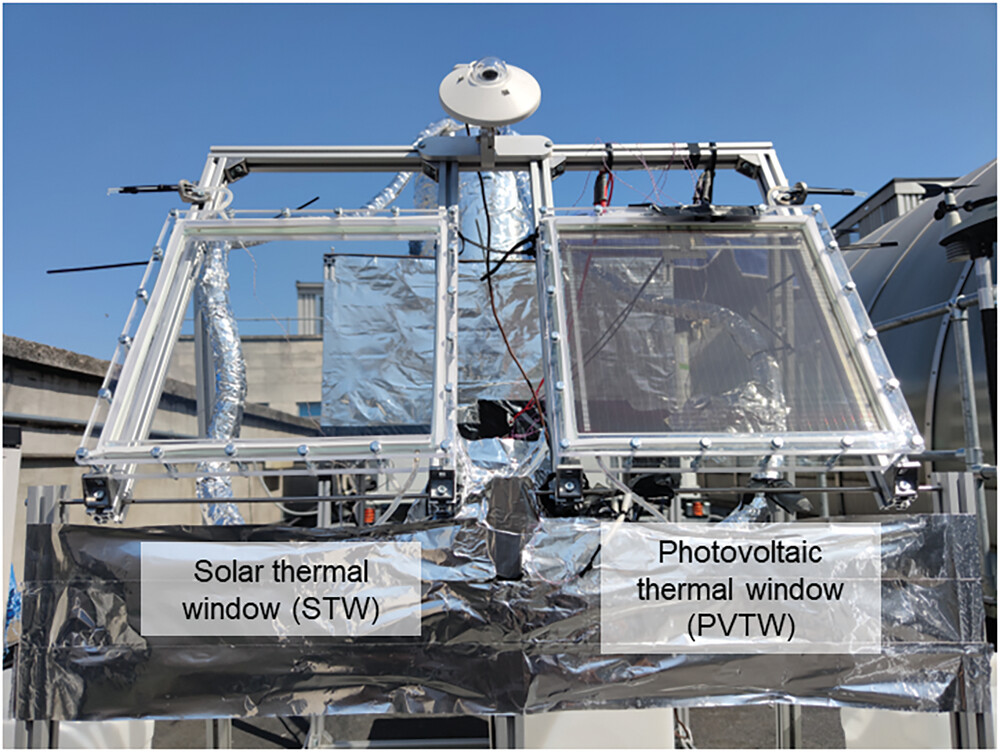
Scientists have developed a window that uses a semi-transparent amorphous silicon PV layer. The group tested the system in London at different tilt angles and found that it can achieve a maximum electrical efficiency of 3.6% and a maximum thermal efficiency of 17.6%.
A German-British research team has developed a new building-integrated hybrid PV-thermal window (PVTW) that can simultaneously produce electricity and domestic hot water (DHW).
“The installation of common solar panels and collectors in the built environment requires access to significant roof space, which is limited. This motivates the development of highly efficient, building-integrated technologies that can maximize space use and energy supply,” the group said. “In this work, a building-integrated hybrid PVTW is fabricated and tested, consisting of a semi-transparent PV layer and a selectively absorbing liquid-based thermal absorber.”
The main component of the PVTW is a glass layer with a series of spaced microstripes of amorphous silicon (a-Si). Only part of the sunlight is absorbed by the PV layer for electricity generation, while the remaining part is passed on to the 4 mm thick water layer below. Two copper pipes are used as inlet and outlet ports for the water, and two polycarbonate frames are used to clamp one standard layer of low-iron glass.
The tests took place on a rooftop in London between July 16 and 23, 2021, when the maximum ambient temperature was measured at 34 C and solar radiation at midday was approximately 1,100 W m−2. The setup was tested at inclination angles of 30°, 60° and 90°, and its performance was compared to that of a reference solar module without a PV component. The latter was identical to the PVTW, except that the PV layer was replaced by a glass layer, resulting in two layers of glass.
Image: Imperial College London, Advanced Science, CC BY 4.0
The tests showed that the PVTW system can achieve an electrical efficiency of 3.6% and a thermal efficiency of 17.6%.
“The PVTW achieved an efficiency of 3.6% in terms of electricity and 10.7% in terms of heat generation at a slope of 30°. Its ability to produce hot water of around 50 degrees Celsius makes it suitable for domestic applications, while electricity generation supports the building’s energy needs,” the team said. “Adjusting the PVTW inclination angle from 30° to 90° demonstrates the importance of orientation in system performance, with changes in output temperature and thermal efficiency observed.”
At a slope of 90°, the PVTW system recorded an electrical efficiency of 3.3%, a thermal efficiency of 17.6% and a maximum outlet water temperature of approximately 42 C. “Compared to a standalone STW, the PVTW not only provides hot water with a higher temperature, but also shows an absolute increase of 10% in thermal efficiency, together with electricity generation,” she added.
“To understand the potential impact of the PVTW on meeting the thermal energy needs of a building, we can estimate the PVTW area required to meet the hot water demand of a typical three-bedroom terraced house in London, UK, occupied by 2 adults and 2 children. ,” said the academics. “On an energy balance basis, a total PVTW area of no more than approximately 1.2 m2 at a 30° slope would be required to immediately meet this demand. Assuming a wider system with a hot water storage tank, we estimate that a total PVTW area of ≈2.8 m2 at the same slope would be required to meet this entire daily demand without the need for a backup boiler.”
The proposed system was presented in “A building-integrated hybrid photovoltaic-thermal (PV-T) window for synergistic light management, electricity and heat generation”, published in Advanced science. Researchers from Imperial College London in Great Britain and the Karlsruhe Institute of Technology in Germany conducted the study.
This content is copyrighted and may not be reused. If you would like to collaborate with us and reuse some of our content, please contact: editors@pv-magazine.com.
Popular content