

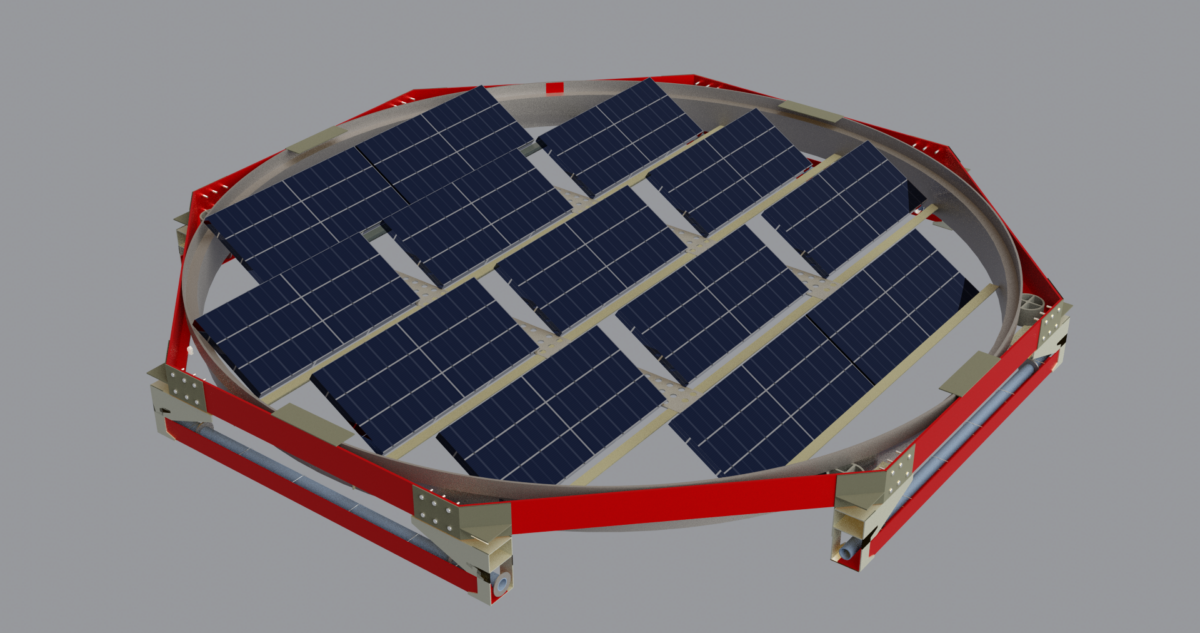
Researchers from Egypt and Great Britain have developed a new floating PV system concept that uses compressed air for energy storage. The system has a round trip efficiency of 34.1% and an exergy efficiency of 41%.
Scientists from Port Said University in Egypt and the University of Strathclyde in the United Kingdom have proposed combining compressed air energy storage (CAES) with floating solar photovoltaics through a new energy management strategy.
“To overcome the intermittency and availability problems of solar energy, the proposed floating PV system is equipped with an environmentally friendly hybrid compressed air energy storage system controlled by a novel energy management strategy to efficiently manage the energy flow between the components of the system without the allowable exceed the limit. operational limits for safe operation,” says the lead author of the study, Erkan Oterkustold pv magazine. “This control strategy is designed to ensure that load requirements are met and even low-value PV power production is utilized, reducing energy waste and improving system efficiency.”
In the proposed concept, the energy management strategy follows the deterministic rule-based approach, which determines the rules using a fuel consumption or emissions map of the system in question. “This approach uses human expertise, intuition, heuristics and mathematical models to generate a set of predetermined rules that control the operation of the system components,” the group pointed out. “These rules are interpretable and can be tuned for better performance of different operational scenarios with low computational burdens.”
The 5 kW prototype uses partially floating PV panels that are in continuous direct contact with the surrounding water, which provides efficient and free cooling and improves the efficiency of the PV panels due to the thermal equilibrium with the surrounding water. The floating platform used to support the PV system is able to automatically track the sunlight for more solar energy production and change the immersion ratio by adjusting the depth of the platform and the tilt angle of the PV panels fit to regulate their cooling or clean them from accumulated dust or dust. fully submerging the PV panels to prevent damage during severe weather conditions.
The storage system is described as a diabatic CAES system integrated with thermal energy storage (TES). It consists of four uncompensated steel air tanks placed on the corners of the floating platform. “Prior to air storage, the hot compressed air is cooled in the heat exchanger,” the researchers explain. “When the generated PV power is lower or higher than the required power of the air compressors, it is proposed to store this electricity in the form of heat in a WKO.”
There is also a hot water tank integrated with a heat exchanger to increase the temperature of the compressed air before it expands. The compressed air is released and heated through the hot water tank before expanding in the expander to regenerate electricity using the generator.
Through a series of simulations, the research team found that the system has a roundtrip efficiency of 34.1% and an exergy efficiency of 41%, with the strongest system performance observed between December and January. “Compared to conventional CAES systems, the proposed hybrid CAES system delivers annual fuel savings of 126.4%. of natural gas,” the academics emphasized. “These fuel savings will also result in an economic benefit by reducing system operating costs by $27,690/year in fuel costs.”
They also found that the energy and exergy efficiency of the system can be significantly affected by the efficiency of individual components, which they say can decrease under off-design and part-load conditions.
The system was described in “Hybrid compressed air energy storage system and control strategy for a partially floating photovoltaic installation”, published in Energy.
This content is copyrighted and may not be reused. If you would like to collaborate with us and reuse some of our content, please contact: editors@pv-magazine.com.
