

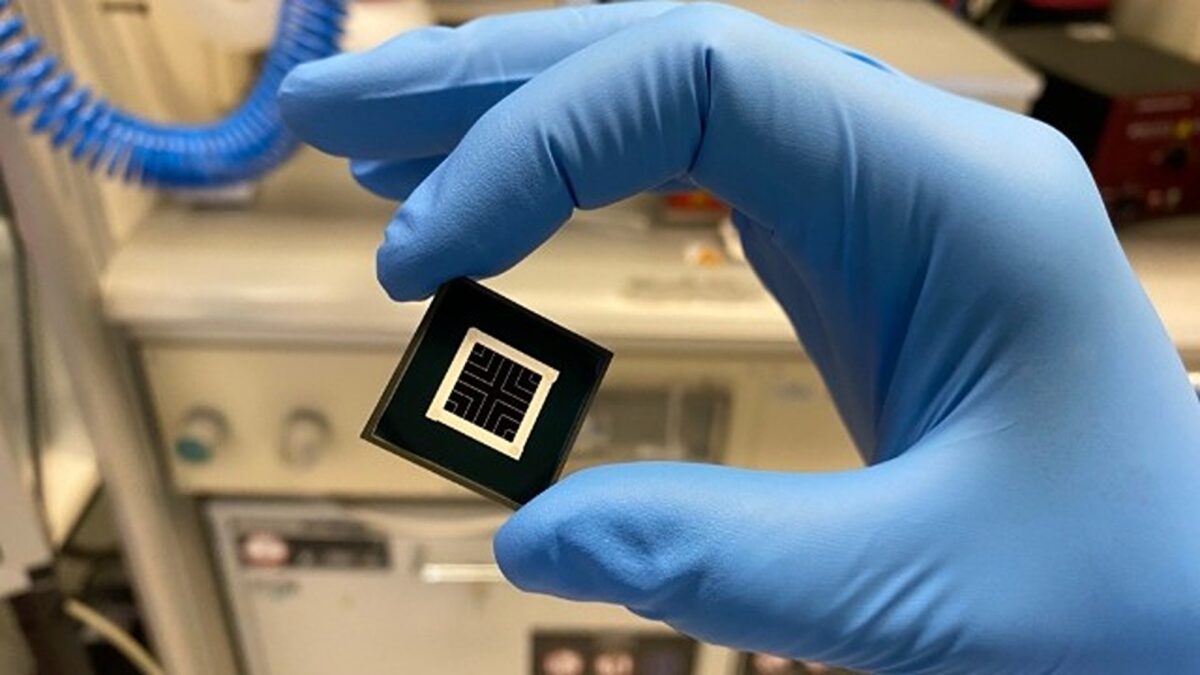
The five-year MaNiTU project, involving six Fraunhofer Institutes, included a series of studies on the life cycle of perovskite-silicon tandem solar cells. It involved the development of a scalable solar cell with an energy conversion efficiency of 31.6%.
Germany Fraunhofer Institute for Solar Energy Systems ISE has shared the results of its five-year lighthouse project MaNiTU. The project, which involved six Fraunhofer institutes, worked on identifying the most sustainable pathways for the market introduction of perovskite-silicon tandem solar cells.
The researchers produced new materials with perovskite crystal structures and compared them with existing materials at the cellular level, concluding that high efficiency can only be achieved with lead perovskites. They then fabricated highly efficient demonstrators, such as a 100 square cm perovskite-silicon tandem solar cell with screen-printed metallization.
The project also included the development of a scalable perovskite-silicon tandem solar cell that provides a 31.6% energy conversion efficiency, first announced in September. The Fraunhofer researchers used a combination of vapor deposition and wet chemical deposition ensure even deposition of the perovskite layer on the structured silicon surface. “Close industrial cooperation is the next step in establishing this future technology in Europe,” says Professor Andreas Bett, coordinator of the project.
In another part of the project, researchers evaluated the efficiency and stability of tandem solar cells. They used characterization data and an optoelectric simulation model to perform a comprehensive loss analysis on the tandem solar cell and determined a practical upper limit of 39.5% efficiency.
Elsewhere in the project, a research team explored the use of non-toxic, lead-free alternatives in perovskites, but failed to produce tandem solar cells with sufficient efficiency from the lead-free materials they analyzed theoretically and experimentally.
Meanwhile, the Fraunhofer Institute for Microstructure of Materials and Systems IMWS evaluated energy-efficient focused ion beam techniques for the preparation of industrial tandem solar cells, which were then analyzed in high resolution using a transmission electron microscope (TEM). A special sample holder was constructed to allow the direct deposition of absorber and contact layers on TEM substrates, while methods were developed to investigate the thickness, degree of coverage, and chemical bonding of self-organized molecular monolayers.
Fraunhofer researchers also conducted an assessment of the environmental impacts of production, using the phase and end of life of the tandem solar cells to develop recycling concepts for perovskite tandem modules. They concluded that by using advanced recycling processes it is possible to create a circular economy for photovoltaic systems using lead perovskites.
The project also consisted of a research team that developed computational models to describe the structural and photovoltaic properties of relevant absorber materials and their interfaces with optically transparent and electrically conductive contact materials. Scientists at the Fraunhofer Institute for Mechanics of Materials IWM have developed a computational simulation workflow that they say can be used for both solar photovoltaics and industrial-level material issues in other technologies such as hydrogen.
This content is copyrighted and may not be reused. If you would like to collaborate with us and reuse some of our content, please contact: editors@pv-magazine.com.
