

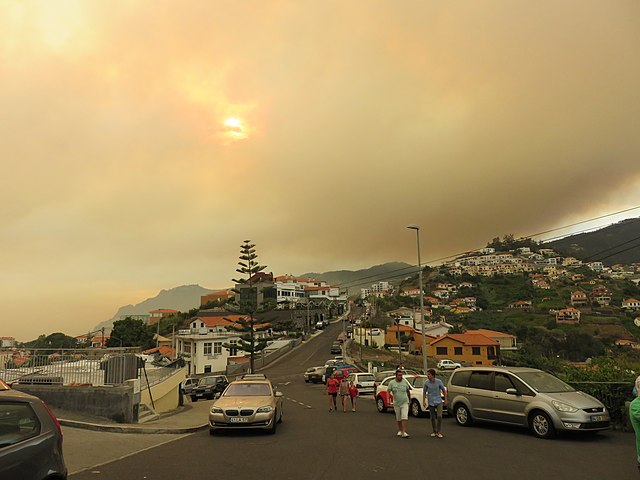
Scientists have quantified the impact of wildfires on the availability of direct normal irradiation and global horizontal irradiation at the state, regional, and national levels in the United States. They found that direct irradiation is more sensitive to smoke than the PV-relevant global horizontal irradiation.
A research team led by Colorado State University analyzed the impact of wildfire smoke on solar energy availability, namely direct normal irradiance (DNI) and global horizontal irradiance (GHI). Using satellite-based smoke, aerosol, and cloud observations, the team was able to measure impacts at the state, regional, and national levels in the United States at different temporal scales.
“Solar resources are rated by the amount of shortwave DNI and GHI radiation a location receives,” they explained. “Concentrating solar thermal energy (CSP) depends on DNI, while PV mainly depends on GHI. However, combined, GHI and DNI indicate the amount of diffuse radiation, which affects PV panel technologies in different ways.”
The researchers used clear-sky and all-sky DNI and GHI data from the National Renewable Energy Laboratory’s National Solar Radiation Database (NSRDB) at a 4 km spatial resolution and a 30-minute temporal resolution over the continental United States . All-sky statistics include the impact of clouds and aerosols, while clear-sky values include aerosols but not clouds.
“We calculate daily averages for each variable using times when the solar zenith angle (SZA) is less than 75°, cloud-induced changes by subtracting the values for clear sky (i.e., cloud-free) and all sky, and smoke-driven changes by subtracting clear sky values on smoke-affected and reference smoke-free days,” the scientists said.
At the smallest scale of their study, the team examined two days from California’s 2020 wildfire season and compared them to analogous smoke-free conditions on the same days in 2019. At larger monthly and annual scales, the team compared regional and national solar energy resources under the high smoke conditions of 2020 and the low smoke conditions of 2019. On an even larger scale, the analysis was extended to 2006-2021 to examine regional interactions between smoke and radiation.
“We find significant losses in model-based daily mean DNI (32-42%) and GHI (11-17%) in California due to local smoke,” the group explains. “Local smoke can also significantly reduce monthly mean DNI (max: 61%) and GHI (max: 25%), with impacts on DNI persisting downwind of fires. However, the impact of transported smoke on GHI is relatively minimal (<5%) on average over the contiguous US (CONUS), even during an extreme wildfire season.”
In conclusion, the academics said the magnitude of the GHI reductions implies that the average impact of smoke plumes on PV resources in the US is relatively minimal, which they say is “encouraging” as more battery storage capacity becomes widely available. when local smoke potentially causes large shifts in radiance on smaller time scales.
Their findings were presented in “Availability of solar energy resources under extreme and historical wildfire smoke conditions”, published in Nature communication. Scientists from Colorado State University, Springfield College and NASA Langley Research Center conducted the study.
This content is copyrighted and may not be reused. If you would like to collaborate with us and reuse some of our content, please contact: editors@pv-magazine.com.
