
Close Menu
  • News
  • Industry
  • Solar Panels
  • Commercial
  • Residential
  • Finance
  • Technology
  • Carbon Credit
  • More
    • Policy
    • Energy Storage
    • Utility
    • Cummunity
What's Hot

Growth in solar and wind capacity slowed last year, analysis shows

March 6, 2026

Tigo introduces a 725 W optimizer for powerful solar panels

March 6, 2026

Fox ESS, SMA, SAX Power, Kostal and BYD impress with high efficiency – SPE

March 6, 2026
Facebook X (Twitter) Instagram
Solar Energy News
Friday, March 6
  • News
  • Industry
  • Solar Panels
  • Commercial
  • Residential
  • Finance
  • Technology
  • Carbon Credit
  • More
    • Policy
    • Energy Storage
    • Utility
    • Cummunity
Solar Energy News
Home - Solar Industry - Scientists design a concentrating PV system equipped with cooling and waste heat recovery technology
Solar Industry

Scientists design a concentrating PV system equipped with cooling and waste heat recovery technology

solarenergyBy solarenergyJanuary 15, 2025No Comments3 Mins Read
Facebook Twitter Pinterest LinkedIn Tumblr Email
Share
Facebook Twitter LinkedIn Pinterest Email

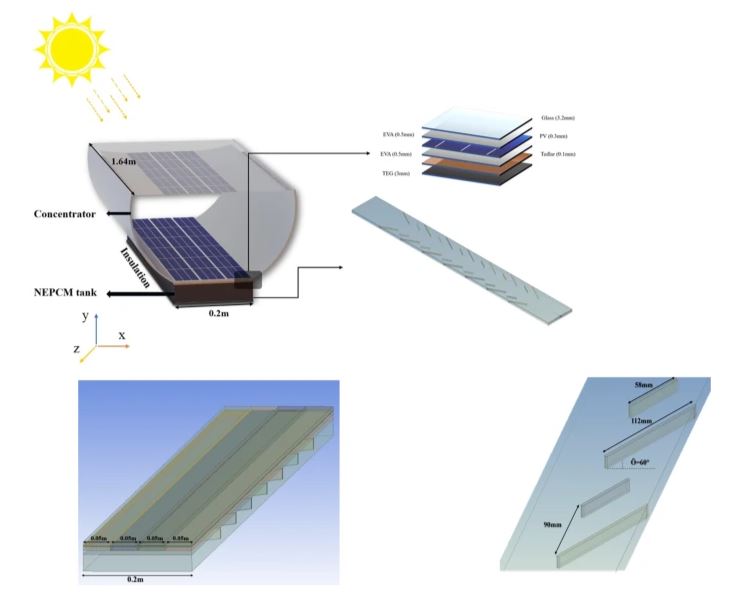
Scientists in Iran have designed a CPV system that integrates a paraffin-based fin nanomaterial cooling system as well as thermoelectric generators that convert waste heat into electricity. Simulated results showed that, with the cooling system in place, PV efficiency improves by approximately 16.46% under clean conditions.

January 15, 2025
Lior Kahana

Researchers from Iran’s Babol Noshirvani University of Technology have investigated improving the electrical efficiency of PV panels by simulating a concentrating PV system (CPV) that integrates parabolic reflectors, a paraffin-based nanomaterial cooling system aimed at lowering the temperature of the solar module, and a thermoelectric generator. TEG) that converts the excess thermal energy into electrical energy.

“To simulate the heat flux introduced by the reflectors, SolTrace software was used, while the unsteady, three-dimensional thermal behavior of the system was analyzed using Ansys Fluent,” the researchers explained. “The innovation of the current paper lies in the combined use of SolTrace for accurate reflector modeling, analysis of heat flux variation across PV layers, and the response of the layered structure to dust accumulation.”

Several cases were tested in the simulation program; the first included only the CPV panel for reference. In the second case, a cooling system has been implemented under the panel using a container filled with paraffin (RT35HC) supplemented with nanoparticles of single-walled carbon nanotubes (SWCNT). In the third case, the container also contained a series of fins to promote conductive heat dissipation across the surface of the PV panel.

All three of these cases were then tested under clean conditions and under dust deposition. Later, all versions of the system were also equipped with a TEG. TEGs can convert heat into electricity through the ‘Seebeck effect’, which occurs when a temperature difference between two semiconductors causes a voltage difference between two substances.

See also  Hybrid perovskite solar cell generates power from sun and rain

“Simulated results have shown that, with the cooling system in place, PV efficiency improves by approximately 16.46% under clean conditions. However, the accumulation of dust on the panel significantly affects performance, reducing efficiency by approximately 46.48% after 60 minutes,” the academics pointed out.

“The addition of fin structures further optimizes the system, increasing overall efficiency by approximately 6.77% in clean conditions and 3.78% in dusty conditions,” she added. “The thermal efficiency for the clean state has increased by approximately 8.47% thanks to the fins.”

Concluding its work, the team said that “the combined effects of parabolic reflectors, fin-enhanced cooling and TEG integration deliver an electrical output power approximately 2.94 times greater than that of a PV panel without any reflector or cooling modifications .”

Their findings were presented in “Development of a new solar system integrating photovoltaic and thermoelectric modules with paraffin-based nanomaterials”, published in Scientific reports.

This content is copyrighted and may not be reused. If you would like to collaborate with us and reuse some of our content, please contact: editors@pv-magazine.com.

Popular content

Source link

concentrating cooling design equipped heat recovery scientists system technology waste
Share. Facebook Twitter Pinterest LinkedIn Tumblr Email
solarenergy
  • Website

Related Posts

Tigo introduces a 725 W optimizer for powerful solar panels

March 6, 2026

Freight costs are rising due to military attacks in the Middle East

March 6, 2026

Mitsubishi Electric Trane announces new heat pump line for hydronic heating – SPE

March 6, 2026
Leave A Reply Cancel Reply

Don't Miss
Technology

New tool is intended to reduce valuable hail losses in solar energy on Utility scale Solar-PV Magazine International

By solarenergyApril 22, 20250

Greeting damage accounts for only 2% of the submitted claims for solar insurance policies, but…

GCL Energy and Ant Digital raise CNY200 million by tokenizing solar assets in China – SPE

December 25, 2024

Ultra-thin CIGS cell based on tungsten disulfide promises 25.7% efficiency

September 17, 2024

Cero Generation secures £ 200 million for 360 MW UK Solar Portfolio

July 25, 2025
Stay In Touch
  • Facebook
  • Twitter
  • Pinterest
  • Instagram
  • YouTube
  • Vimeo
Our Picks

Growth in solar and wind capacity slowed last year, analysis shows

March 6, 2026

Tigo introduces a 725 W optimizer for powerful solar panels

March 6, 2026

Fox ESS, SMA, SAX Power, Kostal and BYD impress with high efficiency – SPE

March 6, 2026

Longi wins tender for 800 MW Hexi solar panels – SPE

March 6, 2026
Our Picks

Growth in solar and wind capacity slowed last year, analysis shows

March 6, 2026

Tigo introduces a 725 W optimizer for powerful solar panels

March 6, 2026

Fox ESS, SMA, SAX Power, Kostal and BYD impress with high efficiency – SPE

March 6, 2026
About
About

Stay updated with the latest in solar energy. Discover innovations, trends, policies, and market insights driving the future of sustainable power worldwide.

Subscribe to Updates

Get the latest creative news and updates about Solar industry directly in your inbox!

Facebook X (Twitter) Instagram Pinterest
  • Contact
  • Privacy Policy
  • Terms & Conditions
© 2026 Tsolarenergynews.co - All rights reserved.

Type above and press Enter to search. Press Esc to cancel.