Researchers have constructed a miniature PV field at an altitude of 2,500 meters in Switzerland. They tested it in 80 different positioning settings and compared the results with the Swiss government’s guidelines for a subsidy program. They found that the simulated yield was underestimated by up to 16%.
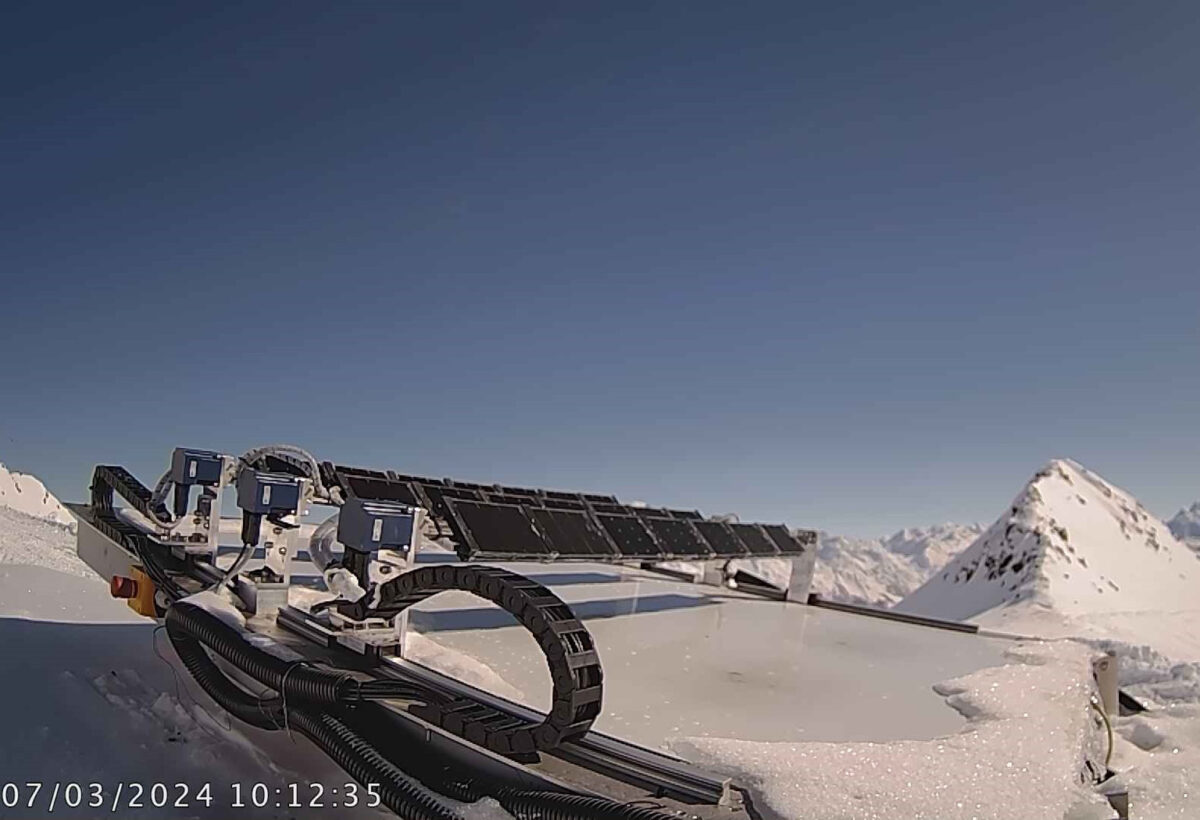
Scientists from ZHAW University of Applied Sciences Zurich have tested a miniature of a fully automatic high-alpine multi-row PV array. The miniature was designed as a 1:12 scale of an alpine PV field and was installed at an altitude of approximately 2,500 meters in Davos, Switzerland. It consisted of three rows of seven back-to-back monofacial panels, virtually simulating bifacial modules.
“High alpine installations are no longer commonplace these days, and as such there is not much practical experience in planning and optimizing field layouts. Yield calculations in steep terrain, combined with highly reflective snow cover, are particularly complex,” says corresponding author Michael Wild pv magazine. “We have been able to demonstrate that industry standard software can perform these calculations satisfactorily, although there are a number of factors that require special attention, such as the albedo of snow. This should increase confidence in the simulation results, which will hopefully in turn increase investor confidence.”
The glass-glass PV modules were custom-made and consisted of three individual interdigitated back-contact (IBC) cells, each measuring 90 mm x 43.3 mm and a maximum power of 2.6 W. Each module row consisted of a carbon fiber rod, on which the modules were attached. The whole is attached to the roof of the shipping container in which the electrical equipment is located. To control the albedo level, a white aluminum plate with an albedo of 0.798, which corresponds to fresh snow, was placed under the modules. Silicone heaters were placed underneath to prevent the accumulation of snow and ice.
Different motors could change the positions of the modules. The entire array could change the slope of the ground from a minimum of 0◦ to a maximum of 40◦; the distance between the rows changed between 115 mm and 700 mm, and the slope of the modules themselves varied from −40◦ to 90◦. A total of 80 position combinations were tested, focusing on the middle modules of the southern and northern bars.
The tests were conducted from October 2023 through March 2024, with December and January results omitted due to technical errors. To validate the miniature system, the team compared it to a large PV system located at the same test site. It consists of six groups of three to four modules, with mono- and bifacial groups with module slopes of 40◦, 60◦ and 90◦.
Image: ZHAW Zurich University of Applied Sciences, Solar Energy, CC BY 4.0
“In general, the measurements from both systems agree remarkably well,” the team emphasizes. “For the monofacial comparison, deviations of less than 1% were observed in November and February, 3.9% in March and 14.2% in October. The comparisons of bifacial measurements were slightly more variable, but still remarkably close given the differences in system design.”
One of the reasons for deploying that miniature setup is to compare their field measurements with those of the commercial software PVsyst, equipped with the Meteonorm albedo settings that correspond to the guidelines of the Swiss Federal Office of Energy. These have been determined for the “Solarexpress” subsidy scheme, which is intended to support PV projects in the Alps.
“To obtain the lucrative subsidy for alpine PV projects in Switzerland, a plant must produce more than 10 GWh annually and reach a specific output of 500 kWh/kWp during the winter months from October to March,” the academics said. “The scale of the investments requires a high level of confidence in return simulations. Although commercial software is available, the accuracy of the simulation results is not necessarily known.”
According to the comparison of the experimental results and the simulation, the albedo values of Meteonorm are too low, resulting in an estimated yield of 7%-16% lower. “It was further shown that using a shadow angle equivalent projected system for arrays on inclined surfaces leads to a systematic error, which itself depends on the respective module slopes,” they emphasized, noting that the underestimation of the energy yield depends on the increased albedo in a snow-covered environment.”
The findings are presented in “Comparison of measurements and simulations using a tunable high-alpine photovoltaic array”, published in Solar energy. “It was honestly surprising to see how well the simulations match what we actually measure across a wide range of parameters – given all the simplifications and idealizations, that wasn’t clear from the start. This also encourages us to broaden the scope of the PV fields we look at, for example non-southern orientations,” Wild added.
This content is copyrighted and may not be reused. If you would like to collaborate with us and reuse some of our content, please contact: editors@pv-magazine.com.
Popular content