

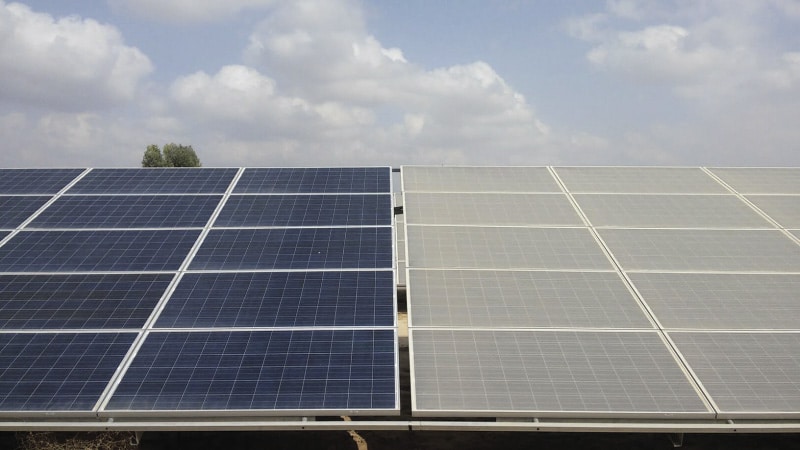
Scientists placed four PV panels in a 21-meter wind tunnel and performed various tests regarding tilt angles, mounting height, distance and incoming current direction. They discovered that when the distance between the panels is greater than twice the panel height, the mutual influence on dust deposition becomes negligible.
Researchers from China’s Ningxia University have investigated the properties of dust deposition on PV panels using a series of wind tunnel experiments. They specifically focused on how variations in tilt angle, mounting height, distance and incoming flow direction affect the mass of the accumulated dust and the distribution of different particle sizes.
“The innovative aspect of this study lies in its empirical approach to quantifying the relationships between installation parameters and dust characteristics, providing practical recommendations for improving the efficiency and performance of photovoltaic systems in environments prone to dust accumulation,” it explains team out.
The wind tunnel used for the experiments had a length of 21 meters and a height and width of 1.2 meters respectively. To simulate desert environments, fine dust particles were introduced from the upper part of the wind tunnel at a wind speed of 5 m/s. Four identical PV panels measuring 670 mm long and 350 mm wide have been placed in a row in the tunnel.
“The experiment was conducted over a period of approximately 14 days, during which the average air temperature was 12 degrees Celsius and humidity was 25%, with no recorded precipitation during the period of our experiment,” the academics added. “To ensure the reliability of the results, all tests were performed in triplicate and the average value was recorded for analysis.”
Testing the impact of different panel slopes, the team placed the panels at 0°, 15°, 30°, 35°, 45° and 60°. According to their findings, the dust accumulation on the first panel shows an almost exponential growth pattern as the tilt angle increases, while the last three panels show an initial increase followed by a decrease.
“The maximum dust accumulation occurs at tilt angles between 30° and 35°. Compared to the dust accumulation at zero tilt angle, the dust accumulation on PV2, PV3 and PV4 can increase by 50%, 200% and 275% respectively,” the academics said. “These findings suggest that optimizing the tilt angle of PV panels can effectively reduce the impact of dust accumulation.”
The team then analyzed the effects of wind direction on dust deposition, testing angles from 0 to 90° between the panels and the wind flow. “The dust deposit mass on PV1 initially increases and then decreases with changes in wind direction. In contrast, the dust mass on PV2, PV3 and PV4 shows an initial increase, followed by an exponential decrease as the wind direction angle increases,” they found.
Given the different mounting heights, the panels in the tunnel were tested at 10 cm, 20 cm, 30 cm and 40 cm. “A key discovery of this research is that when the distance between panels is greater than twice the panel height, the mutual influence on dust deposition becomes negligible, providing best practices for installation spacing,” the group said.
The results are presented in “Characteristics of dust deposition on photovoltaic arrays investigated by wind tunnel experiments”, published in Scientific reports.
This content is copyrighted and may not be reused. If you would like to collaborate with us and reuse some of our content, please contact: editors@pv-magazine.com.
