

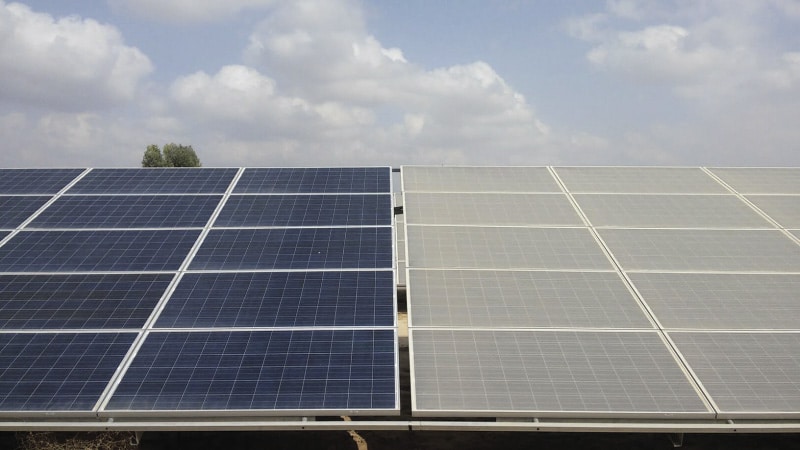
Researchers in China have investigated the dust scale process and various water-based cleaning methods to optimize maintenance strategies for improved safety and efficiency in PV systems.
Scientists from the University of Science and Technology of China have an overview of research into the dust scale process on PV panels and various water-based cleaning methods.
They were able to establish a relationship between different types of dust scales and water cleaning parameters. In general, the team has viewed 250 articles that have been published all over the world until 2024.
“Under complex environmental conditions, dust deposits and scale mechanisms significantly influence the reduction in the efficiency of power generation,” researcher Long Shi told PV Magazine. “The dynamic relationship between dust -scale patterns and water cleaning parameters under varying weather and pollution conditions remains poorly understood. To effectively tackle PV material and scale problems, it is essential to study the relationship between the dust scale process and water cleaning parameters. “
Their analysis of dust scale formation considered dust characteristics and environmental factors. They identified elements, particle size and surface as a key characteristics. Environmental factors include relative humidity, dew and rainfall in different seasons and geographical environments. Mineral dust, organic matter and industrial fabric form four types of scale under these environmental influences.
The combination of different dust characteristics and environmental factors influences scaling mechanisms that influence the scaling type.
“The forms of operation of the formation of dust scale include adsorption, recrystallization, fixed bridge, chemical reaction, oily adhesion, chemical bond, rescheduling, agglomeration and compaction,” the researchers added. “Dust scales include estimated laminar scale, localized accumulation scale, island scale and trench -like laminar scale.”
The scientists analyzed hundreds of articles to match with dust scales, sources and characteristics of cleaning parameters. They identified water cleaning parameters such as water pressure, flow rate, angle of diffusion, distance from the panel and angle (AOI).
Image: University of Science and Technology of China
“Scales formed by only mineral dust have little adhesion and are easily cleaned. Scales that contain some organic material and industrial dust are more challenging to clean, “the researchers said. “For the localized accumulation scale, the island -like scale and the trench -like laminar scale require a higher impact force for effective loosening. For the large thickness of dust scales, the impact force must first be considered, and for the small thickness of dust scaling, the coverage area of the water flow must be considered. “
Fabric from desert, urban and coastal sources forms a “mud girdle” that reduces efficiency and increases thermal risks. Humidity levels between 40% and 80% improve capillary forces, giving substance more likely to cause trays. Studies indicate that PV efficiency is most influenced in Asia, followed by Africa and Oceania, with weekly losses up to up to 7.84%, 3.03%and 2.4%. Regions with high dust density are North Africa, the Central East, West -Asia, the Western United States, Australia and parts of China and India.
“The water cleaning under pressure is improved on average 10.4%,” said the academics. “Weekly water cleaning of PV panels can effectively eliminate dust pollution. The minimum water consumption for aqueous cleaning is 0.31 l/m2, the maximum is 4.95 l/m2 and the average water consumption is 2.1 l/m2. “
They presented their findings in “Combining dust scale behavior of PV panels and water cleaning methods“Which was recently published in Reviews for sustainable and sustainable energy.
This content is protected by copyright and may not be reused. If you want to work with us and reuse part of our content, please contact: editors@pv-magazine.com.
Popular content

