

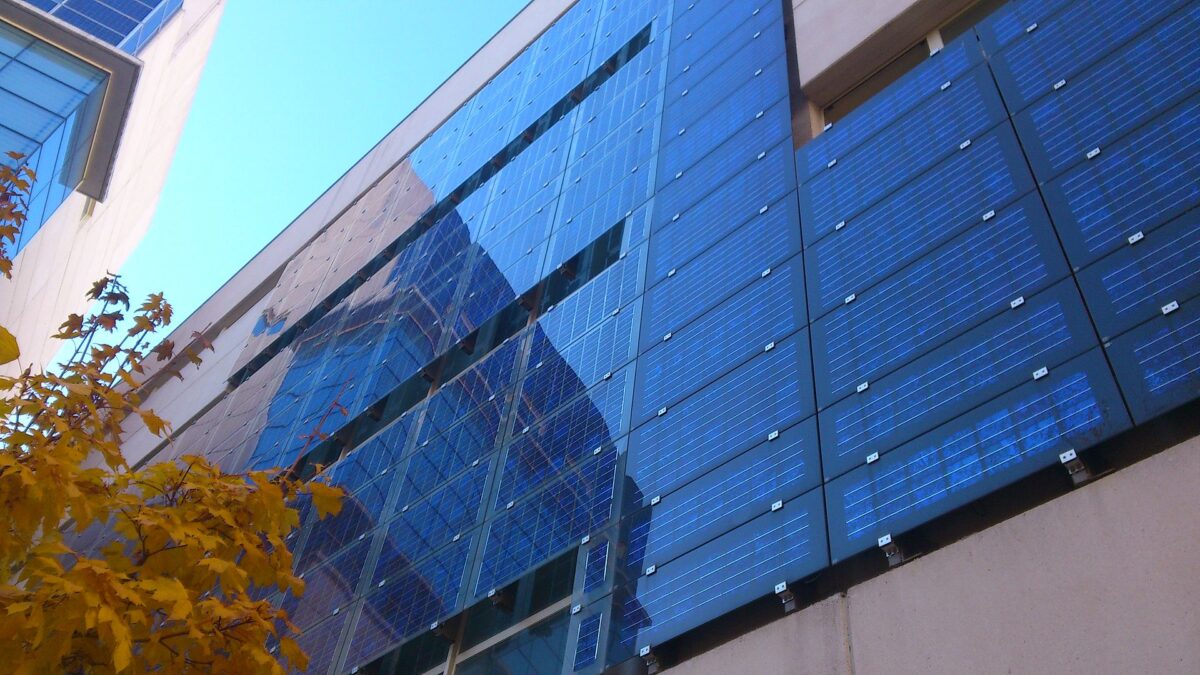
As the global transition to sustainable energy intensifies, building-integrated photovoltaics (BIPV) have emerged as a critical innovation in merging renewable energy with architectural design. The recently published guide “Building-Integrated Photovoltaics: A Technical Guide”, edited by IEA PVPS task 15 experts Nuria Martín Chivelet, Costa Kapsis and Francesco Frontini, offers an extensive source for architects, engineers and urban planners. This article investigates the most important insights of the book, including applications, challenges and future paths.
BIPV technology transforms buildings from passive energy consumers into active energy generators. In contrast to traditional photovoltaic (PV) systems that are applied to existing structures afterwards, BIPV solutions are seamless integrated in envelopesserve a double goal: energy generation and structural functionality. This reduces the need for extra materials, which reduces the environmental impact of buildings and at the same time improves their aesthetics.
The Building-integrated photovoltaisies: a technical guide underlines how BIPV can contribute to the Low -carbon citiesboth reduce Operational energy consumption and greenhouse gas emissions. With solar energy that now forms a considerable part of the global energy mix, BIPV solutions could become a cornerstone of modern architecture, so that urban centers are in accordance with sustainability goals.
Most important features of the guide
The guide offers one structured and technical approach For BIPV, the cover of critical areas such as performance requirements, design considerations, product availability and real-world applications. It is divided into six capital chapters:
- BIPV performance requirements: A discussion about important statistics such as generating electricity, thermal performance, daylight, acoustic insulation and sustainability. The book also dives into safety standards and the aesthetic impact of BIPV systems.
- BIPV products: An exploration of various BIPV module components, including glass glass modules, transparent PV and flexible thin-film solutions. It also includes integration methods for roofs, facades and shadow devices.
- A decision-making process for BIPV design: a step-by-step method for assessing site conditions, conducting studies for solar access, estimating the energy yield and evaluating sustainability aspects.
- Design of BIPV -Envelop- and Casestudies: Detailed case studies that demonstrate successful BIPV projects worldwide, which demonstrates technical feasibility and architectural integration.
- Operation and maintenance of BIPV systems -treats long-term system performance, safety reasons and maintenance strategies to maximize the energy output.
The book also contains 50 annotated reference drawings that illustrate the implementation of BIPV in various architectural elements, along with 24 international case studies that emphasize the best practices in design and construction.
Hinder challenges BIPV adoption
Despite the potential, BIPV’s adoption is limited Due to various challenges that the book tried to resolve valuable sources and references:
- Lack of consciousness and expertise with architects and builders: Many professionals in the construction and design industry are not familiar with BIPV technologies, so they are reluctant to include them in projects. More extensive educational and training programs are needed to bridge this knowledge gap.
- Higher initial costs Compared to some conventional building materials: Although BIPV can offer financial and environmental benefits in the long term, the higher investment often remains a deterrent for many developers and owners of real estate. Improved financing mechanisms, such as subsidies or green loans, can help tackle this problem.
- Regulatory and standardization gaps: BIPV requires compliance with both construction and electric codes. Integrating photovoltaic elements into building materials means that safety, sustainability and energy production all have to be considered at the same time, which requires a more complex approval process.
- Integration complexity: In contrast to standard PV systems that can be mounted on roofs, BIPV must be carefully designed to fit into the construction coat and special care must be taken on retrofit projects. This can make the planning and installation processes more difficult, which requires specialized expertise.
- Market fragmentation and lack of united supply chains: Since BIPV components are produced by both solar manufacturers and companies for building materials, it can be difficult to achieve seamless integration between different systems. Industrial-wide cooperation and standardization efforts can help reduce these challenges.
Future prospects: Solutions for the BIPV scaling
The book proposes various solutions to speed up BIPV implementation:
- Policy support and incentives: Governments must enter subsidies, tax stimuli and mandates for BIPV acceptance in new buildings. Some regions have already implemented solar mandates for new constructions and comparable requirements can be extended to BIPV solutions.
- Innovation in materials and design: Progress in colored, flexible and lightweight PV materials can expand BIPV applications. The continuous development of more aesthetically versatile modules will enable architects to integrate BIPV without jeopardizing design integrity.
- Improved business models: The approval of electricity buying agreements (PPAs) and leasing models can lower the costs in advance for building owners.
- Cooperation: Encouraging partnerships between the solar industry, construction sector and policy makers can streamline the approvals of regulations and speed up market growth. Determining universal standards and certifications for BIPV systems will also offer more confidence to stakeholders.
- Sustainability focus: Future BIPV systems must take into account the reviews of life cycle and recycling for PV materials. Sustainable strategies for the end of life will ensure that BIPV remains an environmentally friendly choice.
Conclusion
Building-integrated photovoltaisies: a technical guide is an essential source for industry professionals who want to use the power of solar energy through architectural design. Since cities strive for net-no-emissions, BIPV will play a crucial role in ensuring that buildings are not only energy efficient, but also be energy-producing, and the book offers a route map for scaling BIPV acceptance.
This article is part of a monthly column by the IEA PVPS program. It was contributed by IEA PVPS task 15 – Turning the framework for the development of BIPV.
Click for more information about IEA PVPS task 15 and BIPV here.
The third phase of task 15, to extend the four -year activities, started in 2024. Participation in task 15 can be a way to influence BIPV standardization without the formal membership of a standardization committee. In the event that you are a potential participant of phase 3 of task 15, please contact the 2-taakco managers Francesco Frontini (for contributions with regard to the topics of “challenges and opportunities of BIPV in a decorated and circular economy”, “BIPV in the digital environment”: “BIPV-Products, Products and Products” Rose Wilson (for contributions with regard to the subject of “BIPV characterization and performance: pre-normative international research”))
This article is part of a monthly column by the IEA PVPS program. It was contributed by IEA PVPS task 15 – Turning the framework for the development of BIPV.
The views and opinions expressed in this article are the author, and do not necessarily reflect it by PV -Magazine.
This content is protected by copyright and may not be reused. If you want to work with us and reuse part of our content, please contact: editors@pv-magazine.com.
