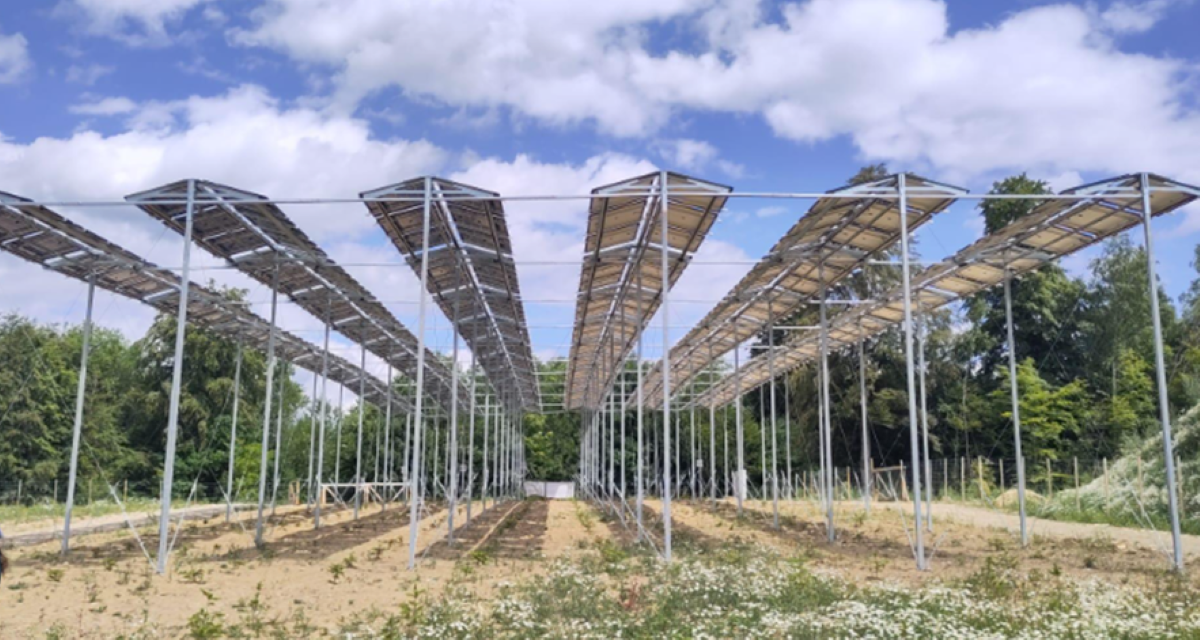
Fraunhofer Institute for Solar Energy Systems (ISE) says that Germany could use agrivoltaic capacity up to 500 GW, based on a national assessment of all agricultural types and criteria for locations.
Germany could install up to 500 GW Agrivoltaic capacity on the most suitable agricultural land, according to a new study by Fraunhofer Isee much larger than its PV expansion objective for 2040.
The researchers first considered all types of agricultural land and evaluated them with the help of various criteria to identify optimum locations for agrivoltaic systems.
“This is the first study in Germany to consider all types of agricultural land to identify suitable locations, including permanent grassland, arable land and permanent crops such as fruit, vineyards or berries,” said researcher Salome Hauger.
Fraunhofer ISE said that the criteria -catalogs included geographical, legal and regulatory factors to determine technically and legally feasible capacity. The first scenario excluded areas under strict limitations, such as nature reserves, and identified sufficient land for 7,900 GW from Agrivoltaics. In the second scenario, the team also excluded areas with soft limitations such as Flora and Fauna -Nature protection zones, which reduces potentially to 5,600 GW.
Regionally Bavaria showed the highest technical potential, with almost 3,500 GW that was considered feasible. After applying the limitations of the second scenario, there were still around 2500 GW left. The study also found high potential in lower Saxony and Bremen, while the prospects for Agrivoltaics in Saarland were limited. The city states were grouped with the larger federal states for the analysis.
Based on the General Area Survey, the researchers applied political, economic and agricultural suitability criteria in a second round to identify the most favorable locations. The aim was to find areas that are particularly suitable for Agrivoltaïschens, due to factors such as solar radiation, proximity to a grid connection point or the presence of permanent crops such as wine or fruit that benefit from synergy effects, the researchers said. To support decision-making, the researchers asked experts from agriculture, science, distribution trid operators and project planning offices to weigh the criteria.
As a result, Fraunhofer Isee developed a soil fitness index. This was the basis for categorizing land in five suitability classes, from the most to the least favorable.
“An important finding of the study is the role of grid expansion: the lack of schedule connection points is a limiting factor for many areas,” said Hauger.
With the help of geo-information-based analyzes, the potential for agrivoltaïschens can be calculated at individual plot level, whereby researchers collaborate with districts and local distribution trenders to validate the data.
The “Agricance” project used this analysis to study the potential in the rural state of Hamburg. The researchers created three scenarios to classify the identified areas from a technological and agricultural-economic perspective. They found a maximum of 620 hectares in the Altes Land and the four and Marschlanders regions, where photovoltaïschen are ideal, especially in combination with permanent crops. The potential for greenhouses is also promising, with 160 hectares on roof space that can host nearly 50 MW Zonne -Zonne energy on existing buildings.
In another study for the districts of Ahrweiler and Breisgau-Hochschwarzwald, the Fraunhofer ISE team considered spatial planning data, rack data and crop rotations. The results showed a significant potential for Agrivoltaïscheers in both districts. On the most suitable country alone, Agrivoltaic systems could supply 16% and 12% of the current energy consumption of each district respectively, according to the researchers.
This content is protected by copyright and may not be reused. If you want to work with us and reuse part of our content, please contact: editors@pv-magazine.com.
Popular content