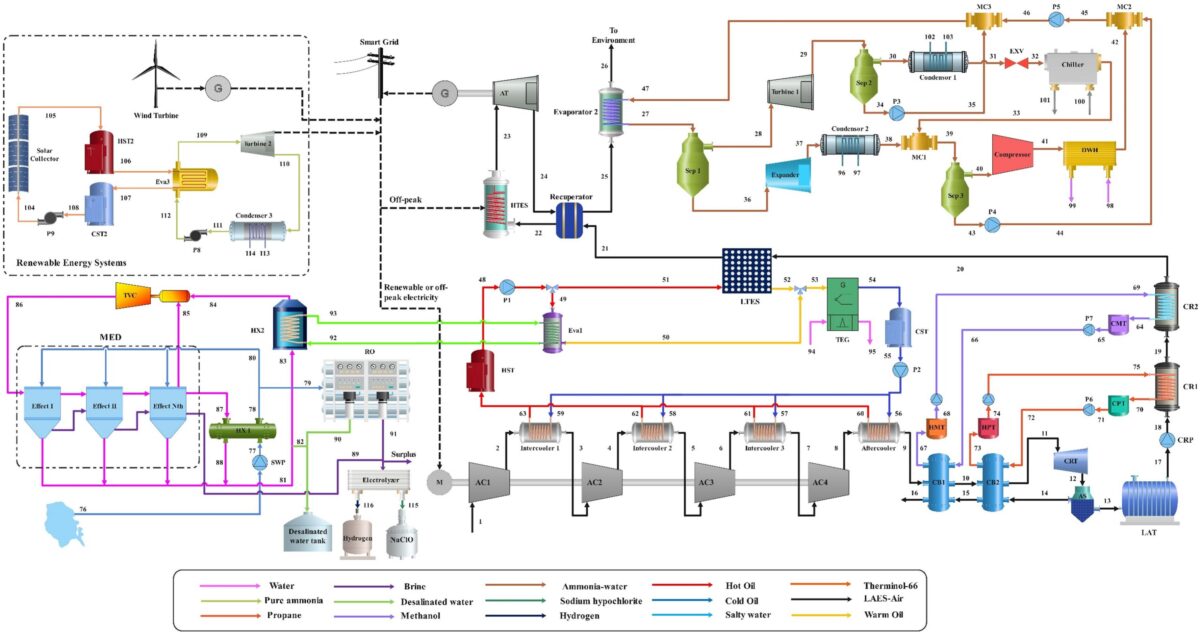
A global scientific team has designed a new multigeneration system based on renewable energy and storage of liquid air energy and then used soft computing techniques to optimize their operation. The optimized livalized costs of hydrogen (LCOH) were $ 1.52/kg and $ 5.22/m³.
A research team led by scientists from the TOOSI University of Technology from Iran has proposed a new multi -owneration system that produces electricity, fresh water, hydrogen, heating, cooling and sodium hypochlorite. It is based on renewable energy with a LAES system (Liquid Air Energy Storage).
“The most new aspect of the work lies in the advanced integration of a Laes system with a hybrid desalination unit (combining thermal and membrane processes) and a multigeneneration system with renewable energy, creating a fully coordinated platform for the same energy and freshwater production,” explained the team. “This configuration not only uses renewable energy to charge the LAEs and to store surplus thermal energy, but also restores smart waste heat during the discharging phase to steer descending and hydrogen production processes.”
The first design of the system comprises a laes with an ISTROPic efficiency of 85%, a loading time of eight hours and a discharging time of four hours. Loading is supposed to be driven by solar panels, 2 meters x 2 meters and wind turbines with an efficiency of 90%. It uses combined cooling, heating and power (CCHP), which is connected to the discharge side of the LAEs. It uses both reverse osmosis (RO) and multi-effect distillation (Med), while the remaining brine in electrolysis is used to produce hydrogen and sodium hypochlorite.
The system is supposed to work 1,200 hours a year and to have an operational lifespan of 20 years. For economic evaluation, the discount rate is considered 3%, inflation and interest rates are both 10%and the maintenance factor is 3%. It was all modeled in the Engineering Equation Solver (ESS) and was validated against previous studies. All different parts of the system have obtained an error than 6%. After this, the system was optimized by a soft computing process.
Image: TOOSI University of Technology, Journal of Energy Storage, CC by 4.0
“The optimization process is the way to discover the most suitable settings. That is why a multi -objective particle swarm optimization (mopso) algorithm is used to give the most satisfying values of selected objective functions. In Mopso all elements are moving through shared and different intelligences. “The aim of applying soft computing techniques for optimization driven by artificial neural networks, the research aims to improve the efficiency, economic feasibility and environmentalness of the introduced configuration.”
Results of the initial system show the effectiveness values of the environmental damage of 9.16 for desalination systems, 3.4 for energy storage facilities and 3.64 for multi -owneration systems. The estimated sustainability index (SI), based on calculated Exergy Efficiency, was 1.88 for the system and 1.92 for the sub -system for liquid lifeguards (LAES). During its lifetime, the solar components of the system saved 6,141.37 tonnes of CO₂, while the wind turbines avoided 2,646.31 tonnes of CO₂ emissions. It also saved more than 55 tons of nitrogen oxides (NOx).
“The optimized values for the level of hydrogen and water from Exergo -economic analysis are $ 1.52/kg and $ 5.22/m3 respectively,” the scientists said. “After optimization, the system can supply 1.15 GW cooling, 1.41 GW household heating, 57.47 T from Naclo, 6.49 x 10⁷ m3 of hydrogen (in gas phase) and 7.59 x 10⁴ m3 of freshwater annually.”
The researchers presented the results in “Soft computing optimization of a renewable energy-integrated multigeneration system with liquid air energy storage“Which was recently published in the Journal of Energy Storage. Scientists from the TOOSI University of Technology of Iran, the Canada University of Waterloo, the International Business University, Balsillie School of International Affairs (BSIA) and the Eindhoven University of Technology of the Netherlands participated in the study.
This content is protected by copyright and may not be reused. If you want to work with us and reuse part of our content, please contact: editors@pv-magazine.com.
Popular content