Researchers in the Netherlands have suggested a residential energy system that combines PV, solar thermal and PV thermal panels with thermal energy storage of Aquifer and a heat pump, achieving a seasonal performance coefficient of seven in five buildings.
A group of researchers from the Delft University of Technology in the Netherlands investigated a hybrid system that combined different types of solar collectors with heat pumps and storage devices. The team simulated the system in five Amsterdam buildings, taking into account various operational modes based on climate conditions and building characteristics.
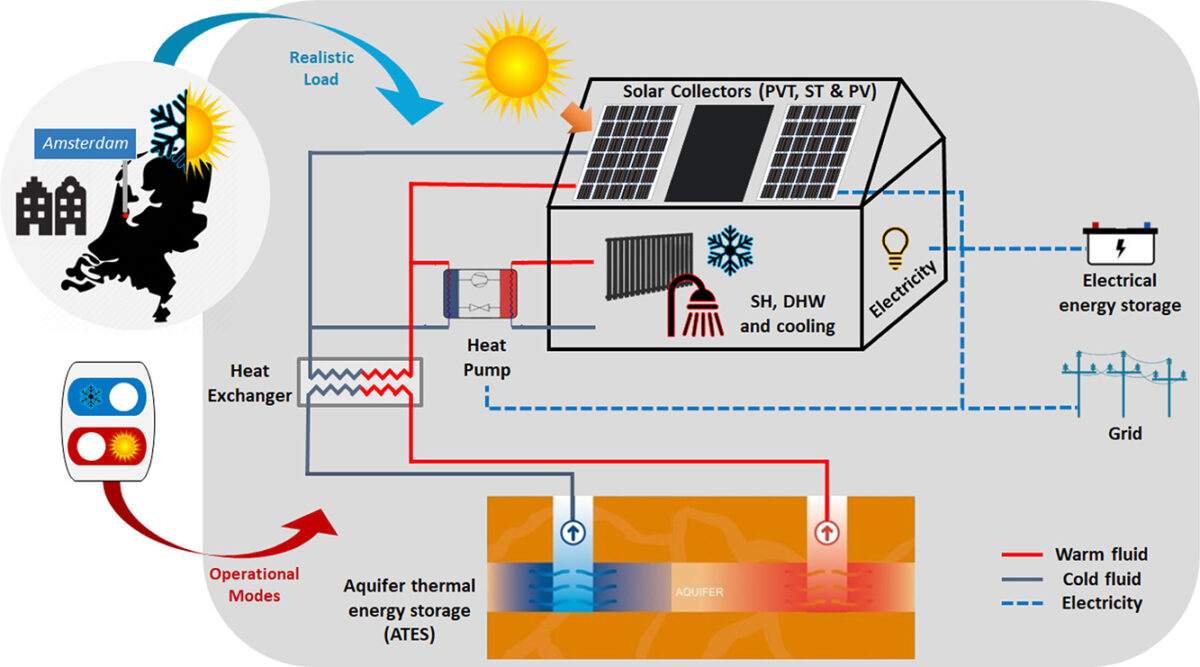
“In this study, a modeling method is presented for evaluating the performance of a hybrid system that integrates different types of solar collectors, namely PV, glazed flat plate Sun thermal (st) and ungayed photovoltaic-thermal (PVT) collectors said the group. “Furthermore, the system is integrated with a seasonal storage that an Aquifer Thermal Energy Storage (ATES) system, a heat exchanger and a heat pump (HP) is to ensure heating, including space heating (SH), domestic hot water (DHW), as well as cooling.”
The PV module uses crystalline silicon (C-SI) with an efficiency of around 20%. It has a simulated area of 2 square meters and it is oriented to the south with a tilt angle of 31 degrees. The ST and PVT panels also measure 2 square meters and are oriented on the south with a tilt angle of 31 degrees. The ATEs have one cold aquatic layer and one warm aquifered layer, and together with the HP it facilitates the exchange of thermal energy. The HP is simulated to work with R-134A (Tetrluorethane) coolant.
The system was simulated with MatLab software. The PV modules generated electricity for the power pump and the HP, while the thermal modules produced hot water for domestic use. The ATES system uses the underground thermal energy to offer both heating and cooling for buildings through a process of seasonal thermal energy storage and extraction.
In the proposed system configuration, the HP takes heat from a heat source with a low temperature, such as the output of solar collectors or the groundwater -carrying and transfers it to a higher temperature to deliver SH or DHW. In the cooling mode, the HP can turn the operation, which removes heat from the inner environment to achieve cooling.
“A heat exchanger facilitates the transmission of thermal energy between two liquids, making it possible to make efficient heating, cooling or heat protection. Circulation pumps circulate the liquids in the system, which guarantees continuous electricity by the collector and the efficient heat transfer is said by the collector and the heat transmission.
Image: Delft University of Technology, Solar Energy, CC by 4.0
The system has five operational modes that use its various components. In solar heating and underground storage mode (mode I), the SH and DHW are heated directly by the solar collectors, stored with excess heat in the water -bearing layer. The heat pump (HP) heating mode (mode II) integrates the output of solar collectors with an HP. Modus III, the HP storage mode, uses an HP in combination with ATEs for heating. Cool mode (mode IV) uses the HP to extract heat from the building, while cold water from the water -bearing layer provides effective cooling. In the DHW heating mode (modus V) ATEs and an HP work together to heat household water. Each mode is activated based on the time of day and season.
The five simulated Amsterdam buildings were randomly selected from a data set of residential buildings. Building B5 has a roof surface of 134 square meters, building B21 has 158 square meters and building B25 has 142 square meters.
Building O3 has a smaller roof surface of 69 square meters, while Building W96 has the largest roof area on 163 square meters. Building W96 has three floors, building B21 has five and the other three buildings each have four floors. A year of operation was simulated for every building.
“Unggestive PVT collectors reach a 7.7% higher electrical output than independent PV modules by reducing the cell temperature by providing heat extraction, at the same time supplying usable thermal energy,” the researchers said. “Glazed ST -Gatherers achieve about 70% higher thermal performance than unglazed PVT collectors due to better heat retention and lower losses. Given the Dutch climate, Glaceed ST consistently more than 50 ° C, while PVT collectors peak at 40 ° C.”
The analysis showed that solar collectors combined with heat pumps for space heating reach an average agent of five, while seasonal storage with heat pumps reached around seven, due to higher input temperatures. A PV/ST system with underfloor heating reaches an agent of 6.09, compared to five for radiator heating with PVT panels, due to lower temperature requirements.
The results also showed that Modus III meets the majority of the heating demand, while Modus I, although less contributes, plays a crucial role by storing heat in the warm water -bearing layer in the summer.
They presented their findings in “Performance -evaluation of solar heat -systems integrated with seasonal heat storage on various business modes for building applications: the case of the Netherlands“Which was recently published in Solar energy.
This content is protected by copyright and may not be reused. If you want to work with us and reuse part of our content, please contact: editors@pv-magazine.com.
Popular content