

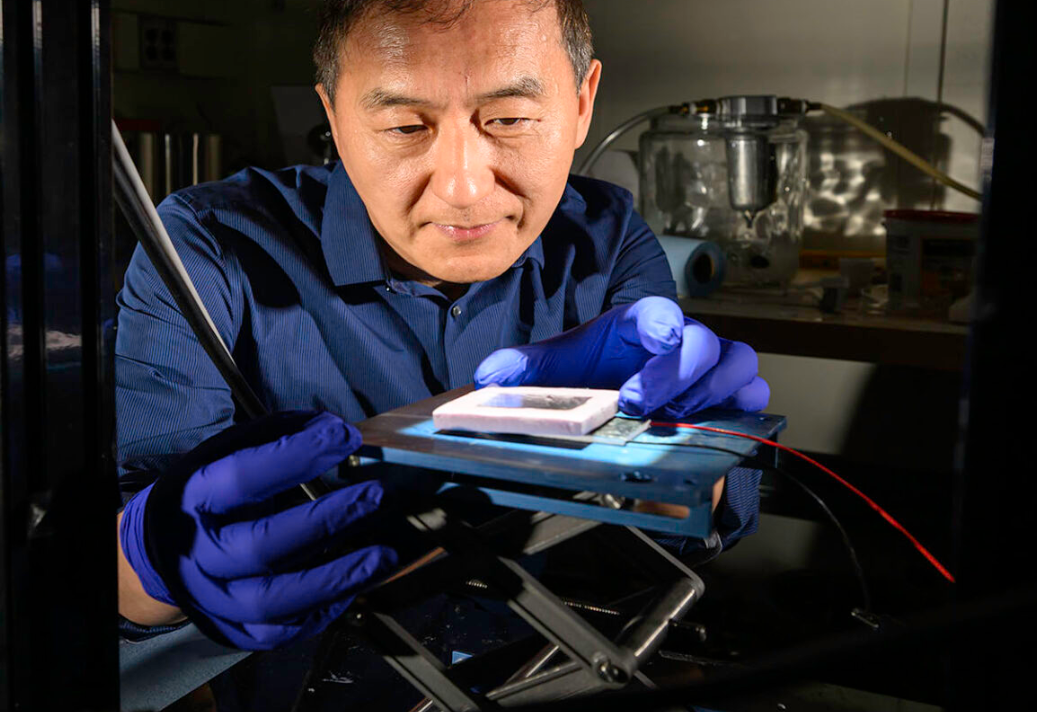
A research team has manufactured a thermoelectric generator (STEG) of a sun feed that is said to be 15 times more efficient than the current state-of-the-art devices by concentrating on managing the hot and cold sides of the device instead of its semiconductor materials.
Scientists from the University of Rochester in the United States have manufactured a thermoelectric generator of solar energy (STEG) that is said to be 15 times more efficient than the current state-of-the-art devices.
A Thermo -Electric Generator (TEN) can convert heat into electricity through the “Seebeck -Effect”, which occurs when a temperature difference between two different semiconductors produces a voltage difference between two substances. The devices are often used for industrial applications to convert excess heat into electricity. However, their high costs and limited performance have limited their acceptance to now on a wider scale.
“At present, most solar -thermo -electric generators are converting less than 1% sunlight in electricity, compared to about 20% for residential solar panel systems,” said the researchers, adding that for their commercial scale, light -weight -weight senior -absorbers (SSAs) and WarmtedissiPators are used.
The novelty of their approach consisted of concentrating on the hot and cold sides of the device instead of working on the semiconductor materials, such as in earlier research.
They designed the device with an internally developed special Black Metal technology that changes shiny metal pitch black. It uses femtosecond laser pulses to transform tungsten to absorb selective light with the sunbell wave lengths with reduced heat disipation with other wavelengths. It is said that it is able to increase the thermal electrical generation by 130% compared to untreated tungsten
“We have covered the Black Metal with a piece of plastic to make a mini -greenhouse, just like on a farm,” said the main authoro of the research, Chunlei Guo. “You can minimize the convection and conductivity to capture more heat, which increases the temperature on the hot side.”
With regard to the cold side, the scientists also used femtosecond laser pulses on aluminum to create a cooling body with small structures that improved the heat department through both radiation and convection.
“When applying both warm and cold thermal management, with the minimized hot-side radiation and convective heat losses and the improved cold silk radiation and convective cooling capacity, more solar energy is carried out and used by the Steg,” they emphasized them. “This results in a larger temperature over the STEG and therefore an output increase of more than 15 times while retaining the compactness of the device with only an increase of 25% in weight.”
The system was introduced in the study “15-fold increase in the performance of the thermoelectric generator of solar energy through femtosecond laser spectral engineering and thermal management“Published in Light: Science and applications.
“Stegs can find potential applications when feeding avionic devices, wireless sensor networks, portable electronics and medical sensors,” the academics concluded.
*The article was changed on August 14 to indicate that the University of Rochester is in the United States, and not in the United Kingdom, as we have reported earlier.
This content is protected by copyright and may not be reused. If you want to work with us and reuse part of our content, please contact: editors@pv-magazine.com.
