

The International Energy Agency (IEA) says capital costs for solar energy remain higher in Southeast Asian countries than in other emerging and developing economies.
Reducing capital costs is key to unlocking further solar energy investment in Southeast Asia, according to analysis from the IEA. The cost of capital represents the minimum return that equity investors and bondholders require to invest in a project, with a higher percentage indicating that an investor will demand a higher return due to actual and perceived risks, making projects more expensive to finance.
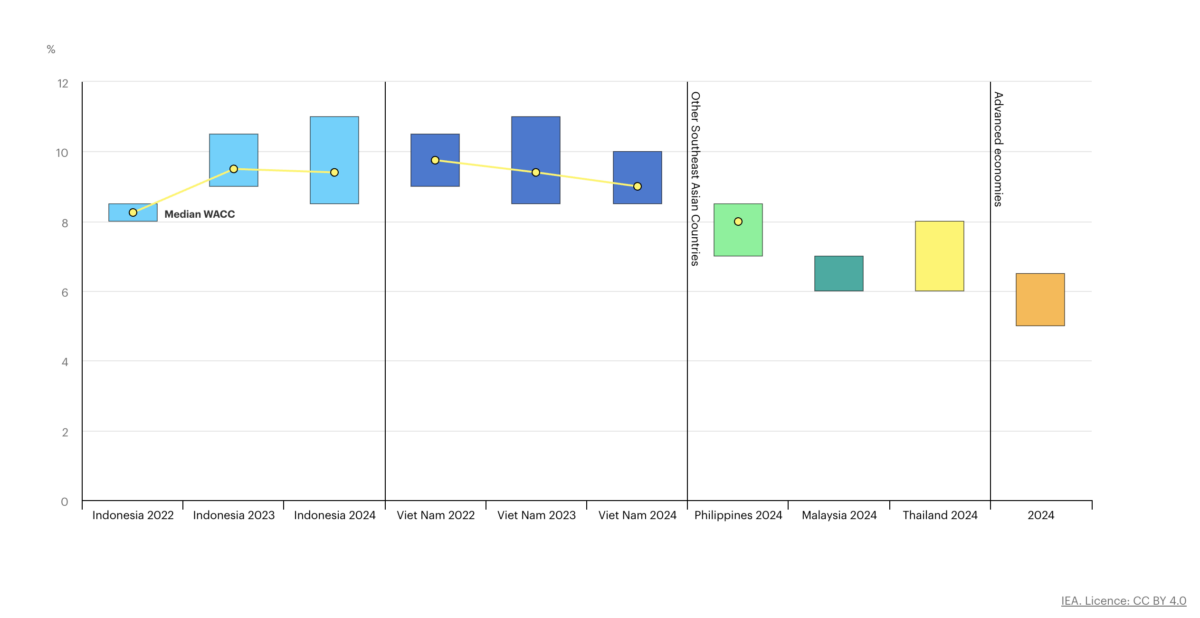
The latest update from the IEA Observatory on the cost of capital found that, based on survey responses, the median weighted average cost of capital (WACC) for solar in 2024 was 9.4% in Indonesia, 9% in Vietnam and 8% in the Philippines. The WACC is nominal, after taxes and adjusted to the local currency.
The agency also reported solar capital costs of between 6% and 8% in Thailand and between 6% and 7% in Malaysia. These figures compare with solar capital costs of between 5% and 6.5% in advanced economies, the agency’s analysis said.
The IEA said lowering capital costs and improving the flow of suitable projects are key to unlocking additional investment in Southeast Asia.
While the WACC for utility-scale solar in the Southeast Asian countries surveyed is comparable or even lower than that of other emerging and developing economies surveyed, the IEA said other countries, such as Brazil and India, are seeing investment volumes in utility-scale solar increase to levels these Southeast Asian countries are not.
This difference is caused by large and predictable solar auctions such as those in Brazil and India. The IEA’s analysis continues, leading the agency to conclude that it is important to increase the pipeline of projects available for financing in Southeast Asia.
The IEA also said it is important for policymakers in Southeast Asia to develop clear regulatory and financial frameworks, test corporate power purchase agreements and prioritize investments in transmission infrastructure to help reduce capital costs.
The recommendations follow a IEA report In September it was published that most Southeast Asian countries can integrate more solar and wind energy in the short term without requiring major changes to the energy system.
This content is copyrighted and may not be reused. If you would like to collaborate with us and reuse some of our content, please contact: editors@pv-magazine.com.
Popular content

