

In a new weekly update for pv magazineOPIS, a Dow Jones company, provides a brief overview of the major price trends in the global PV industry.
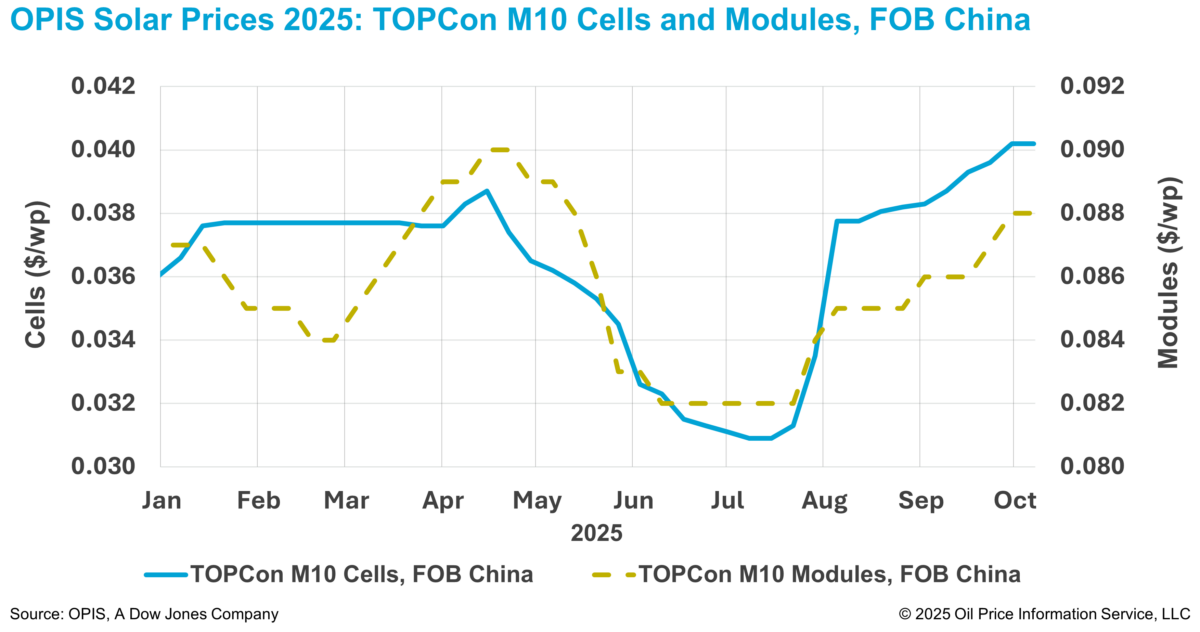
According to the OPIS Solar Weekly Report published on October 7, FOB China TOPCon M10 cell prices held steady this week at $0.0402/W, with price guidance between $0.0380-0.0426/W, interrupting a four-week rally as trading slowed during China’s Golden Week.
The recent rally has pushed TOPCon M10 cell prices up 29.3% since early July, although this still lags behind the increase in upstream wafer costs. According to data from OPIS, the prices of FOB China n-type M10 and G12 wafers increased by 46.3% and 36.7% respectively during the same period.
Whether these gains can be sustained further downstream will depend on end-user demand, market sources said. However, recent data points to a bearish outlook. According to the National Energy Administration, China added just 7.36 GW of new PV capacity in August – the lowest monthly total in 2025 and the fourth consecutive monthly decline.
Against this backdrop of weakening domestic demand, Chinese cell maker sources expect demand from India to rebound after the holiday season as Indian buyers are likely to ramp up their purchasing ahead of the expected imposition of anti-dumping duties on Chinese solar cell imports.
On September 29, India’s Directorate General of Trade Remedies announced its final findings on an anti-dumping investigation into Chinese imports of solar cells. The findings recommended company-specific levies of up to 30% for a period of three years, based on the value of costs, insurance and freight (CIF). The effective date has not yet been announced and will come into effect upon notification from the central government, although some sources expect implementation by the end of this year.
Of the sampled producers, Jinko Solar and Trina Solar will be subject to zero duties. Although these producers had positive injury margins for cell exports, their land prices for modules exceeded the non-injurious price threshold, resulting in an overall duty rate of 0%.
Aiko Solar Group, which only exported cells with positive injury margins, will be subject to duties of 23%. Non-sampled cooperative producers who submitted questionnaire responses are subject to duties of 23% based on the weighted average of sampled producers, while non-cooperative producers are subject to 30%.
Market participants noted that price signals remain unclear given the uncertain timing of the levy’s introduction and limited trading during Golden Week. However, sources expect a rise in prices in the near term once Indian buyers resume purchasing after the break.
Given the recommended tiered duty structure, buyer preferences may shift toward suppliers facing lower or zero duties, a Chinese market analyst noted. Meanwhile, some Indian manufacturers are trying to challenge the exemptions granted to Jinko and Trina, although sources noted that these companies mainly focus on exporting modules rather than cells.
Additionally, a downstream tier-1 Chinese manufacturer noted that domestic cell production in India remains more expensive, suggesting that Chinese imports could remain competitive even under anti-dumping duties. That said, the source also expects a partial diversification of sourcing into Southeast Asia.
Addressing industry concerns about potential supply constraints, DGTR’s final findings predict that India’s domestic cell capacity will reach 64.6 GW by June 2026, sufficient to meet annual demand of approximately 44 GW. However, industry sources were skeptical about this projection. With ALMM List-II currently containing only 17.9 GW by September 2025, achieving the target would require 46.7 GW of new capacity to be brought online and commissioned within nine months – a timeline described by some as unrealistic.
OPIS, a Dow Jones company, provides energy prices, news, data and analysis on gasoline, diesel, jet fuel, LPG/NGL, coal, metals and chemicals, as well as renewable fuels and environmentally friendly feedstocks. It acquired assets with pricing data from Singapore Solar Exchange in 2022 and now publishes the OPIS APAC Solar Weekly Report.
The views and opinions expressed in this article are those of the author and do not necessarily reflect those of the author pv magazine.
This content is copyrighted and may not be reused. If you would like to collaborate with us and reuse some of our content, please contact: editors@pv-magazine.com.
