

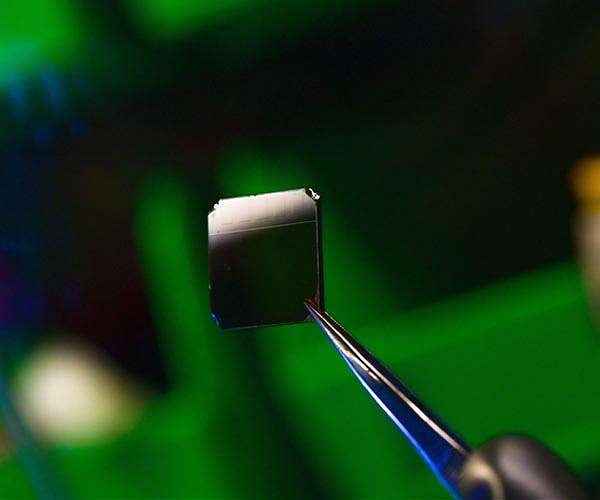
The University of Sydney team achieves a global record for large three-junction perovskite solar cells
A team led by the University of Sydney has achieved another global solar energy milestone by developing the largest and most efficient perovskite-perovskite-silicon tandem solar cell ever reported.
Led by Professor Anita Ho-Baillie, John Hooke Chair of Nanoscience at the University of Sydney’s Nano Institute and School of Physics, the project achieved a certified steady-state energy conversion efficiency of 23.3 percent for a 16 cm2 device, setting a world record for its class. A smaller 1 cm2 version achieved an efficiency of 27.06 percent while maintaining exceptional thermal stability.
The breakthrough, published in Nature Nanotechnology, marks the first time that a 1 cm2 triple-junction cell has passed the International Electrotechnical Commission’s Thermal Cycling test, enduring 200 cycles from -40 to 85 degrees Celsius and retaining 95 percent of its efficiency after 400 hours of illumination.
A three-junction solar cell stacks three semiconductors on top of each other to capture a larger portion of the solar spectrum. The Sydney team improved both the chemistry and design by replacing unstable methylammonium with rubidium, creating a more robust perovskite lattice. They also replaced lithium fluoride with piperazinium dichloride, which increased stability, and used nanoscale gold particles to improve charge transport and light absorption.
Professor Ho-Baillie said these refinements significantly improved performance and resilience: “We have improved both the performance and resilience of these solar cells. This not only demonstrates that large, stable perovskite devices are possible, but also shows the enormous potential for further efficiency gains.”
The research demonstrates scalable, durable perovskite devices suitable for real-world applications. Supported by the Australian Renewable Energy Agency and the Australian Research Council, the work involved collaborators from China, Germany and Slovenia.
“This is the largest three-junction perovskite device demonstrated to date and it has been extensively tested and certified by independent laboratories,” says Professor Ho-Baillie. “That gives us even more confidence that the technology can be scaled up for practical use.”
The publication coincides with Professor Ho-Baillie’s 2025 Eureka Prize for Sustainability Research, awarded for her pioneering work in perovskite solar technology. “Perovskites are already showing us that we can push efficiency beyond the limits of silicon alone,” she said. “This progress means we are moving closer to cheaper, more sustainable solar energy that will help achieve a low-carbon future.”
Research report:Tailoring nanoscale interfaces for perovskite-perovskite-silicon triple-junction solar cells
