

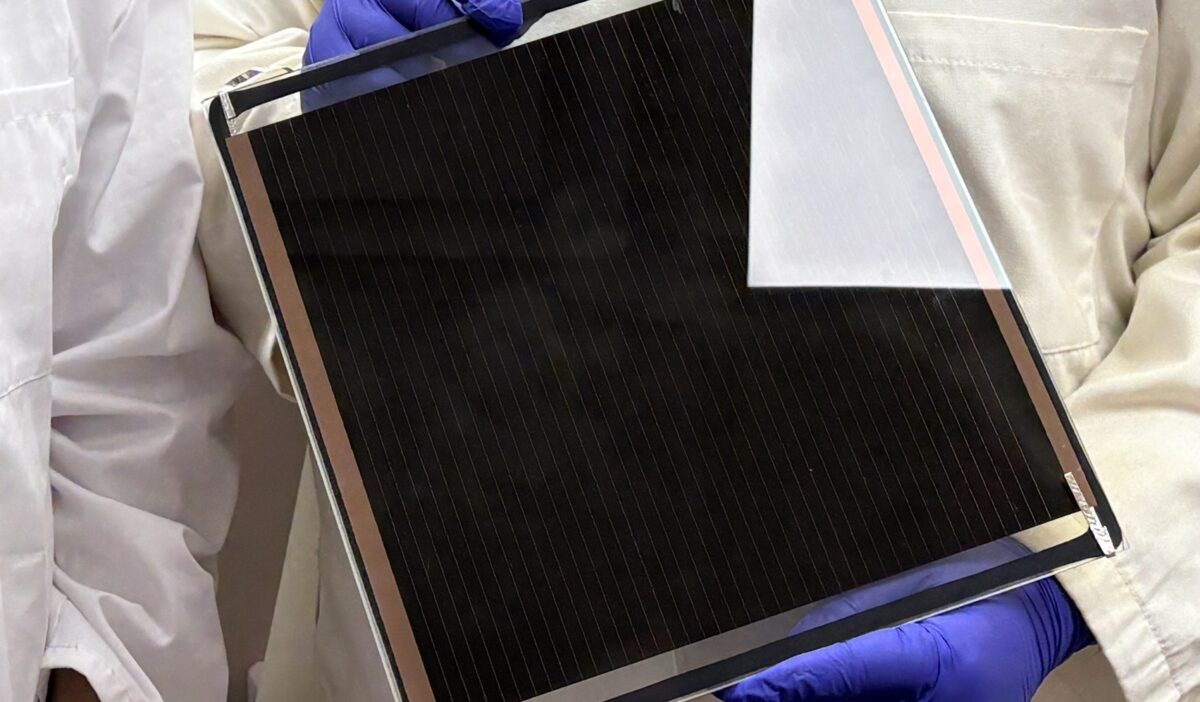
The US startup said the 30 x 30 cm perovskite solar cell device features tin oxide electron transport material produced in a sheet-to-sheet slot die coating process.
Sofab Inks, a US-based manufacturer of functionalized metal oxide materials, has announced that its novel tin oxide (SnO2) electron transport layer (ETL) material has been used in a 22.2% efficient 30 x 30 cm mini perovskite solar module made with industrially compatible processes.
The company’s Tinfab was applied as the ETL with a sheet-to-sheet slot die coating tool, according to Jack Manzella, COO of Sofab Inks, who noted that the perovskite production equipment partner was Alpha Precision Systems, a US-based unit of China-based Suzhou Precision Systems (SPS).
The use of Tinfab enables a fullerene-free design, which Manzella says has several advantages such as stability performance, manufacturability and cost.
The team used inverted cell architecture, also known as a ‘pin’ architecture, with solar cell illumination through the hole transport layer (HTL). “We used our Tinfab, a SnO₂ nanoparticle that is dispersible in orthogonal solvents,” said Manzella pv magazine. “What’s unique about this milestone is that we used a new architecture, adding atomic layer deposition SnO₂ on top of our Tinfab in a PIN architecture,” he added.
In the demonstration, the stack was deposited using Physical Vapor Deposition (PVD), Slot-Die Coating (SDC) and Atomic Layer Deposition (ALD) techniques. The electrode layer was fabricated by PVD, the buffer layer by ALD, the electron transport layer (ETL) and perovskite layer by SDC, and the hole transport layer (HTL) by PVD.
In other company news, Sofab Inks collaborated with the Italian Center for Hybrid and Organic Solar Energy (CHOSE) at Tor Vergata University to conduct stability tests of perovskite devices made with Tinfab. The 2,500 hours The results “exceeded expectations,” Manzella said details will be presented this month at the Perovskite Connect industry conference in Berlin.
The scale-up to 30cm x 30cm comes just a few months after the company reported a 20.4% efficient triple cation solar cell device made with this material, as reported by pv magazine.
The Sofab Inks team is currently working with customers based in AustraliaChina and the United States, as the country transitions to pilot production and in-house R&D. “In the coming months, we aim to achieve comparable efficiencies with 60 x 60 cm modules and begin accelerated stability testing. In the medium term, we will continue to optimize our ink formulations to improve performance and scalability,” said Manzella.
Sofab Inks is a spin-off from the University of Louisville. Founded in 2022, it specializes in functionalized metal oxides, mainly tin oxide and nickel oxide, for high-volume production.
This content is copyrighted and may not be reused. If you would like to collaborate with us and reuse some of our content, please contact: editors@pv-magazine.com.
