

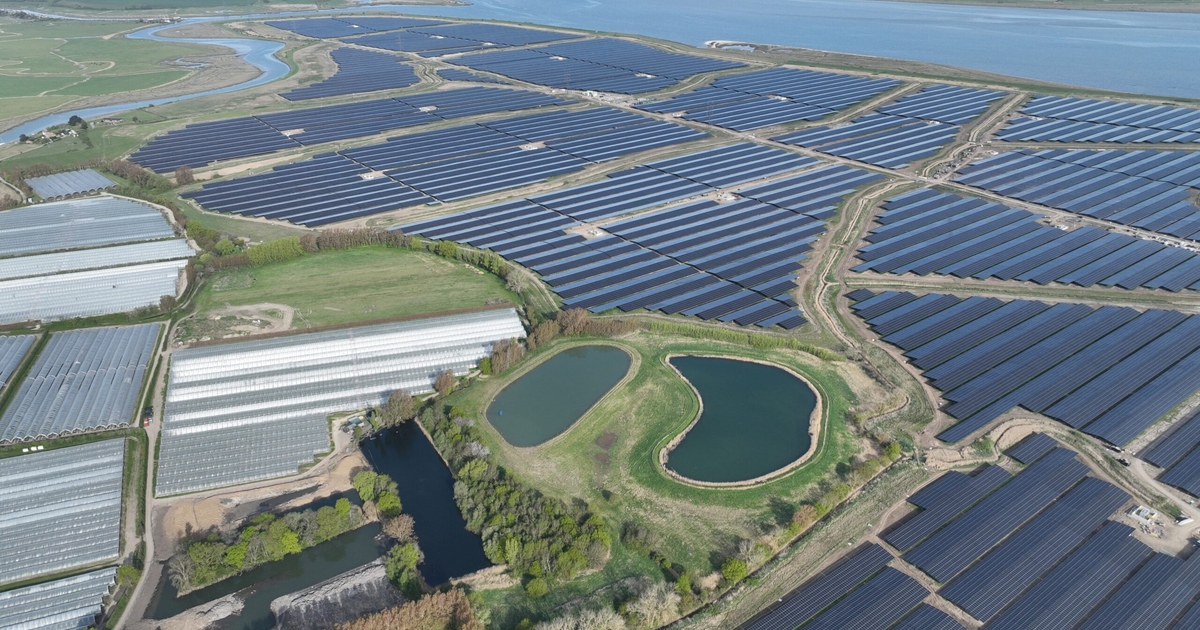
Solar energy analyst Josh Cornes, from Solar Media Market Research, discusses what the delayed grid connection timeline means for the UK’s transmission-scale solar development pipeline.
The National Energy System Operator (NESO) gave transmission-scale developers a hammer blow when it announced that only 11 GW had been allocated to transmission projects before 2030, and another 6 GW between 2030 and 2035.
Transmission developers have taken enormous risks and spent millions over the past five years to secure grid connection offers for solar projects; some collected more than 20 GW of connection offers, which will now only be fulfilled after 2035.
According to the Transmission Entry Capacity (TEC) register, there are more than 220 GW of transmission-scale solar projects awaiting grid connection. The problem here is the combination of megawatts per technology that is described in the ‘installation type’ column.
For example, a project might be listed as an “Energy Storage System; PV array (photovoltaic/solar),” but the developer may only plan to build the energy storage element. It would still be counted towards the amount of solar energy in the TEC register.
Taking this into account, according to Solar Media’s market research, a more realistic value for the solar transmission grid queue is ~140GW – still an astronomical number that raises many questions for these developers about what their next steps are.
Developers were originally expected to find out when their listed projects would now connect to the grid under Gate 2, but the bidding deadline was recently pushed back, meaning they’ll have to sit on their hands for another two months.
Longfield Solar Farm is a perfect example of the time it takes to go from approval to construction, with more than 20 conditions met in the last 12 months, more than three years since the project was approved by government. Construction time also plays a role: Cleve Hill began construction in early 2023 and was not completed until early 2025, two years later.
If developers follow these timelines and wait until the announcement date for their network offerings, those who receive pre-2029 connections simply won’t have enough time to go through the prerequisites process and construction to meet the commercial operation date (COD) that NESO assigns them.
According to NESO timelines, “Offers for protected transmission-connected projects of Gate 2 (with date 26/27) will be released by the end of January 2026” and “Gate 2 end-customer offers covering applications through 2030 (transmission) will be released by the end of Q2 2026.”
The glaring problem here is that of over 7.5 GW of transmission projects approved by their respective governments, only a third of these have “protected status”. This implies that the remaining ~5GW may have to wait until Q2 2026 to find out if they have a date before 2030, assuming they all get Gate 2 offers.
Figure 1 shows the current transmission queue, broken down by status, comparing the targets originally set by NESO, as well as a further estimated amount that could be accrued as a result of the combination of distribution and transmission grid connections after 2030.
Figure 1: UK transmission capacity broken down by status, with an overview of NESO’s CP30 targets. An overview of oversubscription compared to their original target of 17 GW by 2035.
The announcement that after 2030 capacity allocations will no longer be split between transmission and distribution projects was a huge relief for developers with large portfolios of early-stage transmission projects (and the opposite for distribution developers).
The target for 2030 is 36 GW of solar energy at the distribution level and 11 GW of transmission. After that, instead of 16 GW for distribution and 6 GW for transmission between 2030-2035, there is 22 GW up for grabs, meaning there is potential to connect up to 33 GW of transmission-scale solar PV between now and 2035.
However, with approximately 140 GW in the queue, and 31 GW at consultation or further advanced, there is almost 100 GW without online track and potentially without land, a key indicator of the ‘readiness’ metric in the new interconnection process.
I understand there are developers waiting for their grid offers before moving forward as quickly as possible, but with 31 GW currently queued for them and a realistic value of ~23-25 GW to be built out by 2035, time is running out.
The first signs that developers are taking a hit are creeping in. Projects have fallen off the TEC register, implying that the developer has shut down that specific project. Most telling is the withdrawal of White Elm Solar Farm (Elmya Energy) and Tween Bridge Solar Farm (RWE) from the Planning Inspectorate, while Tween Bridge was withdrawn just weeks after submission.
Developers are making tough decisions to place their resources in the right areas and some see transfer as too much of a risk, thinking there simply isn’t enough room to build their projects in the timeline they would like.
Well-founded assumptions and informed decision-making are now crucial. As the timeline of tenders is pushed back by months, there will be a huge knock-on effect on construction, with tenders being halted, and a huge rush in 2026.
Dozens of gigawatts will go away without being submitted to NESO for inspection because developers don’t see transmission as a valuable business prospect. More people will follow suit due to the disappointing news about the Gate 1 offers, while the only real winners will be the minimum number of developers who receive their Gate 2 offer. Their next challenge will be actually building these projects within the required timelines, with two infamous projects already postponed from an expected COD of 2027 to completion in 2029.
If you would like to access the data to make informed decisions about where your project is queued and to help understand where to allocate your resources, please contact [email protected].
