

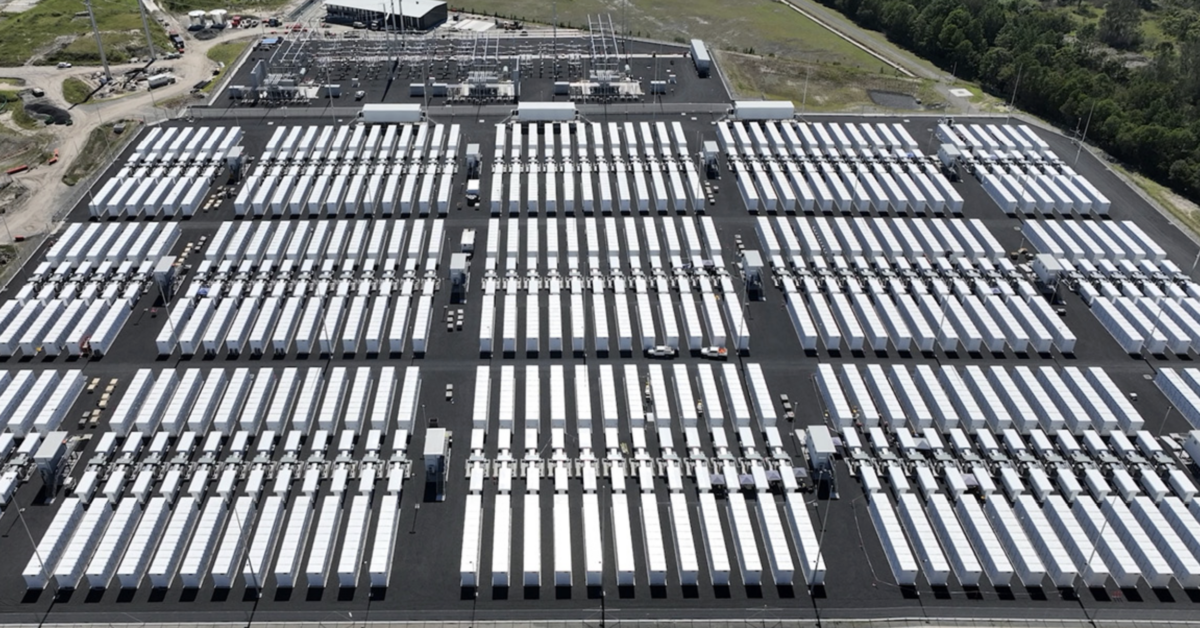
Australia is now the world’s third largest market by capacity for large-scale battery energy storage, with 14 GW/37 GWh of battery energy storage capacity at or near financial close, reflecting expected capacity over the next two years. The pipeline of battery projects increased by 45 GW in twelve months, from 109 GW in August 2024 to 154 GW a year later.
Australia is also the first country to exceed 1 GWh of utility battery capacity per million inhabitants, putting it in a league of its own, far ahead of China and the United States, which each have less than 400 MWh per 1 million inhabitants.
These figures are reported in the “August 2025 Utility Battery Market Review – Australia” from the independent research company Rystad Energy.
Rystad Australia Renewables Research Senior Analyst David Dixon shared this pv magazine Utility Battery Energy Storage Systems (BESS) are a major renewable energy success story in Australia, but in reality it shouldn’t be the third largest market in the world.
“We are simply not big enough, and we won’t be in the longer term, but for now this newly achieved status underlines the investment case and success we are having here in the Australian market,” said Dixon. “We have record levels of energy batteries being built, but that means we will also have record levels of energy supply and commissioning, and that has to compete for resources – with the solar energy, the wind energy and the few gas plants that are going through this process.”
Due to pressure on resources and in the wider context of engineering, procurement and construction (EPC) services, labor costs will increase in the future.
“For context, all renewable energy projects have seen these types of development costs increase by 50% to 80% over the last 12 to 24 months, so competition for raw materials will be fierce. The same goes for grid connections,” said Dixon.
Connection Scorecard
According to the Australian Energy Market Operator (AEMO) “August 2025 Electricity Statement of Opportunities (ESOO)” report, the country’s operational electricity consumption will increase by 28% over the next decade.
That consumption was about 178 TWh in the 2024-25 financial year and is expected to reach 229 TWh in 2034-35. The current increase in the number of grid-scale batteries reaching full capacity is documented in AEMO’s National Electricity Market Connections Scorecard for the quarter ending June 2025. During that period, 10 new storage projects were approved for a total of 2.4 GW, six were registered for a total of 866 MW, and three entered full operation for a total of 485 MW.
Daniel Westerman, CEO of AEMO, said that given the large volume of fossil fuel generation set to retire over the next decade, the timely delivery of new storage, generation and transmission, along with consumer energy sources to support reliability, remains critical.
“The investment pipeline for the next decade looks healthy,” he said.
Super battery
Investments in new storage capacity by 2030 are expected to exceed AUD21 billion ($14 billion), supported by the Australian Government’s Capacity Investment Scheme (CIS). This will be led by local utilities and a small number of international developers who dominate Australian BESS investment and ownership. Companies operating in this space include clean energy developer Neoen, which powered its 270MW/540MWh Western Downs BESS Stage 2 project six weeks ahead of schedule in September 2025.
Then there’s Australian large-scale battery developer Akaysha Energy, which has a 4 GWh BESS portfolio under construction in Australia and a further 13 GWh in its development pipeline, including the $1 billion (USD 650 million) 850 MW/1.6 GWh Waratah Super Battery (WSB).
Akaysha Energy CEO Nick Carter shared this pv magazine While the size and capacity of the BESS provide significant benefits, they also pose challenges.
“It is the largest, fastest and most flexible generation asset/battery in the world, and it was built in record time,” Carter said. “But as it is the largest generator and connection point in the National Electricity Market (NEM), testing, injecting and extracting so much power (850 MW) has never been done before in any network in the world, that is the main challenge.”
WSB’s 3,598 containerized lithium iron phosphate (LFP) batteries, built, managed and operated by Akaysha for state-owned EnergyCo of New South Wales (NSW), will be deployed 100km north of Sydney at the site of the decommissioned Munmorah coal-fired power station on the state’s central coast.
Together with its supply partners, South Australia-based engineers Consolidated Power Projects (CPP), NSW transmission network service provider (TNSP) Transgrid, US BESS company Powin and Spanish electronics company Eks Energy, Akaysha completed the first phase (350 MW / 700 MWh) of energization and registration in the NEM in August 2025.
When fully operational, WSB will provide a guaranteed continuous active power of at least 700 MW and a usable energy storage capacity of at least 1.4 GWh. For one hour, the capacity is sufficient to supply 970,000 households with electricity, or for a full day 80,000 households, based on a consumption of 21 kWh per day. The facility features 288 large inverters from Hitachi, 144 medium-voltage transformers from Melbourne-based Wilsons Transformers and 3,598 Chinese-made battery units – 70% from Rept Battero and 30% from EVE Energy.
Waratah’s testing and commissioning process began in early September 2025, propelling the facility towards commercialization and readiness to deliver a System Integration Protection Scheme (SIPS) to the NSW electrical network, keeping the lights on in Sydney and the nearby cities of Newcastle and Wollongong.
System integration
The Waratah Super Battery is a shock absorber that can respond in milliseconds to changes caused by lightning strikes, wildfires or other major disturbances to the NEM, and the SIPS is integral to providing guaranteed, continuous active power capacity.
The SIPS network services contract requires 700MW of Waratah’s battery capacity to be available at certain times of the day. TransGrid will send a signal to the BESS when it needs WSB to support the network.
“Battery will increase and connected generation will decrease, protecting the transmission network,” Carter said.
The paired generation includes hydro, solar or wind generators in the New England and Snowy regions of NSW, which can be curtailed to balance supply across the electricity grid.
“It is the fastest, cheapest and most economical method to expand electric grids and transmission systems,” Carter said. “In Australia and other markets, we simply cannot build sufficient transmission fast enough – or at all – to leverage the buildout of renewable energy sources – wind and solar – to reduce consumer costs and enable an orderly exit from coal and other thermal generation.”
The SIPS network includes 19 locations installed by Transgrid around NSW and monitors 36 transmission lines for faults, while the project control system detects potential line overloads and signals the WSB to charge and discharge across the network as necessary.
Carter added that network stability and security of network services have previously been contracted in Australia and other global markets such as Germany, Japan and the United States. Akaysha is poised to develop BESS projects in those markets after successfully closing a AUD300 million ($200 million) corporate debt facility in September 2025, the first base loan structure of its kind in the Australian renewable energy sector.
“Other examples of SIPS in Australia include the Hornsdale Power Reserve in South Australia and the Victoria Big Battery (VBB), both of which have network services contracts and have common elements with the SIPS contract,” Carter said.
Future question
New BESS capacity is needed in Australia over the next decade to help the NEM make up for the gaps left by the closure of 11 GW of mainly coal-fired power stations, including in New South Wales the 2.8 GW Eraring, in Victoria the 1.4 GW Yallourn and in Queensland the 700 MW Callide B.
AEMO predicts that at least 49 GW of energy storage capacity, in terms of energy yields, will be needed by 2050 to meet net zero targets. This includes grid-scale battery storage, pumped hydro and virtual power plant (VPP) capacity.
With the rise of artificial intelligence data centers and cloud services, of which Australia currently has around 200, it is difficult to set a capacity target to meet the new demand.
“It’s a question everyone asks, and there’s no clear answer,” Dixon said. “It’s also worth noting that the ISP assumes that a large portion of future energy storage needs will be behind the meter, which we disagree with. Because the benefits you get from the different revenue streams and large batteries are the opposite of the rooftop story, where residential batteries are typically twice as expensive as utility batteries, so we see a preference for utility batteries on that front.”
This content is copyrighted and may not be reused. If you would like to collaborate with us and reuse some of our content, please contact: editors@pv-magazine.com.
