

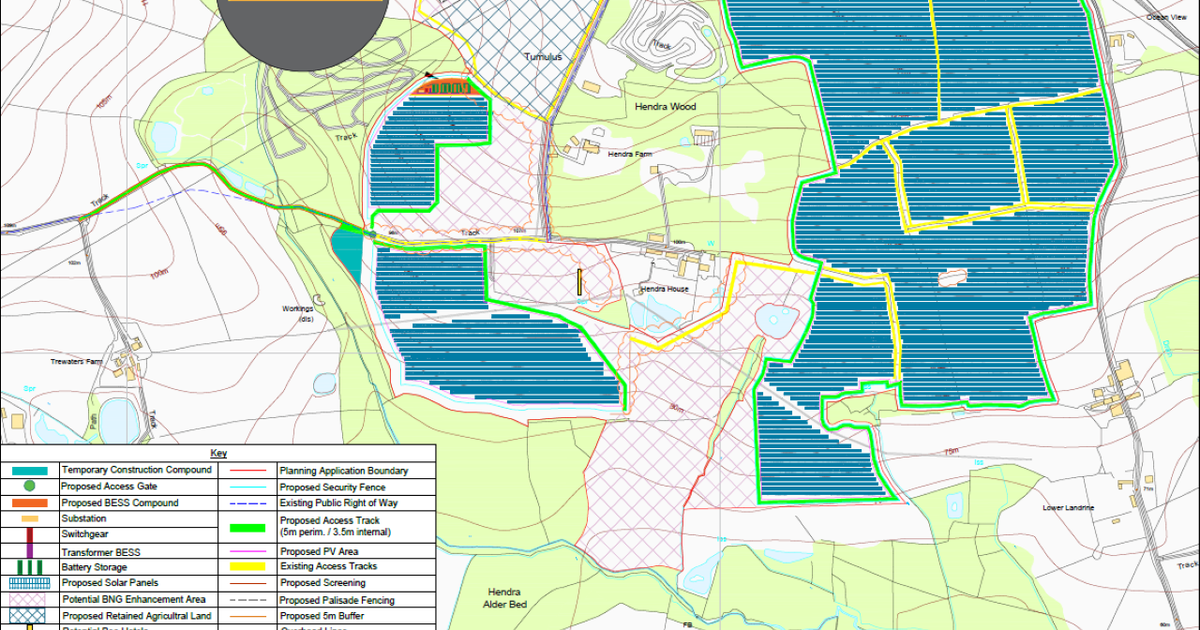
Downing Renewable Developments (DRD) has been given permission for a 49.9MW solar power plant in Cornwall after appealing against the council’s initial refusal.
The Fair Park solar power station, with associated battery storage, will be built near Carland Cross in Cornwall. DRD, an investment manager who set up Downing LLP to build renewable energy sources on land in Britain, said the site’s 30-year operational period will allow sheep grazing and deliver a net biodiversity gain of 148%.
When construction begins, a one-off community payment of £1,000/MW will be given to each local parish council to support local community projects, and DRD will also provide free rooftop solar installations for local residents.
It is a controversial project, which was initially rejected by the city council in November 2024. The decision document stated that “due to their man-made appearance and regular arrangement over a significant part of the landscape” the PV installation – covering a total of 200 hectares of land – would damage the character of the local landscape “particularly when viewed from nearby roads and public rights of way”.
The document stated that this is “notwithstanding DRD’s proposed mitigation and enhancement measures, including new hedgerows, wildflower meadows and habitat improvements, which the developer believes exceed statutory planning requirements.
Planning officers warned Cornwall Council that its refusal was likely to lead to a costly appeal process; In May this year, DRD submitted an appeal to the Planning Inspectorate (PINS).
A update of the National Planning Policy Framework (NPPF) The plan, implemented by the government in December, stipulates that planning authorities must give “significant weight to the benefits associated with renewable and low-carbon energy generation and the proposal’s contribution to a net zero future” when assessing applications.
The designated inspector, Rosalyn Kirby, said in her decision to approve the site that she was “satisfied that there would be wider public benefits from the scheme of sufficient magnitude to outweigh the less than substantial damage that would be caused”, and that “the damage that would be caused to the character and appearance of the area and the conflict with the development plan does not outweigh the benefits of the proposal”.
This reflects the decision made by the inspector in an appeal by BOOM Power for its (now approved) 49.9 MW solar power station in Yorkshire.
As Solar Media Market Research analyst Josh Cornes noted in a recent articlerefusal rates at local planning authority level are increasing annually, with 50 projects, for a total of 2.4 GWp, in the appeal process from September 2025.
