

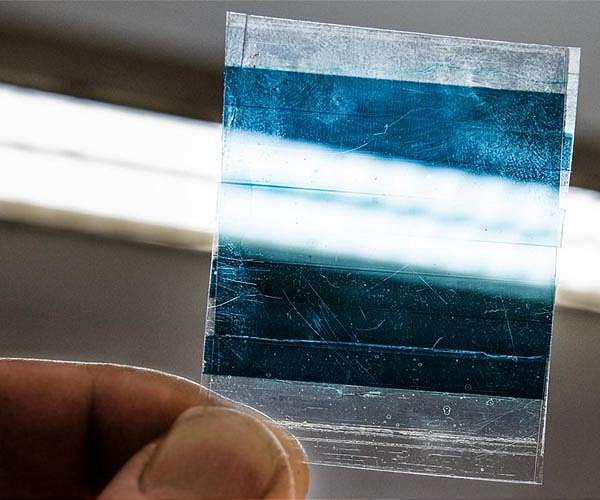
Advances in semi-transparent solar cell technology drive future energy solutions for buildings
Researchers at Hong Kong Polytechnic University have succeeded in setting a new benchmark for semi-transparent organic photovoltaic (ST-OPV) technology, an innovation that enables the integration of solar cells into windows, screens and other surfaces for urban environments. ST-OPVs address the crucial challenge of balancing transparency with high energy conversion efficiency, combining attractive visual design with effective energy generation for smart building integration.
A major achievement of the PolyU team was the development of the dimensionless parameter FoMLUE, which screens photoactive materials by combining visual transmittance, band gap and current density, enabling a deeper understanding of material properties through normalized absorption analysis. Led by Prof. LI Gang and research colleague Dr. YU Jiangsheng, the team demonstrated that ST-OPVs using ternary materials with the highest FoMLUE achieved superior thermal insulation and operational stability, with a new record light-use efficiency of 6.05 percent, the highest reported figure for any semi-transparent solar cell.
The study further evaluated geographic influences on system performance, developing a transient model to simulate the power of an ST-OPV window. Applied in 371 Chinese cities, the results indicated annual tax reductions in more than 90 percent of locations. Regions with hot summers and warm winters showed the greatest suitability, with annual total energy savings reaching 1.43 GJ per square meter. This approach suggests that ST-OPV glazing can improve the energy efficiency of buildings without compromising aesthetic appeal.
Prof. Li stated, “As an emerging solar photovoltaic technology, solar windows offer new opportunities for practical deployment in BIPV, renewable energy vehicles and agricultural greenhouses. Our findings highlight the multifunctionality and geographical adaptability of high-performance ST-OPVs in the construction of sustainable and energy-saving smart windows without compromising the integrity of the architectural design, demonstrating their promising commercial prospects.”
The PolyU team plans to further strengthen ST-OPV’s sustainability and scale up production of larger solar panels to advance commercial deployment.
Research report:Semi-transparent organic solar photovoltaics with wide geographical adaptability as sustainable smart windows
