

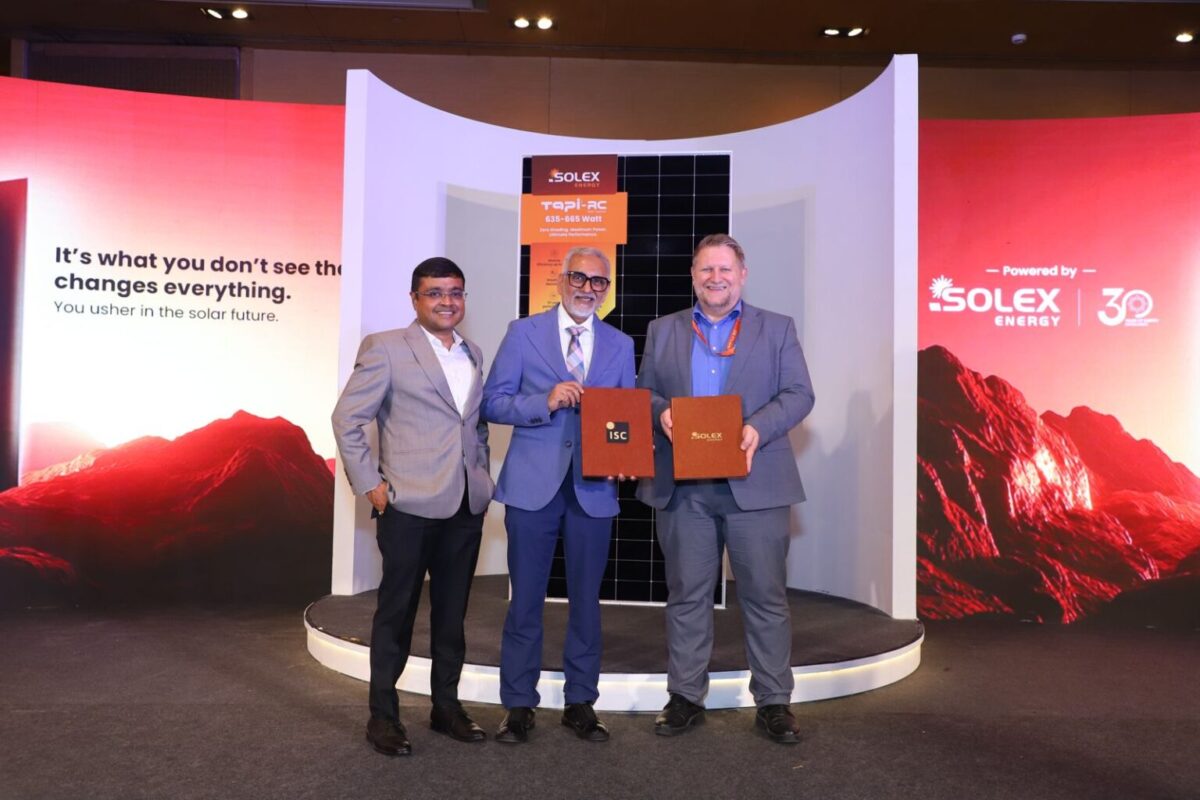
Solex Energy Ltd has signed a Memorandum of Understanding with Germany’s ISC Konstanz to collaborate on R&D and technological advancements in the production of high-efficiency solar cells.
Under this strategic partnership, ISC Konstanz will provide comprehensive technology support to Solex to upgrade its upcoming TOPCon cell line and adopt back-contact and perovskite-silicon tandem technologies. The alliance will also facilitate the setup of Solex’s dedicated in-house R&D line, supported by ISC Konstanz’s patent portfolio, to drive continued innovation and high-efficiency solar energy production in India.
“This partnership marks a decisive chapter in Solex’s journey towards technological excellence and global leadership,” said Chetan Shah, Chairman and Managing Director of Solex Energy Ltd. “Under our Vision 2030, we want to transform India into a hub of solar innovation with a targeted valuation of INR 1 lakh crore, $1.5 billion in planned investments and a 25,000-strong skilled workforce that will drive that vision forward.”
“Since 2005, ISC Konstanz has been working to steadily increase photovoltaic efficiency while reducing costs,” says Radovan Kopeček, Head of Strategy and Education at ISC Konstanz. Our mission is to produce research results that benefit both industry and society. We set global standards, share expertise worldwide and remain driven by one goal: making clean solar energy accessible and affordable for everyone. Our collaboration with Solex Energy brings us closer to that vision and a successful global energy transition.”
The concept launch of the new solar module with rear contact from Solex also took place during the event. Powered by n-type rear contact technology, the TAPI Rear Contact module delivers up to 24.6% efficiency and 665W output power, with no front shading and excellent temperature performance. Commercial production is expected to begin in fiscal year 27.
Solex Energy, headquartered in Surat, currently operates 4 GW of PV module manufacturing capacity. Under the Vision 2030 roadmap, the company aims to achieve a manufacturing capacity of 10 GW of solar modules and 10 GW of solar cells, setting new benchmarks for the Indian solar industry.
This content is copyrighted and may not be reused. If you would like to collaborate with us and reuse some of our content, please contact: editors@pv-magazine.com.
Popular content

