

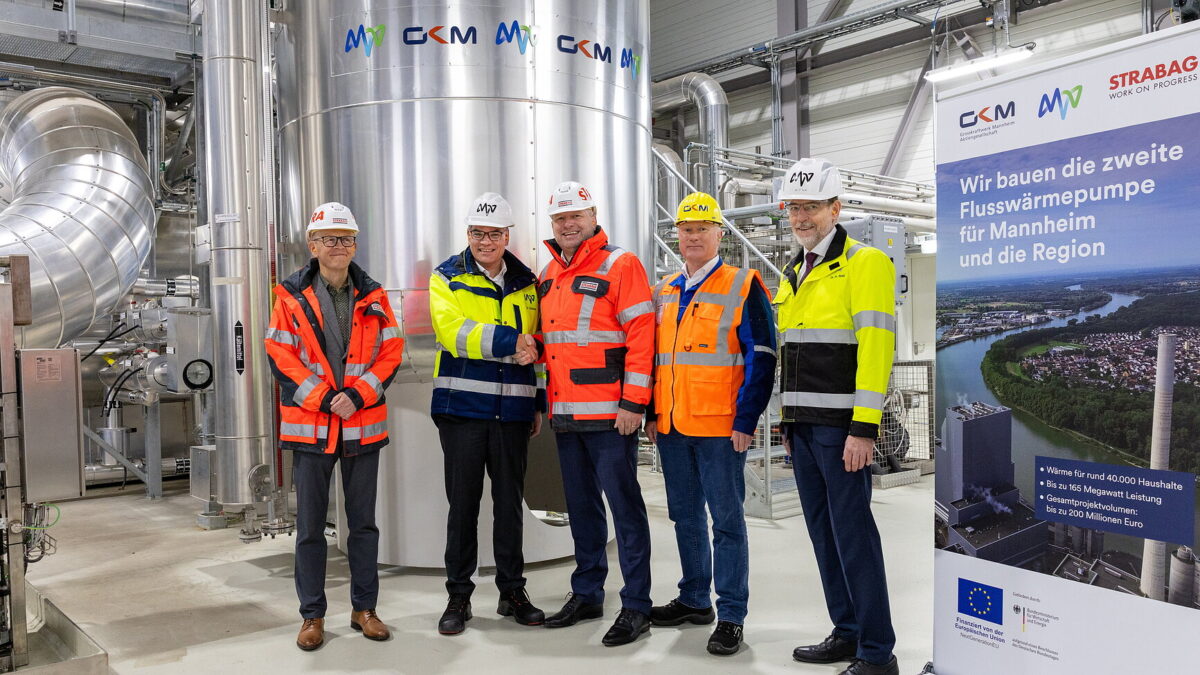
In the photo from left to right: Thomas Büchner, Managing Director of STRABAG Umwelttechnik GmbH; Dr. Gabriël Clemens, CEO of MVV; Christian Sadleder, Member of the Board of Directors of STRABAG AG Austria, Head of Energy Infrastructure; Thomas Hörtinger, CTO of GKM; Dr. Hansjörg Roll, CTO of MVV.
Image: Strabag
German utility MVV Energie AG and Strabag Umwelttechnik GmbH plan to build a 162 MW industrial heat pump at the Grosskraftwerk Mannheim facility, a 2.1 GW coal-fired power plant in Mannheim, in Germany’s southern state of Baden-Württemberg.
Once completed, the heat pump will be the largest system of its kind in the world.
The €200 million ($231.4 million) project is funded by the German Federal Financing Program for Efficient Heating Networks (BEW).
“The large-scale heat pump will consist of two separate modules, each with a capacity of 82.5 MW,” Strabag said in a statement. “They will use Rhine water as a heat source and generate district heat with temperatures up to 130 C using the natural refrigerant isobutane. Construction work is expected to start in mid-2026.”
The system is expected to begin commercial operations in winter 2028.
MVV Energie AG has already built a 20 MW river heat pump at the same location in 2023.
MVV Energy said that the water of the Rhine in Mannheim can reach up to 25 degrees Celsius in summer and only around 5 degrees Celsius in winter. This thermal energy is sufficient to evaporate the refrigerant in the heat pump and reduce the temperature of the Rhine water by approximately 2 to 5 degrees Celsius.
The refrigerant vapor is then compressed using an electrically driven compressor to increase the pressure and temperature. The heat generated by the refrigerant vapor is transferred to the district heating water via condensation in a heat exchanger, producing hot water with temperatures ranging from 83 C to 99 C.
The refrigerant becomes liquid and expands again in the heat exchanger. It then cools and absorbs thermal energy from the low-temperature river water to start a new cycle.
This content is copyrighted and may not be reused. If you would like to collaborate with us and reuse some of our content, please contact: editors@pv-magazine.com.
Popular content

