

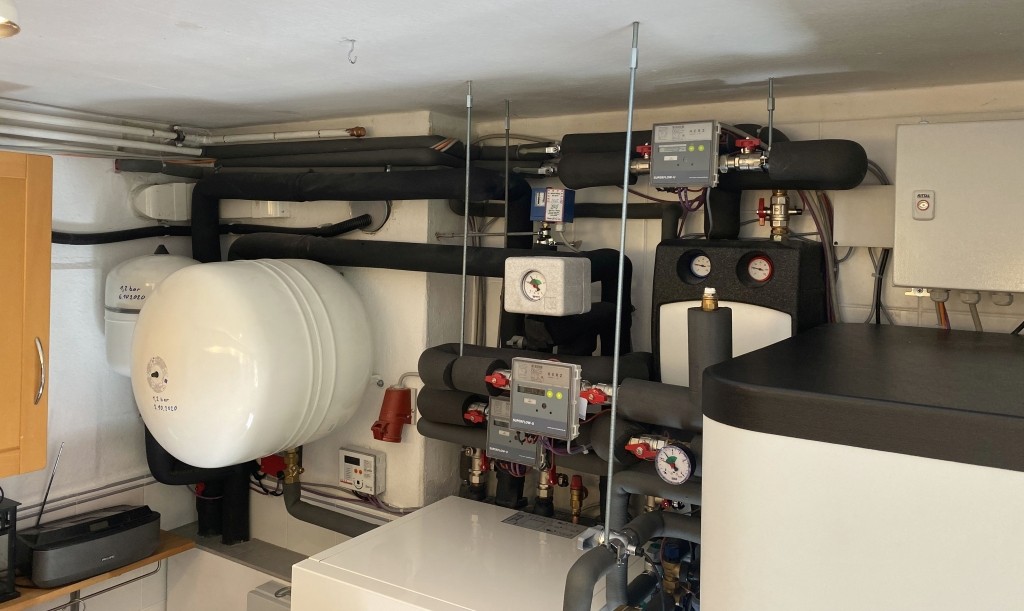
Researchers from Fraunhofer ISE tested different types of heat pumps in existing buildings across Germany for four years, finding that the systems achieved seasonal performance factors between 2.6 and 5.4. The team also showed that PV-powered heat pumps can increase self-consumption, especially when combined with battery storage.
Germany’s Fraunhofer Institute for Solar Energy Systems (Fraunhofer ISE) this week presented the results of a four-year study into the performance of various heat pump systems installed in existing residential buildings across the country.
In total, the institute’s researchers analyzed 77 commercially available heat pumps operating in one- to three-family homes, some dating back to 1826 and others completed in 2001. The buildings represented a mix of fully renovated properties and others still in need of energy efficiency upgrades.
“The results clearly show that heat pumps can be used efficiently even in older buildings and that they provide climate-friendly heating without the need to renovate the buildings according to new construction standards,” says Danny Günther, team leader for ‘Heat pumps and transformation of existing buildings’ at Fraunhofer ISE. “However, we have also uncovered optimization potential.”
The measurements were carried out through a minute-by-minute recording of compressors, controls and heating rods, as well as the hydraulic circuits of the heat source and heat utilization system, energies, performances, flow rates and temperature.
The analysis found that the 77 heat pumps outperformed those examined in a previous Fraunhofer ISE study, completed in 2019. In the latest tests, air-to-water heat pumps achieved an average seasonal performance factor (ASPF) of 3.4, compared to 3.1 in the earlier project.
Groundwater heat pumps delivered the highest efficiency, with an average ASPF of 4.3 and values ranging from 3.6 to 5.4. The researchers also found no connection between the age of the buildings and the performance of the heat pumps.
The team also found that heat pumps, when used in conjunction with residential PV systems, can provide significant savings for homeowners.
“The results of the analysis of six heat pump-PV combinations show that buildings equipped with PV systems without battery storage achieve an energy autonomy of 25% to 40% and self-consumption of 22% to 37%,” the researchers explain. “When a battery is added, these figures increase significantly – to 32% to 62% for autonomy and 40% to 83% for self-consumption.”
The tests also showed that many of the heat pumps were oversized in relation to the actual heating demand of the households and that some units exhibited “excessively high” switching frequencies.
Major heat pump manufacturers such as Daikin, Viessmann, Panasonic and Vaillant participated in the project.
This content is copyrighted and may not be reused. If you would like to collaborate with us and reuse some of our content, please contact: editors@pv-magazine.com.
