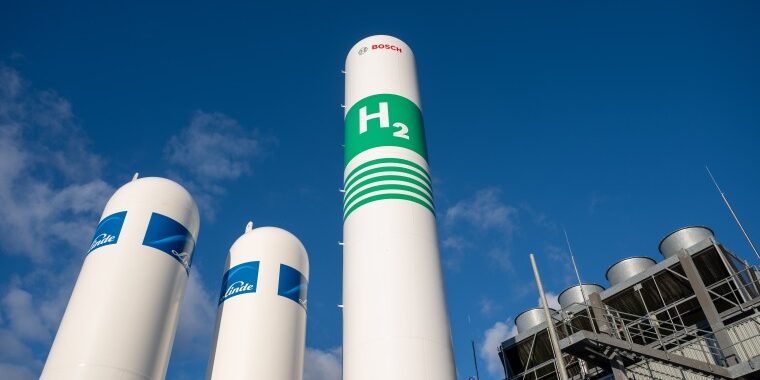
The green hydrogen is stored in the 21 meter high tank under a pressure of up to 50 bar
Image: Bosch
German manufacturer Bosch has put its first self-operating hydrogen electrolyzer, consisting of two proton exchange membrane (PEM) electrolysis stacks with a combined power of 2.5 MW, into operation at its Bamberg site in southern Germany.
Bosch said the new in-house system produces renewable hydrogen in accordance with European Union requirements, which require simultaneous generation of renewable electricity and proximity between energy source and electrolyzer within the same price zone.
The Bosch Hybrion electrolysis stacks, each weighing 23 kilograms, were built at the Bamberg factory and assembled into a complete unit by German hydrogen specialist FEST GmbH in Goslar.
At full load, the system can generate more than one tonne of green hydrogen per day – enough to power a 40-ton electric truck equipped with Bosch’s Fuel Cell Power Module (FCPM) for up to 14,000 kilometers.
Bosch also plans to operate the FCPM continuously in a ‘lifetime container’ in Bamberg, where hydrogen from the electrolyzer will be used to test long-term system performance. The electricity produced by the FCPM is fed back to the electrolyzer, both for testing and for on-site hydrogen generation. Bosch said multiple operational scenarios will be simulated in the test container.
This content is copyrighted and may not be reused. If you would like to collaborate with us and reuse some of our content, please contact: editors@pv-magazine.com.
Popular content