

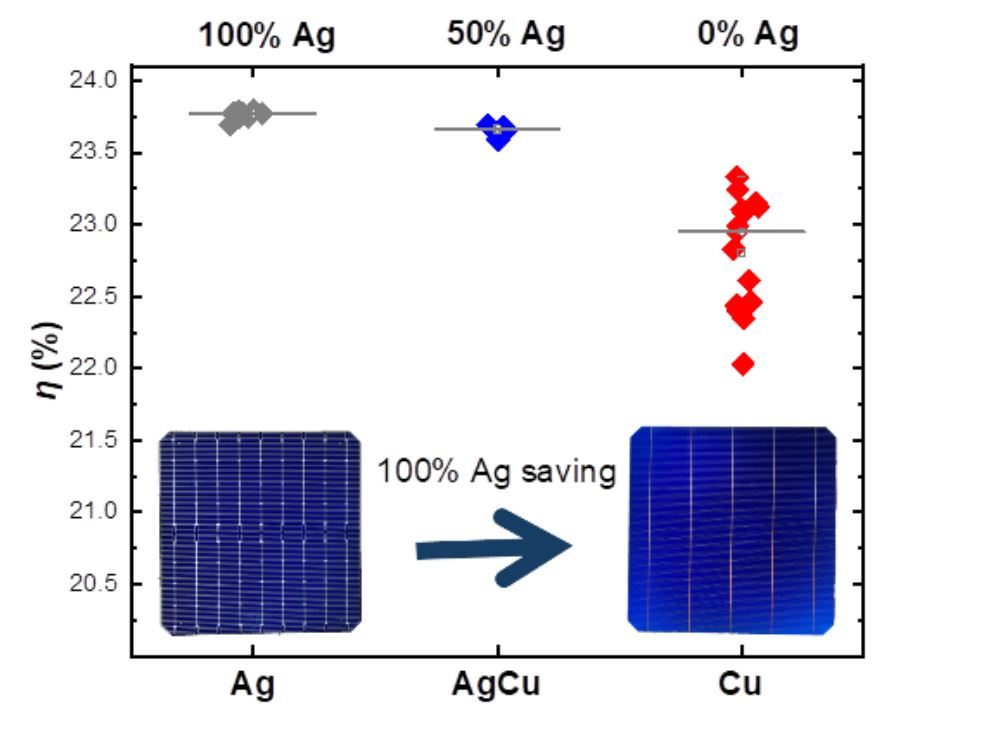
The cell reportedly shows only a 0.4% efficiency loss compared to a reference device that underwent full silver metallization.
The German Forschungszentrum Jülich has announced a world record efficiency of 23.08% for a silver-free heterojunction (HJT) solar cell that is fully metallized with copper (Cu).
The cell reportedly exhibits only a 0.4% efficiency loss compared to a reference device that underwent full silver (Ag) metallization. “The cells with copper on both sides achieved an average efficiency of 22.4% absolute and a maximum of 23.08% absolute, which represents the highest performance ever measured for cells with copper on both sides,” the researchers said.
In the newspaper “Achieving high efficiency for silicon heterojunction solar cells using silver-free metallization”, which was published in Progress in photovoltaicsthe research team explained that their initial analysis took into account factors such as line resistance, finger width, aspect ratio, contact resistance and bulk resistance of the AgCu, Cu and Ag pastes. “This comparison showed that copper (Cu) showed the highest performance figures, outperforming silver-copper (AgCu), which in turn outperformed silver (Ag),” they noted.
The scientists further stated that heterojunction cells (HJT cells) are the most suitable photovoltaic devices to reduce the potential degradation caused by copper, due to the rapid diffusion of this metal in silicon. This is made possible by the transparent conductive oxides (TCOs) used in HJT cells, which act as effective diffusion barriers.
For their experiments, the researchers fabricated cells using 135 μm n-type monocrystalline silicon wafers and applied three different metallization processes: one using only silver, one using only copper, and one using a copper-silver (Cu/Ag) metallization paste.
They used flatbed screen printing (SP) to build Ag and AgCu fingers with a knotless screen with a finger opening of 23 μm, while for the Cu fingers a finger opening screen of 30 μm was used.
“The same screen design was used for all three pastes, with 96 fingers with a pitch of 1.6 mm. In addition, a single nozzle was used to print Ag, AgCu and Cu pastes,” they further explained. “The Ag and AgCu fingers were annealed using a furnace, while the annealing of the Cu fingers was done using a manual process in which the solar cells were placed on a hot plate.”
The team built several solar cells with different metallization combinations, where devices with Cu on the back were combined with Cu, AgCu and Ag on the front, and cells with Ag on the back were combined with Cu, AgCu and Ag on the front.
The cells were tested under standard lighting conditions. The Cu-based device was found to achieve an energy conversion efficiency of 23.08%, an open-circuit voltage of 742.4 mV, a short-circuit current density of 37.88 mA/cm2, and a fill factor of 85.70%.
In comparison, the fully Ag metallized device achieved an energy conversion efficiency of 23.79%, an open-circuit voltage of 739.6 mV, a short-circuit current density of 38.94 mA/cm2, and a fill factor of 85.60%.
Furthermore, the cell with Ag/Cu on the front and Ag on the back achieved an efficiency of 23.95%, an open-circuit voltage of 743.5 mV, a short-circuit current density of 39.16 mA/cm2 and a fill factor of 82.27%. Meanwhile, the device with Ag/Cu on the front and Cu on the back achieved an efficiency of 23.62%, an open-circuit voltage of 743.3 mV, a short-circuit current density of 39.13 mA/cm2 and a fill factor of 81.20%.
“These results highlight the impact of using Cu on the front, back or both sides of SHJ solar cells, especially the impact of the Cu annealing conditions,” the team said. “Compared to cells with Ag on the back, cells with Cu show reduced efficiency, attributed to a lower fill factor with an average decrease of 0.5% to 3%. This reduction in fill factor is associated with a higher series resistance.”
“Although Cu faces challenges such as oxidation and potential contamination of silicon, its high abundance and low cost make it a promising candidate to reduce dependence on Ag,” the academics concluded.
This content is copyrighted and may not be reused. If you would like to collaborate with us and reuse some of our content, please contact: editors@pv-magazine.com.
