


In this article, Warwick Johnston analyzes exclusive data from Australian market research firm Sunwiz, providing a more positive picture of domestic battery installations than expected.
Running a business without reliable data is like flying through the clouds without instruments: you may stay in the air for a while, but you’re flying blind and may end up hurtling toward the ground without time to pull up.
For solar energy, the MCS database provides valuable information on the total number of installations under 50 kW. But when it comes to battery energy storage systems (BESS), the picture is incomplete. That leaves a gaping hole in the industry’s understanding of what’s actually happening on the ground, and makes it difficult for brands to accurately track their performance.
The problem with the current view
The MCS data shows a connection rate of approximately 20 batteries per 100 PV systems. Yet SunWiz’s analysis tells a completely different story.
Many battery installations are not registered. Why? According to what we’ve heard, UK installers are facing additional costs and administrative hurdles when trying to add battery accreditation to their solar license. With limited incentives to do this, thousands of legitimate installations are never included in the official database.
The result: underreported battery adoption, distorted market trends, and brands questioning their performance.
And that is no small problem. If the market is actually much bigger than you think, then your… market share is smaller than you think. You may think you are holding your position, when in reality the market is speeding past you.
In this kind of fog, strategy tends to drift. Pricing decisions, channel priorities and product launches are often based on flawed assumptions. Marketing teams overestimate their traction; sales teams underestimate the competition. Meanwhile, faster brands – those that read the real market pulse – are quietly gaining ground.
Without an accurate picture of battery adoption, companies risk optimizing for the wrong reality. What looks like stability may actually be a slow decline.
SunWiz’s data is closely aligned with MCS, which shows the UK regions where solar and storage are being installed, confirming that we are looking at the same market landscape. But look closer and the difference is striking: while MCS sees batteries in one in five systems, SunWiz’s view suggests that storage has become the norm rather than the exception in many regions. The actual attachment rate is quickly approaching universality.
Emerging patterns in battery adoption in the UK
In addition to sheer volume, the UK market exhibits distinctive characteristics compared to Australia.
While in Australia a large proportion of battery installations are retrofits – added to existing PV systems – almost all of the UK installations observed by SunWiz are simultaneous PV and BESS. Homeowners are choosing to install generation and storage together from the start, signaling a more integrated approach to self-consumption and energy independence.
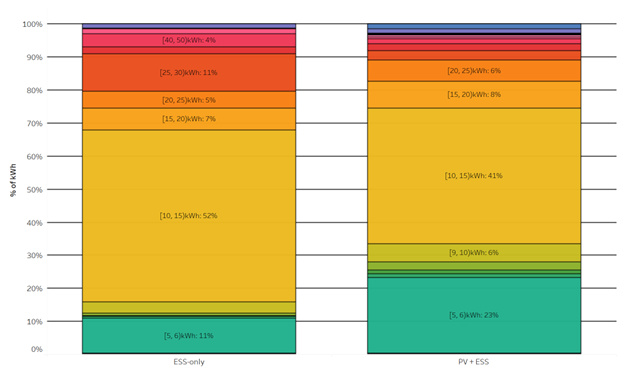
Interestingly, there are now the first glimpses of BESS-only installations in Britain; systems added without new PV. These are typically larger-scale installations, with fewer 5 kWh units and more installations of 25 kWh or larger, indicating a growing demand for flexible, backup or rate-shifting storage solutions.
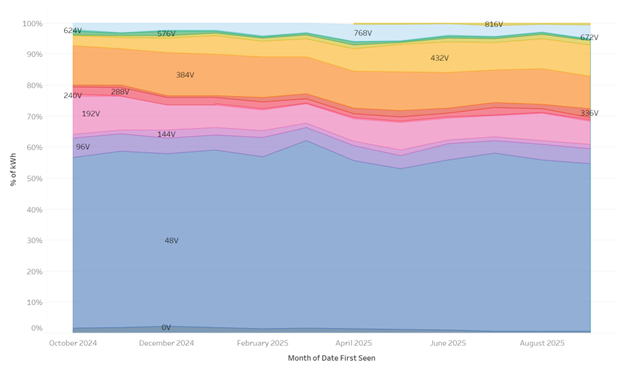
Another clear difference lies in battery technology: 48-volt systems now account for more than half of recent installations in Britain, compared to only about a quarter in Australia. This technical difference may reflect the preferences of installers in Britain, system design standards or the strong presence of certain brands in the residential market.
Each of these signals indicates that the UK storage market is not only growing, but moving in its own direction.
Better data, better decisions
This evolving landscape creates both opportunity and confusion. Growth is strong, but visibility is weak – and without reliable insight, even the most capable brands risk misreading the market.
More broadly, insight into the UK battery market may be greater than MCS data suggests, helping the UK solar and storage industry demonstrate the crucial contribution it makes to the national economy. It can help industry organizations advocate for better outcomes. It can help companies across the supply chain.
The result is not just a better strategy, it’s a healthier, more competitive and more sustainable industry overall.
In the meantime, one thing is already clear: the actual number of battery attachments in Britain is much higher than previously thought.
