

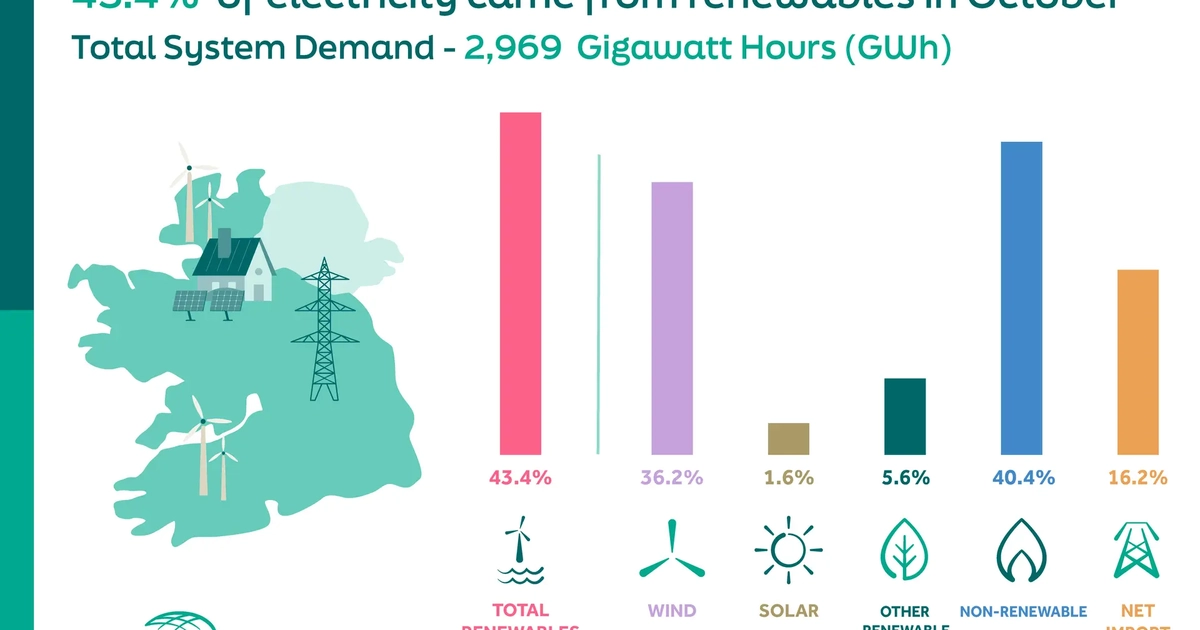
In total, 43.4% of Ireland’s electricity demand was met by renewable energy generation in October.
Figures from Irish grid operator EirGrid show that electricity demand in October was 2,969 GWh, compared to 2,715 GWh in September.
Grid-scale solar covered around 2% of this, the operator said, with the majority of the renewable share of electricity coming from wind power plants, which accounted for 36% of Ireland’s electricity consumption.
In October last year, when demand was slightly lower, EirGrid metrics show that 41.5% of the electricity mix was generated from renewables, of which only 1.1% was from grid-scale solar.
Unsurprisingly, solar power generation was lower as the dark winter months began, but Ireland’s solar fleet is increasingly meeting demand. Utility-scale solar PV in Ireland generated more electricity in the first seven months of 2025 than in all of 2024.
Several peak solar activity records were recorded during the summer, with the highest level observed 798MW on July 9 at 3pm.
EirGrid’s figures also do not take into account solar energy on roofs.
Due to the variable nature of renewable generation, as clearly seen in EirGrid’s monthly statistics, the Transmission System Operator (TSO) recently launched a consultation on a proposed procurement mechanism and operational considerations for the Long-Term Energy Storage System (LDES).
It said it is seeking 500MW of LDES resources to help manage periods of high renewable energy production by importing to reduce constraint- and constraint-based re-dispatch, and exporting during periods of lower renewable energy production to help manage evening demand as solar generation declines.
