Accurate technology cost assumptions are a cornerstone of effective energy transition planning. Although we have been blessed with rapid cost declines in renewable energy technologies, most energy models and policy analyzes remain based on outdated assumptions.
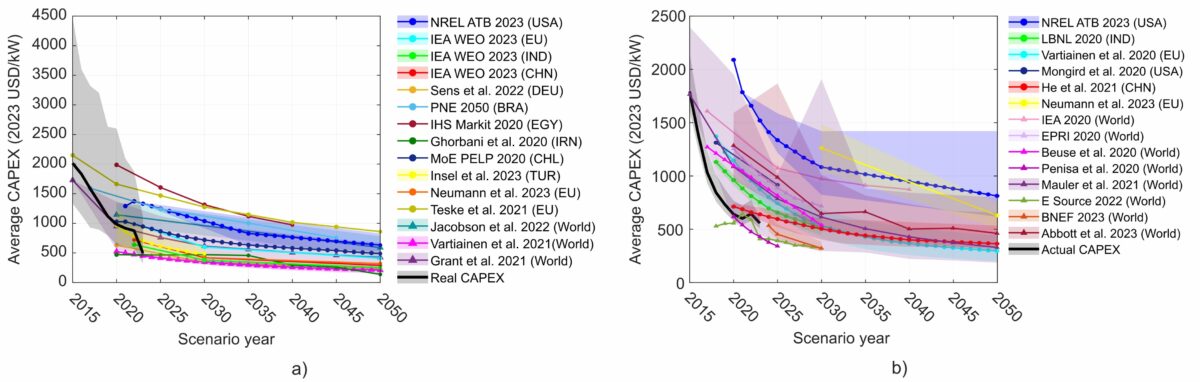
A new study by researchers from the University of Canterbury, LUT University, the German Aerospace Center (DLR) and the International Renewable Energy Agency (IRENA): “Are we too pessimistic? Cost forecasts for solar photovoltaics, wind energy and batteries overestimate actual costs worldwide”, published in Applied energysystematically reviewed 40 studies and 150 long-term scenarios for sustainable energy technologies. It compared their expected costs (all adjusted for inflation in 2023 USD) with real market data and found a consistent trend: the cost forecasts are too pessimistic.
The cost of solar energy and batteries is falling faster than a stone
For solar energy, the backbone of the energy transition, the gap between expected and actual costs is particularly striking. Most studies estimate that utility-scale solar will cost between $160 and $630 per kW by 2050. However, the current global average is already around $500 per kW, and could be even lower, as the latest figures show. Trend report from IEA-PVPS. It seems the future arrived decades earlier. Despite several attempts in the past to highlight the risk of underestimating renewable energy technologies, and in particular solar energy, as by Victoria et al., Jaxa-Rozen and TrutnevyteAnd Xiao et al.this problem persists in all energy scenarios.
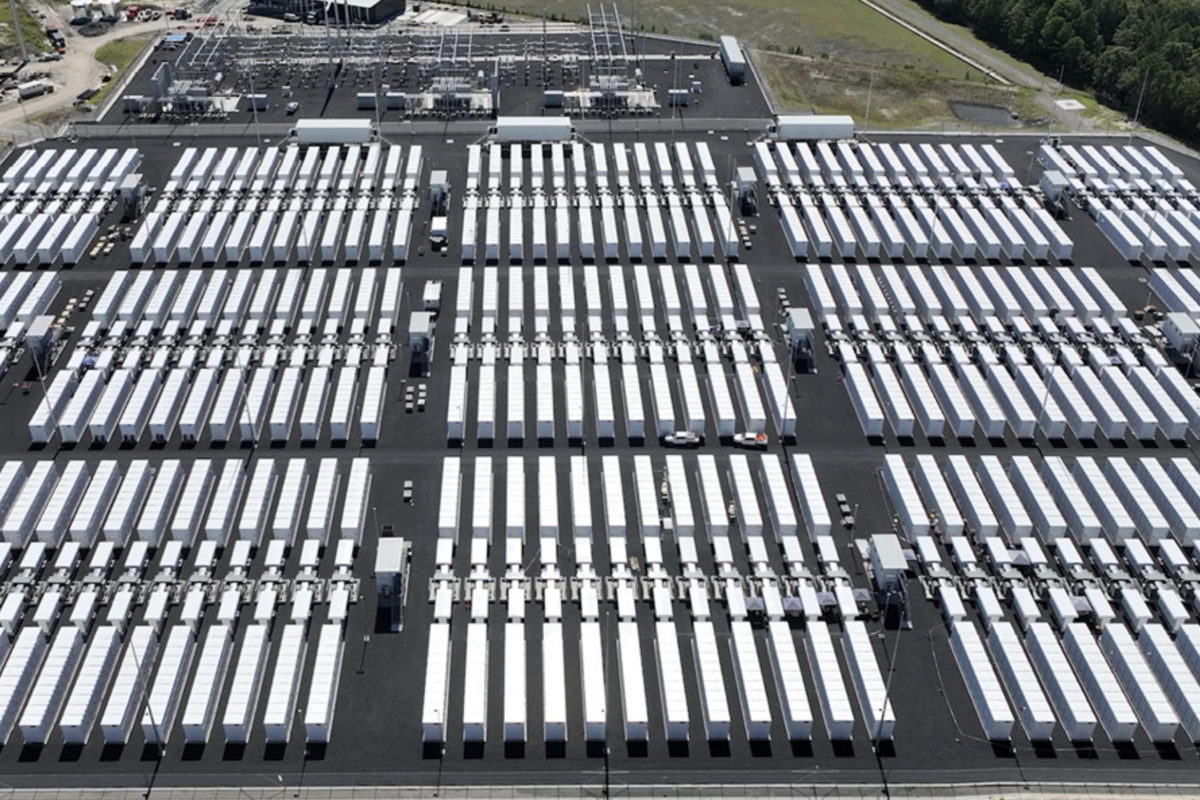
This overestimation of costs is important. In many energy system models, these high costs make solar energy look less competitive than fossil fuels, leading to more conservative policy paths and underinvestment in grid integration and storage. The same goes for battery energy storage, where current costs are already lower than most 2030 projections.
Why projections remain conservative
The problem lies less with technological performance and more with the assumptions underlying the models. Many cost forecasts are still based on outdated assumptions and inconsistent regional factors, such as learning rates and soft costs, which can misrepresent the true potential for CAPEX reduction.
A common limitation is the use of uniform discount rates across countries. This overlooks region-specific financing conditions, risk profiles and soft cost structures that have a major impact on the actual economics of sustainable energy projects. In reality, the capital cost for a solar PV installation in Germany differs significantly from that in India or Chile, yet many models still assume a single global capital cost value. Challenges in energy scenarios may be less about identifying the right capital costs for the present, and more about how best to project them into the future, often decades ahead, as has happened. discussed by researchers.
Although solar and battery learning rates tend to remain relatively stable over time, the number of cumulative doublings, and thus the magnitude of cost savings, is often set too conservatively in forecasting exercises. Such simplifications can distort estimates of the levelized cost of electricity (LCOE), sometimes making renewable energy options appear more expensive than they likely are, and at other times overlooking circumstances where costs could fall even lower (particularly in high-stake, low-risk markets). The result is a systematic distortion that reduces the expected cost trajectory and undermines the actual pace of technological progress.
Evidence from updated datasets
Encouragingly, newer datasets are catching up. For example, the US National Renewable Energy Laboratory (NREL) Annual Technology Baseline has reduced its 2050 cost forecast for utility-scale PV by more than 50% between the 2015 and 2024 editions. Yet even these improved estimates still lag behind actual market trends.
A similar pattern can be observed for onshore and offshore wind energy. Although projections recognize declining costs, they often underestimate the steepness of that decline. Offshore wind energy in particular remains volatile, with higher capital costs due to infrastructure and supply chain complexity. Still, the long-term learning potential remains strong given the significant betting potential along densely populated coastlines around the world.
Image: Sustainable Energy Research Group, University of Canterbury
Implications for energy system modeling
Cost forecasting is not just an academic exercise; they directly determine how national and international models plan and prioritize future energy systems, and determine where billions in investments go.
When models use conservative assumptions, renewable energy appears less competitive, and complementary technologies such as green hydrogen, power-to-X fuels, chemicals and materials, and electric mobility appear less viable. This, in turn, may mislead policymakers’ and investors’ decision-making toward more expensive, slower transition paths.
In practice, underestimating future cost savings does not simply misrepresent the technology potential; it can translate into billions of dollars in avoidable system costs. By delaying the deployment of renewable energy, countries risk being locked into fossil fuel-based infrastructure, missing opportunities for cheaper clean energy and increasing energy prices for consumers in the long term.
Outdated cost assumptions also risk delaying the implementation of technologies that are already cost-competitive. In other words: they not only make the transition slower, but also more expensive.
A call to renew assumptions
The analysis shows that innovation in the real world consistently exceeds expectations. Solar PV modules, batteries and related technologies are improving faster, becoming cheaper and scaling up faster than expected. To ensure that models and policies remain credible, cost databases should be updated regularly and transparently, incorporating region-specific discount rates and evidence-based learning curves.
Otherwise we risk designing a future that is already outdated. The markets are ready to build tomorrow’s energy system today, and cost forecasts must reflect that momentum. The energy transition does not wait for the catch-up that overly slow projections make. The message is clear: models must evolve as quickly as the technologies they try to predict.
Looking ahead
The pace of cost declines in solar, wind and batteries continues to exceed expectations, driven by global adoption, maturing supply chains and improving financial conditions. The question is no longer whether these technologies will become cheaper, but how quickly they will become cheaper and whether the models and policies employed can keep up.
To avoid capturing outdated assumptions, cost databases must evolve as quickly as the technologies they describe: regularly updated, adapted to region-specific conditions, and reflecting the real-world experience already evident in global markets.
Conservative estimates may seem conservative, but in practice they risk delaying investments, delaying electrification and increasing system costs in the long run, becoming a costly hesitation. Accurate, dynamic assumptions are essential for planning a future that matches the speed of innovation. The energy transition is already here, as evidenced by the fact that more than 90% of all newly installed energy capacity is contributed by renewable energy technologies.
Authors: Hadi Vatankhah Ghadim, Jannik Haas, Belén Silva Cardenas, Dominik Keiner and Christian Breyer
This article is part of a monthly column from LUT University.
Research at LUT University includes various analyzes related to energy, heat, transport, industry, desalination and negative CO2 emission options. Power-to-X research is a core subject at the university, integrated into the focus areas Planetary Resources, Business and Society, Digital Revolution and Energy Transition. Solar energy plays a key role in all aspects of research.
The views and opinions expressed in this article are those of the author and do not necessarily reflect those of the author pv magazine.
This content is copyrighted and may not be reused. If you would like to collaborate with us and reuse some of our content, please contact: editors@pv-magazine.com.
Popular content