

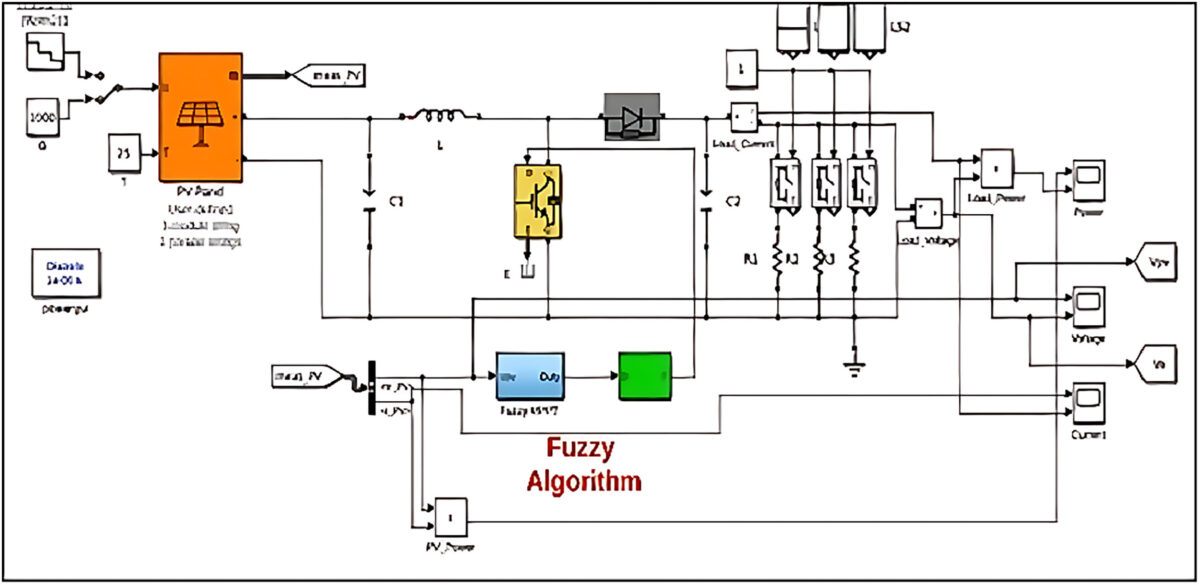
Researchers in the Middle East have developed a fuzzy logic controller that simultaneously optimizes the tilt angle of PV systems and performs maximum power point tracking (MPPT). Years of simulations indicate that the proposed approach increases energy generation by approximately 20%.
A team of scientists from Prince Mohammad Bin Fahd University in Saudi Arabia explored the use of a fuzzy logic controller (FLC) to simultaneously optimize the tilt angle of photovoltaic panels and perform maximum power point tracking (MPPT).
“The novelty of the current study is that it presents an intelligent optimization method based on the fuzzy logic control where the tilt angle of the PV panels can be dynamically adjusted in response to changes in the environment,” said corresponding author Nivine Guler. pv magazine. “Unlike standard systems, which use fixed or periodically manipulated angles, ours will continually change as the sun changes, to improve the system’s energy output and efficiency without requiring the use of complex mechanical tracking systems.”
Using the Simulink MATLAB-based environment, the group tested the operation of the FLC for an entire year.
Unlike classical controllers, which operate in discrete terms of true or false or 1 and 0, an FLC analyzes the input in logical terms between 0 and 1. As for the MPPT portion of the controller, two inputs are required: an error, which represents the difference between the actual PV output voltage and the reference voltage, and a change in error, which indicates how quickly that error is changing. The output variable is then the duty cycle, that is, the control signal sent to the buck-boost converter to adjust the voltage. In the case of the tilt angle, the FLC takes radiation and temperature as real-time input and performs a tilt that maximizes the absorption of radiation.
The system was simulated to operate at a secret location between March 1, 2023 and the end of February 2024. During this period, solar radiation varied between 2,048 kWh/m² and 10,007 kWh/m². The optimal tilt angles for the 12 months beginning in March and ending in February were 28.4°, 16.4°, 12.4°, 9.4°, 20.4°, 21.4°, 22.4°, 28.4°, 32.4°, 39.4°, 38.4°, and 35.4°, respectively. The total electrical energy generated by the PV system was between 38.33 kWh and 210.92 kWh.
“The degree of efficiency improvement from using this adaptive fuzzy logic implementation was one of the most surprising results, especially when irradiation conditions were partly cloudy or non-ideal,” Guler added. “The system showed up to 20-25% improvement in power generation over the fixed angle systems, with stability and low computational cost.”
The academics found that the average tracking efficiency of the fuzzy MPPT controller was 89.25%, or 17.836 W of the expected 19.82 W. Compared to the traditional P&O technique, the proposed FLC-based method produced a 20% increase in output power, which the research group claims verifies its robustness level and high tracking ability. “These findings point to the power, flexibility and overall admirability of this proposed FLC-based PV control system in promoting solar energy harvesting,” she added.
In conclusion, Guler stated that in the near future, the research team will focus on integrating renewable energy forecasting with machine learning algorithms to improve the control and performance of solar systems. They are also experimenting with hybrid optimization models that combine fuzzy logic with artificial neural networks to further improve the accuracy of energy harvesting under changing climatic conditions.
The research work was presented in “A Fuzzy Logic-driven solar tilt angle optimization for a PV system”, published in Franklin opened. Researchers from Saudi Arabia’s Prince Mohammad Bin Fahd University, Barhain Technical University, Kuwait Technical College and Turkey’s Aydin University in Istanbul contributed to the study.
This content is copyrighted and may not be reused. If you would like to collaborate with us and reuse some of our content, please contact: editors@pv-magazine.com.
