

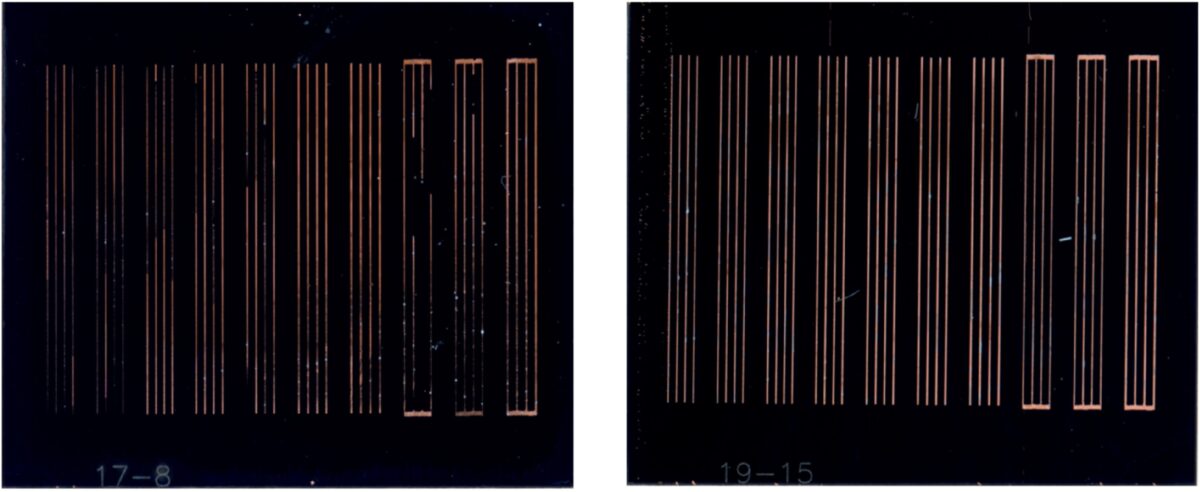
Using the mask-and-plate copper metallization technique, scientists from the German research center have fabricated a 1.21 cm² perovskite-silicon tandem solar cell with a heterojunction bottom device. The cell achieved an efficiency of 19.35%, reportedly the highest value achieved to date for this cell type using galvanic front metallization.
Researchers from the Fraunhofer Institute for Solar Energy Systems (Fraunhofer ISE) in Germany have applied the so-called mask-and-plate front metallization approach to the development of perovskite-silicon tandem solar cells for the first time.
“The novelty of this work is threefold: first, we achieve very small feature sizes of the copper electrodes, as small as 15 µm with an aspect ratio of about 1, through optimized inkjet printing of the electroplating resist,” said the study’s corresponding author, Jörg Schube. pv magazine. “Second, we have found a way to deposit the copper electrodes directly onto ITO-coated substrates with sufficiently high mechanical adhesion. Third, we provide a proof-of-principle that mask and plate metallization is applicable to perovskite-silicon tandem solar cells without significantly damaging the stack of perovskite layers.“
“In recent years, we have successfully demonstrated mask and plate as a cost-efficient alternative to traditional lithography in III-V junction-based solar cells. This breakthrough holds promise well beyond solar photovoltaics,” said co-author Roman Keding. “The same approach could improve lithography-dependent applications such as silicon carbide (SiC) and Si-based power chips toward higher productivity and resource efficiency. Now we see enormous potential to explore this method together with manufacturers across industries.”
Using the mask and plate approach, ultrafine metal contacts can be formed on solar cells by first inkjet printing a precise resist “mask” with narrow openings and then electroplating metals such as copper or nickel. This allows for extremely narrow fingers, reducing shadowing and improving efficiency while avoiding costly photolithography. Because the process can use copper instead of silver, material costs are significantly reduced and resource scalability is improved.
Image: Fraunhofer ISE, Solar Energy Materials and Solar Cells, CC BY 4.0
Using the mask and plate method and industrial production equipment, the researchers fabricated an M6-sized copper-metallized heterojunction solar cell with an efficiency of 22.5%. This efficiency level was found to be slightly higher than that of a comparable silver-metallized device.
They attributed the efficiency gains to reduced shadow losses due to the copper metallization and strong mechanical bonding of the copper contacts, achieved by a plasma processing step applied between mask printing and galvanic metal deposition.
Using laboratory-scale equipment and the same technique, the team also produced a 1.21 cm² perovskite-silicon tandem solar cell with an HJT bottom cell. Under standard lighting it achieved an energy conversion efficiency of 19.35%, reportedly the highest value achieved to date for this cell type using galvanic front metallization.
“This work further demonstrates the applicability of mask and sheet copper metallization up to 1.21 cm2-sized perovskite-silicon tandem solar cells without significant damage. It can thus contribute to the silver-free industrial metallization of next-generation solar cells,” the academics concluded. “Further work is needed to confirm the finding that it does not harm perovskite-silicon tandem solar cells when used in the sequence of the mask and plate metallization process.”
Their findings were presented in “Mask and sheet copper metallization for silicon heterojunction and perovskite-silicon tandem solar cells”, published in Solar energy materials and solar cells.
The Fraunhofer ISE has developed various production technologies to reduce silver use in solar cells. These include screen printing, FlexTrail printing, gravure printing and rotary printing.
This content is copyrighted and may not be reused. If you would like to collaborate with us and reuse some of our content, please contact: editors@pv-magazine.com.
Popular content

