

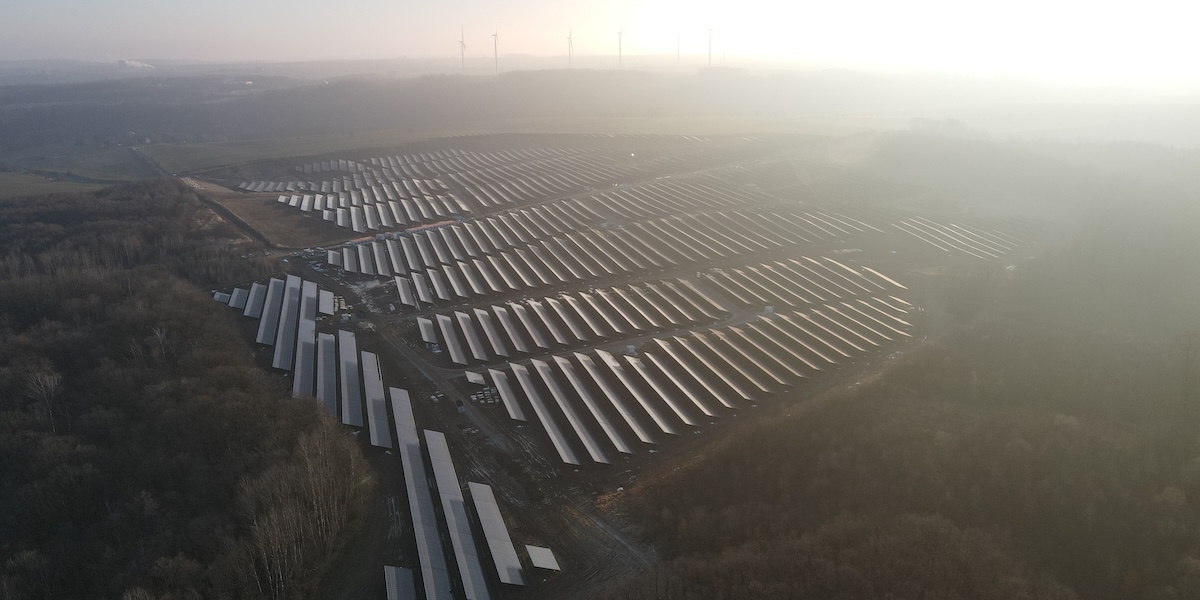
Sunnic Lighthouse says Germany’s first prequalified secondary control reserve solar project shows how quickly PV assets can be moved into advanced grid services markets.
Enerparc subsidiary Sunnic Lighthouse, flexibility provider Entelios and transmission system operator 50Hertz completed prequalification for the 37.4 MW Schkölen solar park in Thuringia, Germany, to participate in the secondary control reserves market. The plant has provided up to 25 MW of positive and negative automatic frequency restoration reserve in the past week.
Photovoltaic assets have not previously participated in Germany’s secondary reserve segment. The companies said the Schkölen project “sets new standards in the integration of renewable energy,” with three additional parks in the pipeline. Managing Director Arved von Harpe said any large factory could participate and smaller factories could be eligible “if we can pool them together.” He added that networking multiple assets provides redundancy, and Schkölen still retains a significant buffer even though the maximum reserve capacity is 25 MW.
aFRR is within one of the four reserve segments and must be fully provisioned for 15 minutes within a five-minute activation window. The tenders are now issued the day before in four-hour blocks, while the Federal Network Agency plans to switch to 15-minute blocks next spring. This change is in favor of the generation of photovoltaic energy and wind energy. The primary backup segment must respond within 30 seconds, while the tertiary backup segment allows 12.5 minutes for delivery.
Photovoltaic systems can deliver positive and negative aFRR, and the Schkölen plant is qualified for both. An increase in grid frequency enables rapid curtailment, while a decrease allows a previously curtailed power plant to increase production. Under strong irradiation the response may exceed the boost capacity of fossil fuel units or large industrial loads. Market rules already anticipate such participation.
Operators said the technical challenge lies in ensuring real-time visibility into available balancing energy, which varies by time, season and weather. Limited data transparency has limited wind energy participation and previously excluded solar energy completely. The consortium described Schkölen as an “innovative flagship” that marks a “paradigm shift,” says von Harpe, “not only for Sunnic and our industry, but also for the entire energy system.”
Entelios has adapted the park’s operating system for aFRR compatibility. The project is “a real milestone – and a testament to what is possible when technological innovation and collaborative partnership come together,” said Fabian Becker, CEO of Entelios. Sunnic Lighthouse, Entelios and 50Hertz jointly developed the measurement setup, the data architecture and the AI-supported prediction model. Both companies praised 50Hertz, which initiated this effort. Von Harpe said a call came “two years ago” after previous attempts at aFRR solar had stalled, with 50Hertz committing to supporting solar-based balancing energy.
From a policy perspective, operators say the economics are compelling. Excess PV periods allow a solar farm to provide secondary reserve at market premiums or PPA prices, often at a lower cost than gas-fired capacity. While demand balancing remains limited, the service provides a new revenue stream for solar owners.
This content is copyrighted and may not be reused. If you would like to collaborate with us and reuse some of our content, please contact: editors@pv-magazine.com.
