

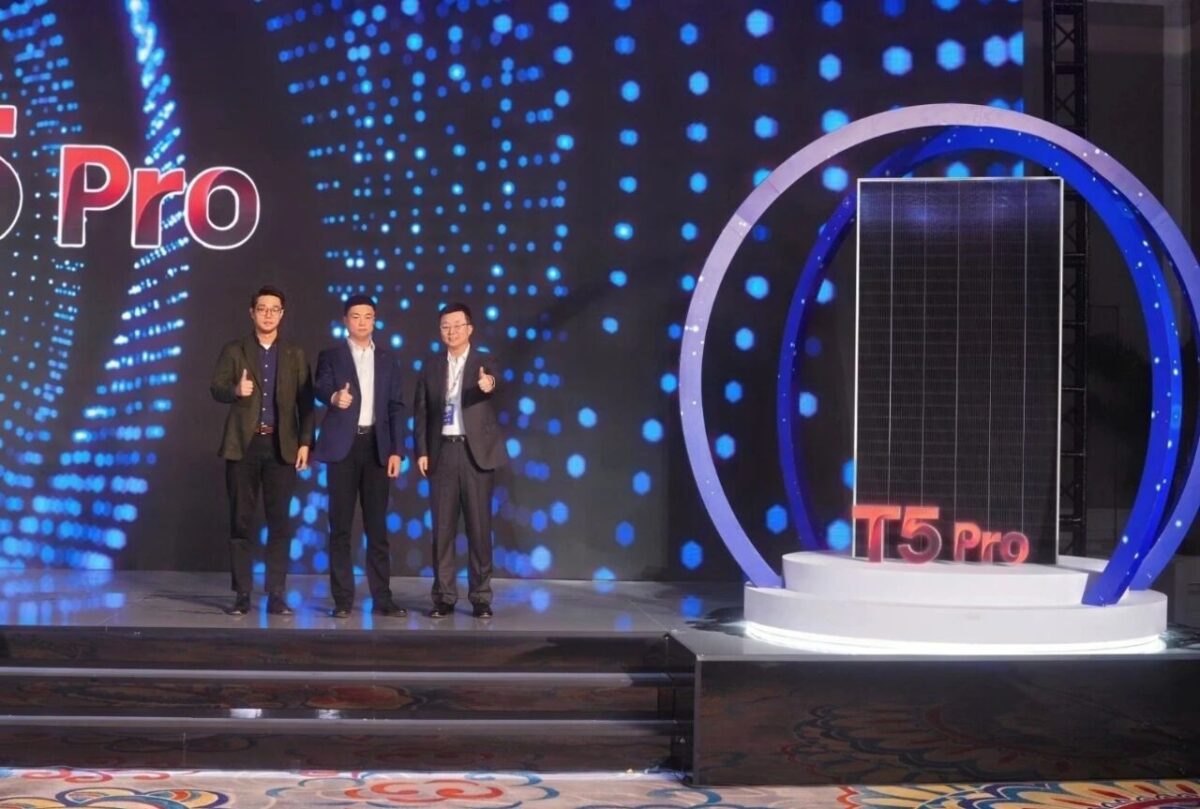
The Chinese manufacturer said its new T5 Pro modules have high power density and a low current and low resistance profile. The series has a power range of 480 W to 760 W and a power conversion efficiency of up to 25.17%.
TCL Zhonghuan has launched its T5 Pro series of high-efficiency solar modules in Beijing, describing the line as the company’s new N-type TOPCon flagship and a “strategic move toward higher-value, application-driven differentiation amid increasing competition in the PV supply chain.”
The T5 Pro range includes three power classes: 760W for utility-scale installations, 680W for commercial and industrial (C&I) roofs and 480W for residential systems.
The platform is built on a tri-slice architecture, where a full-size wafer is divided into three units and assembled using a zero-gap matrix interconnect structure. According to TCL Zhonghuan, the design increases output power by more than 15 W and increases module efficiency by more than 0.5 percentage points, while maintaining the standard footprint of 2,382 mm x 1,134 mm.
The largest product has an energy conversion efficiency of up to 25.17%.
A core technical focus is the low current and low resistance profile of the module. Each sub-cell operates at just 5.09 A, reducing resistance losses to 1.3 W, which according to the manufacturer is 74.5% lower than conventional half-cell modules.
Performance improvements are most pronounced in the areas of shade tolerance and thermal management, the company said, adding that independent testing by TÜV Rheinland shows the T5 Pro generates 17% more energy than conventional modules under partial shade, with power conservation reaching 67%, compared to around 50% for standard half-cells.
Hotspot temperatures are reported to be lower than traditional modules, while average operating temperatures drop by 1 to 1.5 C, reducing long-term thermal stress and degradation. The module has passed salt spray level 8, ammonia and sand abrasion tests and has recorded a degradation of 0.22% after combined mechanical loading, thermal cycling (TC50) and moisture freeze testing, which the company claims is well below the industry benchmark of 5%.
Project-level data from TCL highlights the economic impact of these technical benefits, with balance-of-system (BOS) expenditure reportedly reduced by 2.63% in pilot deployments, saving CNY0.0126 ($0.0018)/W at a utility plant in Inner Mongolia and CNY0.0830/W in Shandong, where land costs are higher.
TCL Zhonghuan estimates a 4% increase in lifetime energy output for a 3,800 m² commercial rooftop project in Suzhou, translating into more than CNY 1.8 million in additional electricity revenue over 30 years. The LCOE reductions range from 0.66% to 1.82%, while lower failure rates could reduce annual O&M costs by CNY 50,000-80,000 for a 200 MW project.
The company also points to value retention, noting that the module’s low degradation profile – 1% in the first year and 0.4% annually thereafter – could increase an asset’s resale value by 5 to 10% after 15 years.
TCL Zhonghuan reports more than 15 GW of multi-slice capacity and cumulative shipments of more than 35 GW, supported by its G12/G12R wafer platform.
This content is copyrighted and may not be reused. If you would like to collaborate with us and reuse some of our content, please contact: editors@pv-magazine.com.
