

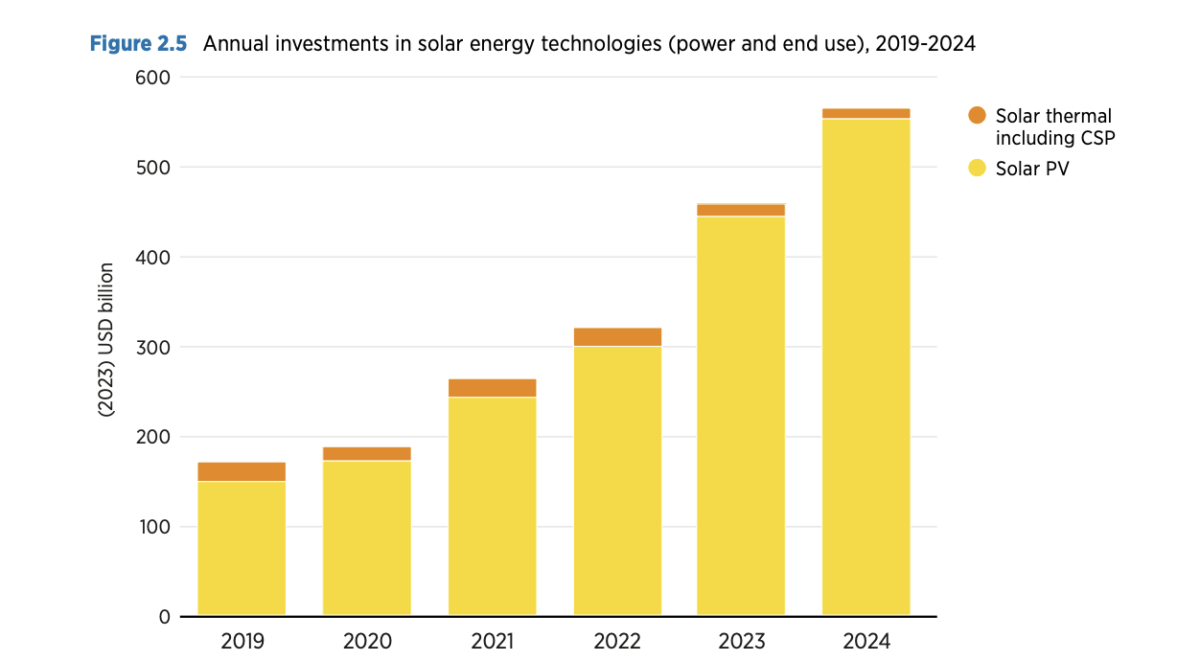
The International Renewable Energy Agency (IRENA) says solar is the only renewable energy technology where current investment levels approach the annual average needed until 2030 to align with the 1.5C trajectory.
According to IRENA’s, investments in solar energy technologies will reach a record $554 billion by 2024 Global energy transition financing landscape 2025.
The figure, which corresponds to IRENA’s projections compared to August last year is a 49% increase over the average investment level in 2023 and 2023. It positions solar energy as the dominant renewable energy source in terms of investments, accounting for 69% of the $807 billion going to all renewable energy technologies in 2024.
The agency says policy support, combined with significant savings in utility-scale and small-scale solar costs, boosted investment last year, which is now at levels close to the average annual investment required under IRENA’s 1.5°C scenario, a pathway to limit global warming to 1.5°C by 2050.
China, Europe and the United States accounted for 70% of solar investment by 2024, but the report also highlights Brazil, India, Pakistan and South Africa as countries where solar investment is increasing significantly.
IRENA expects the pace of investment in solar to accelerate further, but highlights evolving trade dynamics, tariff uncertainties, macroeconomic headwinds and changing geopolitical dynamics as potential barriers. “To sustain this growth amid higher market penetration, it will be critical to develop new business models, expand storage solutions and implement supportive policies to maintain momentum,” the report said.
Total investments in the energy transition supply chain fell 21% year-on-year last year to $102 billion. This was largely due to a 72% drop in investment in solar plants, which reached $24.5 billion last year. IRENA attributes this decline to an oversupply of global manufacturing capacity and the proliferation of tariffs and non-tariff trade barriers on solar panel imports.
In contrast, investments in battery factors increased by 112% last year to a total of $74.5 billion, with China responsible for 84% of investments in battery production in 2023 and 2024.
IRENA predicts that investments in manufacturing solar, wind, battery and hydrogen technologies will reach $123 billion this year, approaching the record high of 2023, before falling again in 2026.
IRENA’s report shows that a total of $2.4 billion was spent on global investments in energy transition technologies in 2024, an increase of 9% compared to 2023. In addition to renewables, electric vehicles accounted for $763 billion, while $359 billion went to electricity networks, $346 billion to green hydrogen, $54 billion to battery storage and $39 billion to electric vehicle charging infrastructure.
Combined investments in renewable technologies, networks and battery storage reached $1.19 trillion last year, exceeding the $1.13 trillion spent on fossil fuels globally, although investments in the latter rose 3% year-on-year.
Elsewhere in the report, an analysis of global renewable energy investment over 2022-2023 shows that 48.4% of it was provided in the form of debt, most of it at market interest rates. Half of total investments took the form of equity, while cheap debt and subsidies made up the remaining 1.6%.
IRENA says this finding highlights the urgent need to mobilize investments, especially in impact-driven capital such as cheap debt and subsidies, to maintain the momentum of the energy transition and prevent a worsening of debt burdens.
“IRENA has long called for a smarter use of public resources to attract private investment through risk mitigation tools. Yet the heavy reliance on profit-driven capital is leaving developing countries behind,” said Francesco La Camera, director general of the agency. “Where private finance will not flow, the public sector must take the lead, supported by stronger multilateral and bilateral cooperation and scaled-up climate finance.”
This content is copyrighted and may not be reused. If you would like to collaborate with us and reuse some of our content, please contact: editors@pv-magazine.com.
Popular content

