

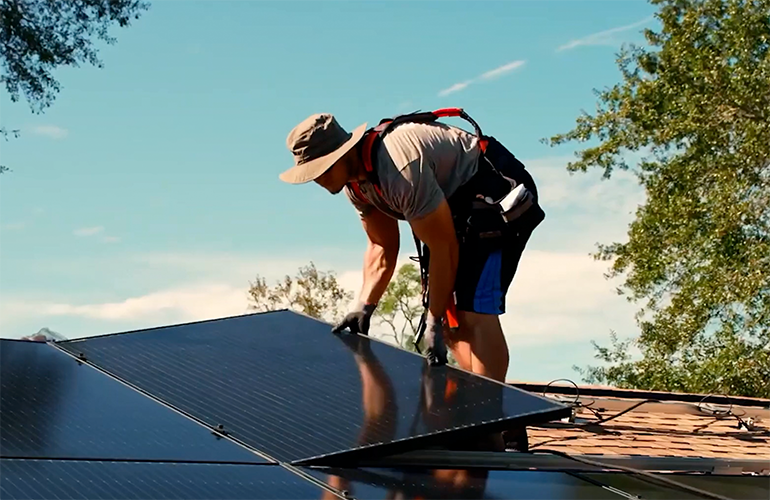

An installer completes a GoodLeap project.
The Home Investment Tax Credit (ITC) has helped millions of Americans switch to solar energy over the years by making installations more affordable. More than 1.2 million homeowners claimed the 30% tax credit in tax year 2023, but that number will soon drop to zero with the residential ITC ending on December 31, 2025.
While the One Big Beautiful Bill Act (HR1) eliminated the 25D direct solar incentive for homeowners, it retained another tax credit for the residential solar industry. Third-party (TPO) companies successfully lobbied Congress to preserve the 48E ITC, giving them until at least 2027 to commission projects and still collect the tax credit.
TPO companies lease solar projects to homeowners at fixed monthly rates for an extended period of time, typically 20 to 25 years. The homeowner does not own the system and thus does not collect tax credits directly, but these companies say they pass their tax credit savings on to consumers with competitive rates to offset rising energy prices.
Loan to lease movement
Loans reigned supreme for residential solar purchases in the early 1920s thanks to low interest rates, but recent years of skyrocketing rates combined with the 48E ITC for third-party projects have changed that.
“We’ve seen a major shift from loans to leases and PPAs over the past three years, driven in large part by the rapid and steep rise in interest rates. This spike changed the economics for the average homeowner, and contractors followed that trend,” said Dan Lotano, COO and chief strategy officer at financing company GoodLeap.
Solar marketplace EnergySage found in its first half 2025 report that as the average loan rate on the platform rose to 7.5%, 38% of contractors reported reduced demand for loans as customers looked for alternative financing options such as solar leases.
“Even as higher interest rates have made traditional loan financing less attractive, we see that demand for solar has not disappeared, but is only shifting,” said Emily Walker, director of insights at EnergySage, in a fall 2025 press release. “We expect attractive new financing models to emerge next year, driving the adoption of residential solar forward.”
Companies like GoodLeap hope to step in and offer such options to installers in the United States.
“There is a large flow of activity from installers to complete their pipeline for the 25D ‘out of business’ sales, if you will. But then we and others expect that the vast majority of installers will move into the leasing sector in the future,” Lotano said. “That will be your main financing mechanism in the coming years.”
Companies typically offer two different financing options in the solar leasing industry: a traditional lease agreement, with a fixed monthly payment for the duration of the contract, or a power purchase agreement (PPA), where the homeowner is compensated based on the amount of power produced by the array.
TPO financiers say these structures help installers keep their pipelines full and provide competitive project wages. Leasing options like LightReach integrate directly into the most popular installer point-of-sale technologies – including Aurora and OpenSolar – making the sales process seamless when a customer chooses a leased system.
How TPO programs work

Installers working on a Palmetto project.
If solar contractors want to add leasing options to their services, they must first sign up with a TPO financing company. TPO companies hold electrical and general contractor licenses, but use third-party solar contractors to perform the installations and any ongoing O&M.
The installation companies, in turn, are typically responsible for acquiring customers, administering permits, and working with the utility to obtain permission to operate. Once the project is completed, the financier owns the project and handles the O&M and monitoring, typically using the same installer to troubleshoot issues as needed.
Once contractors pass the lender’s various checks and are endorsed and registered as certified installers, they can access the company’s financing tools to price and sell leased solar projects to customers. Companies like Palmetto LightReach have online pricing tools to show installers how much they will earn for a given project, taking into account the potential production value and the monthly rate the customer will be charged, including any annual rate increases. These companies pay the installers directly for each project.
The onboarding process for installers to work with leasing companies also includes some business, sales and administrative training.
“There are a lot more requirements on our part – because we own the assets – when it comes to: How was it installed? What equipment can you use? How big can a system be? There’s just another layer of quality control that certain installers just aren’t used to,” says Sean Hayes, SVP and general manager of Palmetto LightReach.
In addition to explaining the quality and equipment standards unique to TPO projects, financiers give installers sales pitches to close deals, including the long-term O&M coverage not common on loan or cash projects, production guarantees that give homeowners bill credits if the system produces less than 90% of expected energy, as well as additional options such as enrollment in virtual power plants.
“We understand it’s a different product than what some people traditionally sell, so education can be helpful,” Lotano said.
Finance companies have also been working to secure sufficient materials to minimize inevitable industry supply chain issues and comply with future ITC materials procurement regulations. Both GoodLeap and LightReach say they have enough safe products – inverters, batteries and panels – to last until 2030.
“Financers have taken it upon themselves to secure a large part of this equipment so that it would be compliant with future changing regulations. Some installers may not have access to this as they typically do not think two, three years into the future. That is why we are also helping the sector to address any short to medium supply chain issues by also ensuring that this equipment complies with future tax legislation,” said Lotano.
TPO installation networks

Credit: Palmetto
Both LightReach and GoodLeap expect to expand their installer networks statewide as the residential ITC comes to an end. Currently, LightReach has about 600 certified contractors in more than 30 states, while GoodLeap has about 250.
At least, according to the NC Clean Energy Technology Center 29 states plus Washington, DC and Puerto Rico currently enable solar purchase agreements with third parties. Some states, such as Colorado, Nevada and Texas, have system size restrictions. Others, such as the states of Indiana, Minnesota and Washington, do not allow entities other than regulated utilities to sell power to consumers. TPO companies are working to change this and have already seen some success.
“With the current tax regime being what it is, it forces the industry to move in that kind of direction,” Lotano said. “While some states and regulators may have been more resistant in the past, now you’re seeing a whole new acceptance of those discussions and helping them think about how to move in that direction.”
Virginia was among the states barred from TPO companies until the state legislature passed a bill in the summer of 2024 making TPO solar projects possible. Lotano hopes the legislation will serve as a model for other states that currently ban the practice.
“Virginia is a perfect example of someone who realized that, as the data center capital of the world, they needed more electrons, and they shouldn’t let archaic rules stop them from doing so,” he said.
Concerns about solar leasing
While third-party systems can lower the barrier to solar participation with minimal upfront costs, they are not foolproof. Over the past decade, the industry has seen many TPO companies rise and then fall just as quickly, leaving customers with roofing systems they don’t technically own and no one to turn to for O&M help if something goes wrong. From Sungevity to Sunnova, these specters of vanished TPO companies are not easy to erase from the industry’s consciousness.
To ensure they get a good deal, consumers should read contracts very carefully before signing up for a solar lease, says Roger Horowitz, VP of Go Solar programs at a residential solar nonprofit. Solar Energy United Neighbors (SUN). SUN operates a free Solar energy helpdesk for anyone who wants a second opinion about a TPO contract.
“The main thing I always look for with third-party ownership is: who is going to do the maintenance? What are the terms if the system stops working? Is there a production guarantee to ensure you don’t pay if the system breaks down?” Horowitz said.
When it comes to escalation clauses or annual rate increases, his team advises consumers to ensure that the escalation always remains below the expected energy rate growth of around 5% per year. That way they know they will continue to save money on the agreement.
“I’ve seen a lot of great terms. I’ve seen a lot of clients who are very, very happy with third-party ownership, whether it’s a lease or a PPA. It just brings a new level of complexity that a lot of people aren’t willing to dive into,” Horowitz said. “I certainly encourage people to look at it even more carefully than you would with a sales contract, just because you’re locking yourself into a long-term agreement.”
